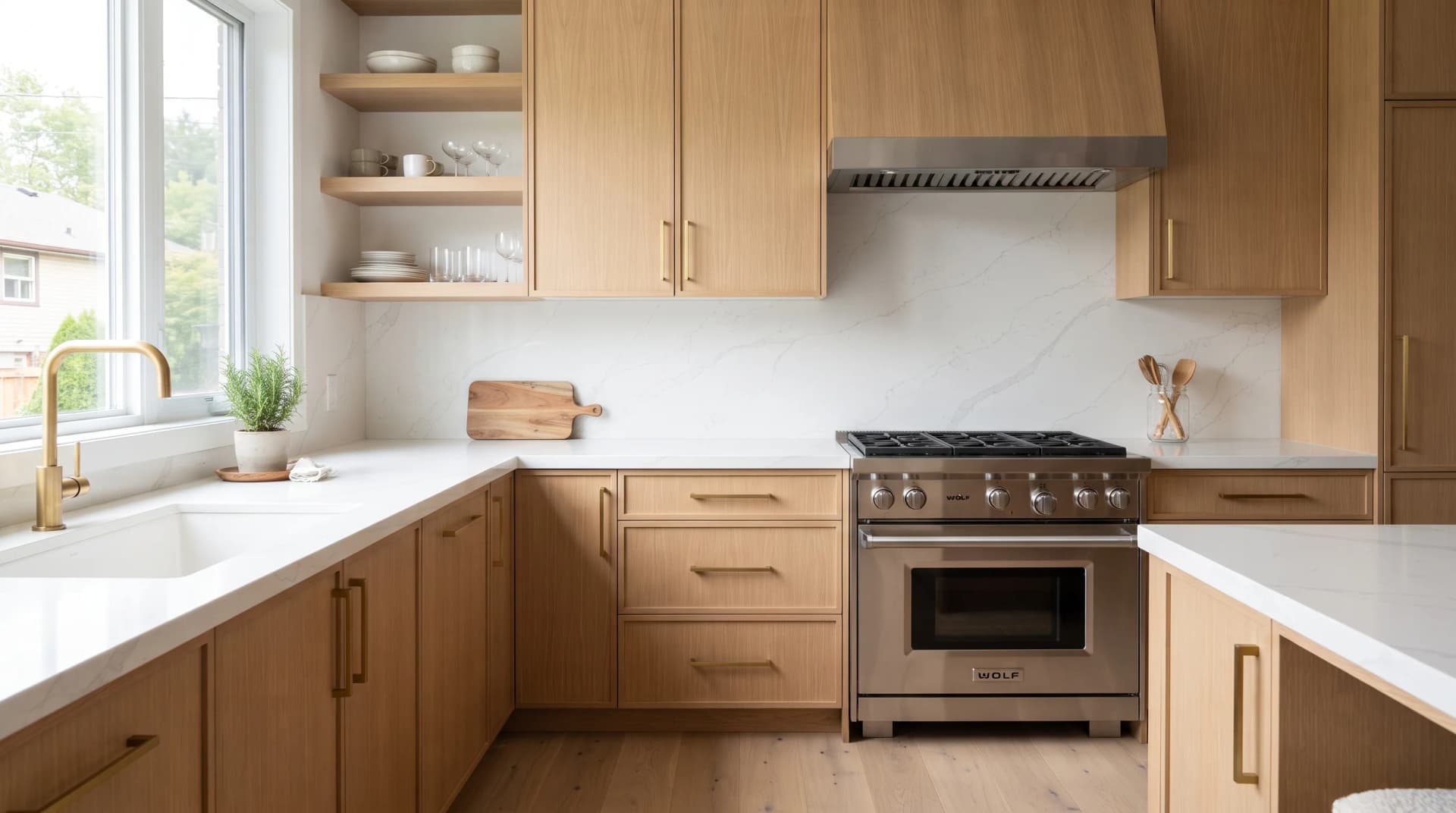
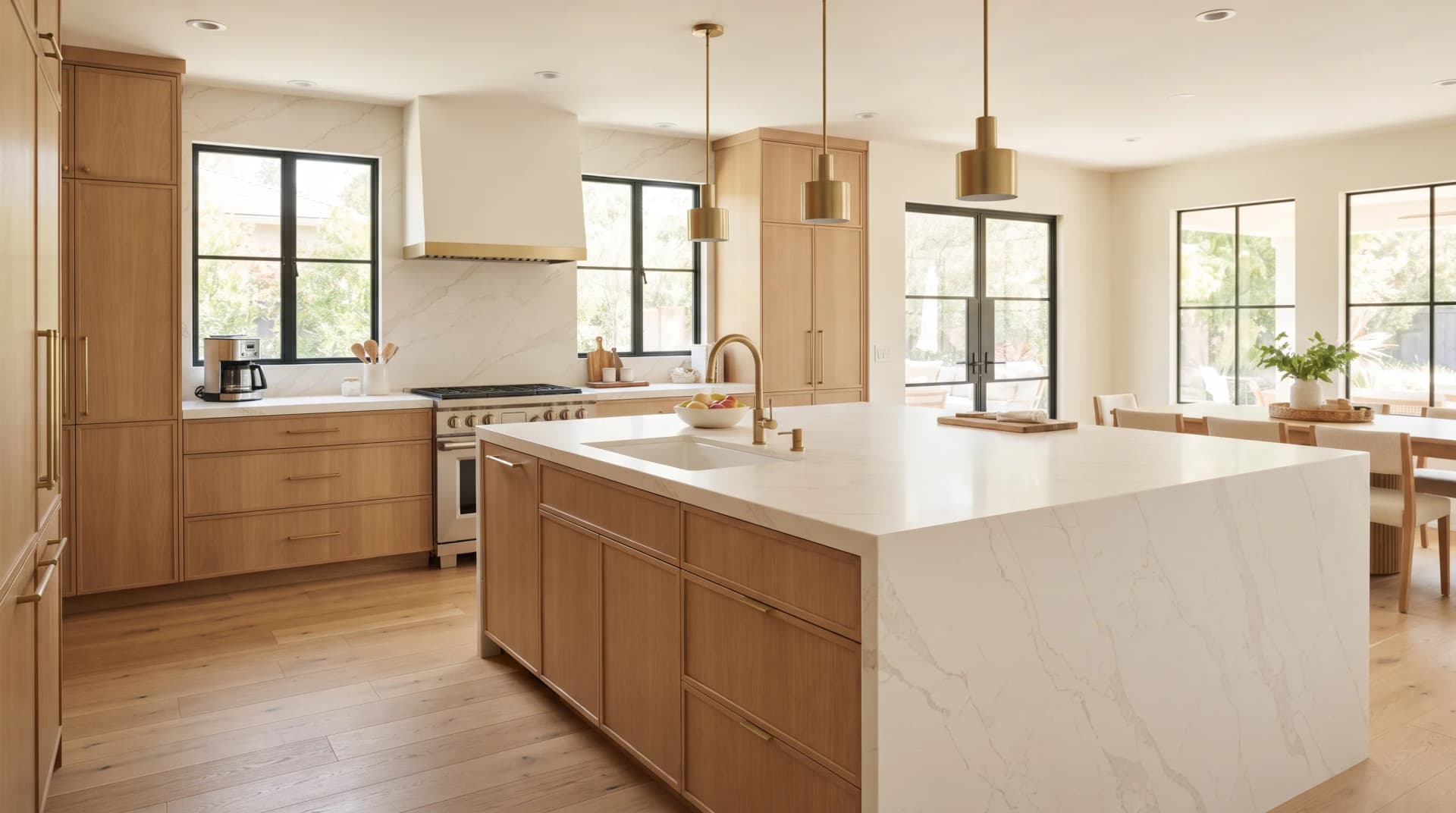
Your edge profile is visible from every angle, every day, for decades. It's one of those details that seems minor during planning but becomes very noticeable after installation. The wrong edge can make an expensive countertop look cheap. The right edge elevates the entire kitchen.
We've fabricated and installed over 4,200 countertops across Canada. The edge profile question comes up on 100% of projects—and approximately 34% of homeowners change their edge selection after seeing samples. That's not indecision; it's the reality that edge profiles look different in person than in photos.
This guide shows you every common edge option, explains the cost and practical implications, and helps you choose with confidence.
The most popular edge profiles in 2026 are eased (simple, modern, lowest cost), beveled (modern with subtle detail), and bullnose (classic, rounded, family-friendly). Traditional kitchens often use ogee or dupont profiles. Premium installations feature mitered edges for waterfall designs. Choose based on your kitchen style, budget, and how the edge complements your overall design.
- Eased and beveled edges are the most affordable and work with any style
- Bullnose and half-bullnose are ideal for families (no sharp corners)
- Ogee, dupont, and cove edges suit traditional/transitional kitchens
- Mitered edges create luxury waterfall effects but cost 30-50% more
- Edge profile can add $5-30+ per linear foot to your project cost
Why Edge Profiles Matter
The edge profile affects more than just appearance:
Visual Impact
Your countertop edge is at eye level when you're seated at an island or standing at the counter. It catches light, creates shadows, and contributes to the overall aesthetic of your kitchen.
- Simple edges = clean, modern, understated
- Decorative edges = traditional, elegant, detailed
- Thick/laminated edges = substantial, luxurious
Practical Considerations
Different profiles have different implications:
- Sharp corners can be uncomfortable and dangerous around children
- Decorative profiles collect more dust and are harder to clean
- Thicker edges require more material and cost more
- Some profiles work better with certain materials (porcelain has limitations)
Cost Impact
Edge profiles significantly affect your total project cost:
- Basic profiles (eased, beveled): Often included at no extra charge
- Standard profiles (bullnose, ogee): Add $5-15 per linear foot
- Premium profiles (mitered, laminated): Add $20-50+ per linear foot
For a kitchen with 30 linear feet of edge, that's a $150-$1,500 difference.

Edge Profile Cost Overview
| Edge Profile | Cost Level | Style Match | Child-Friendly | Cleaning Ease |
|---|---|---|---|---|
| Eased | Included/Low | Modern, Contemporary | No (90° corner) | Very Easy |
| Beveled | Included/Low | Modern, Transitional | Better | Very Easy |
| Half-Bullnose | Low-Medium | Any Style | Yes | Easy |
| Full Bullnose | Medium | Traditional, Transitional | Yes | Easy |
| Ogee | Medium-High | Traditional, Classic | No | Moderate |
| Dupont | High | Traditional, Elegant | No | Moderate |
| Cove | Medium | Transitional | Yes | Easy |
| Mitered | High | Modern Luxury | No | Easy |
| Chiseled | Medium-High | Rustic, Natural | No | Difficult |
| Laminated | High | Modern, Substantial | Varies | Varies |
Eased Edge (Flat Edge)
The Profile
The eased edge is the simplest option—a flat, square profile with corners that are very slightly rounded (just enough to remove sharpness). The top surface meets the front face at approximately 90 degrees.
Best For
- Modern and contemporary kitchens: Clean lines, minimal ornamentation
- Budget-conscious projects: Often included at no extra charge
- Industrial aesthetics: Complements concrete-look and solid surfaces
Pros
- Most affordable option (usually included in base pricing)
- Clean, modern appearance
- Easy to fabricate and install
- Simple to clean (no crevices)
Cons
- Corners can feel sharp against body
- May chip more easily on sharp corners
- Less visual interest than decorative options
Price Impact
Typically included in base pricing or adds $0-5/linear foot.
“We went with eased edges throughout our modern kitchen. No regrets—it looks clean and current. The only issue is bumping my hip on the corner occasionally. A small price for the aesthetic we wanted.”
Beveled Edge
The Profile
A beveled edge features a small angled cut (typically 45°) along the top edge. This creates a subtle detail that catches light while maintaining a modern overall appearance.
Best For
- Modern and transitional kitchens: Adds detail without being ornate
- Those who want slightly softer edges: Bevel removes the sharpest corner
- Minimalist designs: Subtle visual interest without distraction
Pros
- Small cost increase over eased
- Softer than fully square corners
- Catches light attractively
- Modern but not stark
Cons
- Not as child-friendly as rounded profiles
- Less traditional appeal
- The small bevel can collect minor debris
Price Impact
Usually included or $0-5/linear foot additional.
Half-Bullnose Edge
The Profile
The half-bullnose features a rounded top edge (approximately half-circle curve) while the bottom remains flat. This creates a softer look than eased or beveled while maintaining some visual weight.
Best For
- Family kitchens: No sharp corners to hurt children
- Transitional styles: Works with modern or traditional cabinets
- Versatile applications: Works in virtually any setting
Pros
- Child-safe rounded profile
- Comfortable to lean against
- Works with any kitchen style
- Moderate price point
- Easy to clean
Cons
- More expensive than eased/beveled
- Some find it "builder-grade" (very common profile)
- Not distinctive or unique
Price Impact
Typically $5-10/linear foot additional.
Full Bullnose Edge
The Profile
A full bullnose curves the entire edge into a half-circle shape. Both the top and bottom of the edge are rounded, creating a soft, substantial appearance.
Best For
- Traditional kitchens: Classic, timeless look
- Families with young children: Completely rounded profile
- Thick slab appearances: Creates visual weight
Pros
- Very comfortable (no corners whatsoever)
- Classic, traditional aesthetic
- Makes slabs appear thicker
- Extremely child-safe
Cons
- Can look dated in very modern settings
- More expensive than half-bullnose
- Some consider it old-fashioned
Price Impact
Typically $8-15/linear foot additional.
Not sure which edge profile suits your style?
Request a free quote to discuss material samples and edge profile options. Our team can help you match edges to your design vision.
Request Free QuoteOgee Edge
The Profile
The ogee edge is a decorative S-curve profile—a concave curve flowing into a convex curve. It's one of the most recognizable traditional edge styles, often seen in high-end traditional kitchens.
Best For
- Traditional and classic kitchens: Elegant, formal appearance
- Luxury installations: Signals quality and craftsmanship
- Statement islands: Draws attention to countertop detail
Pros
- Elegant, sophisticated appearance
- Catches light beautifully
- Signals quality craftsmanship
- Timeless traditional look
Cons
- Higher cost than simple profiles
- Dust and grime collect in curves
- Doesn't suit modern designs
- Sharp points in the profile
Price Impact
Typically $12-20/linear foot additional.
“Our 1920s home demanded traditional details. The ogee edge on our marble-look quartz makes the kitchen feel like it belongs to the house. Worth every penny.”
Dupont Edge
The Profile
The dupont (sometimes called "laminated ogee") combines a flat step at the top with a curved profile below. It creates a substantial, layered appearance that's more ornate than standard ogee.
Best For
- High-end traditional kitchens: Maximum decorative impact
- Large islands: The substantial profile suits scale
- Formal spaces: Elegant and impressive
Pros
- Substantial, luxurious appearance
- Creates illusion of thicker countertop
- Highly decorative
- Classic elegance
Cons
- Most expensive standard profile
- Difficult to clean (multiple curves)
- Very traditional—won't age into modern trends
- Sharp elements in design
Price Impact
Typically $15-25/linear foot additional.
Cove Edge (Demi-Bullnose)
The Profile
The cove edge features a concave (inward-curving) profile—the opposite of bullnose's convex curve. It creates a gentle, understated detail that's smooth to the touch.
Best For
- Transitional kitchens: Modern enough but not stark
- Comfortable functionality: Very smooth to lean against
- Understated elegance: Detail without drama
Pros
- Comfortable and child-safe
- Subtle decorative element
- Easy to clean
- Works with many styles
Cons
- Less common (may require specific request)
- Not as traditional as ogee
- Not as modern as eased/beveled
Price Impact
Typically $8-12/linear foot additional.
Waterfall (Mitered) Edge
The Profile
A waterfall edge isn't a profile shape—it's a design technique where the countertop material continues down the vertical sides of an island or cabinet, meeting at a 45° mitered seam. The result is a continuous flow of material from horizontal to vertical surface.
Best For
- Modern luxury kitchens: High-impact design statement
- Kitchen islands: The classic waterfall application
- Showcasing dramatic material: Veined patterns flow beautifully
- Contemporary design: Current, high-end aesthetic
Pros
- Dramatic visual impact
- Showcases veining/pattern
- Modern luxury aesthetic
- Creates substantial, grounded appearance
- Hides cabinet sides completely
Cons
- Significantly more expensive (30-50% more material)
- Requires skilled fabrication
- Seam at miter may be visible
- Material pattern must align at seam
Price Impact
Adds 30-50% to material cost (requires full additional slab for sides) plus $20-40/linear foot for mitered fabrication.
Important Considerations
For waterfall edges, pattern alignment matters enormously. The veining on the horizontal surface should flow seamlessly into the vertical surface. This requires:
- Careful slab selection
- Precise fabrication
- Skilled installation
We recommend waterfall designs with porcelain or dramatic quartz patterns where veining creates visual continuity.

Chiseled (Rock Face) Edge
The Profile
A chiseled edge (also called rock face, broken edge, or natural edge) leaves the edge rough and unpolished, mimicking naturally broken stone. It's created by mechanically fracturing the edge to expose the raw material.
Best For
- Rustic and farmhouse kitchens: Natural, organic aesthetic
- Outdoor kitchens: Durable and weather-appropriate
- Granite applications: Shows natural stone character
Pros
- Natural, organic appearance
- Hides minor chips
- Distinctive and unusual
- Works well with rustic design
Cons
- Rough surface—not child-friendly
- Collects debris and is difficult to clean
- Not suitable for all materials (porcelain, most quartz)
- Very style-specific
Price Impact
Typically $10-15/linear foot additional. Primarily available for granite.
Laminated Edges
The Concept
Laminated edges add additional material to create a thicker appearance. A strip of material is adhered beneath the main slab edge, making the countertop look substantially thicker (typically doubling apparent thickness).
Common Applications
- 3cm + laminated: Creates 6cm (2.5") thick appearance
- 2cm + laminated: Creates 4cm (1.5") thick appearance
- Porcelain 12mm + laminated: Creates 24mm appearance
Best For
- Luxury modern kitchens: Substantial, high-end look
- Waterfall designs: Extra weight and presence
- Making thin material appear substantial: Porcelain especially
Pros
- Creates impressive visual weight
- More affordable than solid 6cm material
- Allows thicker appearance with standard slabs
Cons
- Visible seam line where materials meet
- More expensive than standard edges
- Seam may be noticeable on close inspection
Price Impact
Typically $20-30/linear foot additional depending on profile style.
Matching Edge to Kitchen Style
| Kitchen Style | Recommended Edges | Avoid |
|---|---|---|
| Modern/Contemporary | Eased, Beveled, Mitered/Waterfall | Ogee, Dupont, Chiseled |
| Traditional/Classic | Ogee, Dupont, Full Bullnose | Eased, Mitered |
| Transitional | Half-Bullnose, Beveled, Cove | Dupont, Chiseled |
| Farmhouse/Rustic | Half-Bullnose, Chiseled, Eased | Ogee, Mitered |
| Minimalist | Eased, Square | All decorative profiles |
| Luxury Modern | Mitered/Waterfall, Laminated | Ogee, Dupont, Chiseled |
| Family-Friendly | Half-Bullnose, Full Bullnose, Cove | Eased, Chiseled, Ogee |
Quick Decision Framework
On a budget? Choose eased or beveled (usually included).
Have young children? Choose half-bullnose, full bullnose, or cove.
Want traditional elegance? Choose ogee or dupont.
Want modern luxury? Choose waterfall/mitered or laminated.
Want maximum versatility? Choose half-bullnose (works everywhere).
“We went back and forth between ogee and half-bullnose. Our designer recommended half-bullnose because our kitchen is transitional—not fully traditional. It was the right call. The ogee would have been too ornate.”
Need help choosing the right edge profile?
Book a call with our team. We'll discuss your kitchen style, practical needs, and help you select an edge that enhances your design.
Schedule a CallFrequently Asked Questions
Explore countertop options that complement any edge profile


Your Next Steps
Now that you understand countertop edge profiles, here's how to move forward:
If you want to see edge profiles in person:
Request a free quote and we can discuss material and edge profile options with you. Seeing and touching the profiles in your space helps more than photos.
If you want to explore design options:
- Explore 2026 Countertop Colour Trends to match edges to colours
- Read What Is Engineered Quartz? for material fundamentals
- Compare materials in our Heat Resistance Showdown
If you're ready for pricing:
Submit your measurements and edge preferences for a detailed estimate.
Your Next Steps

We fabricate and install what this article describes — see our Delta showroom and service area and our New Westminster showroom and service area.