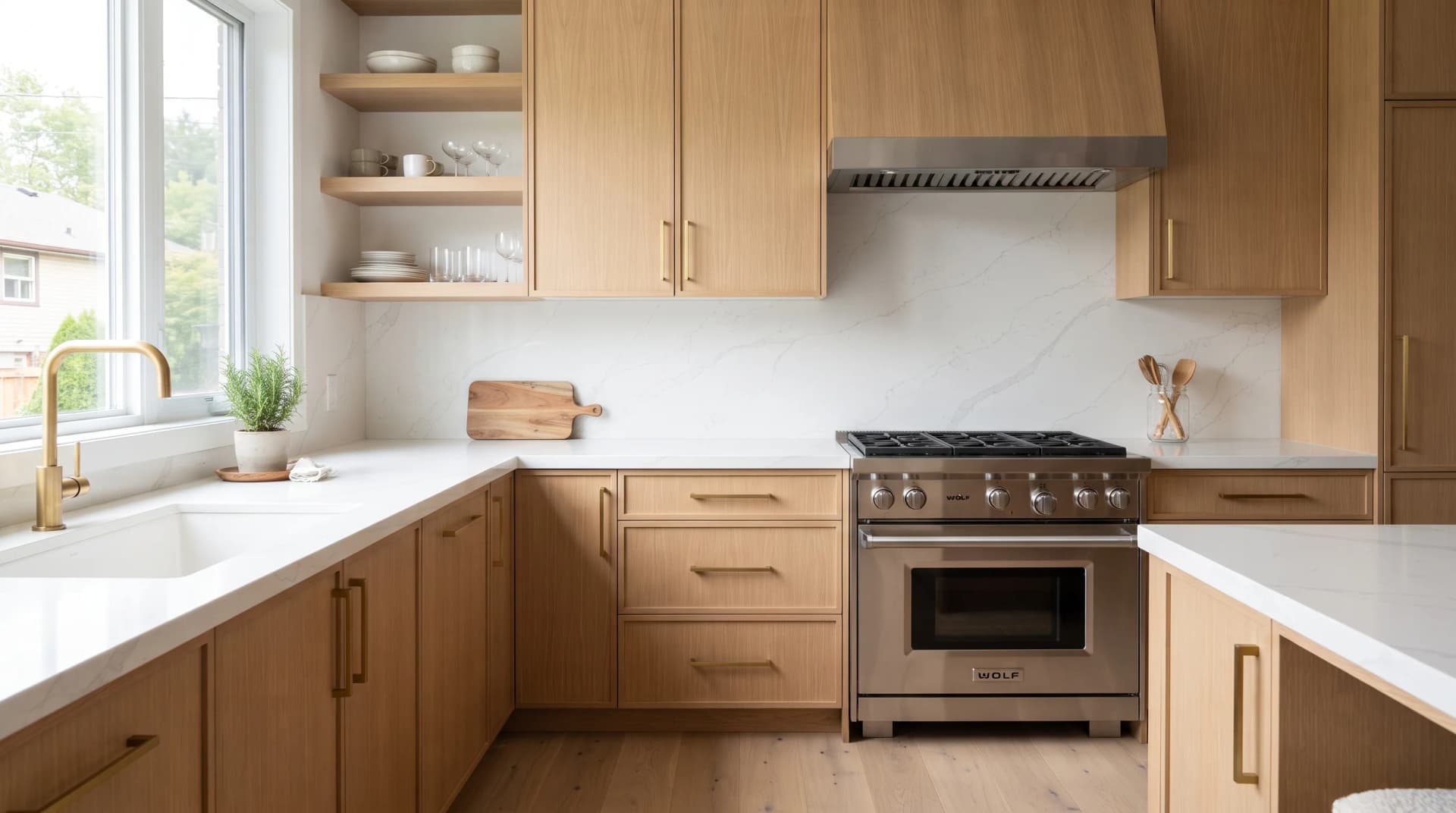
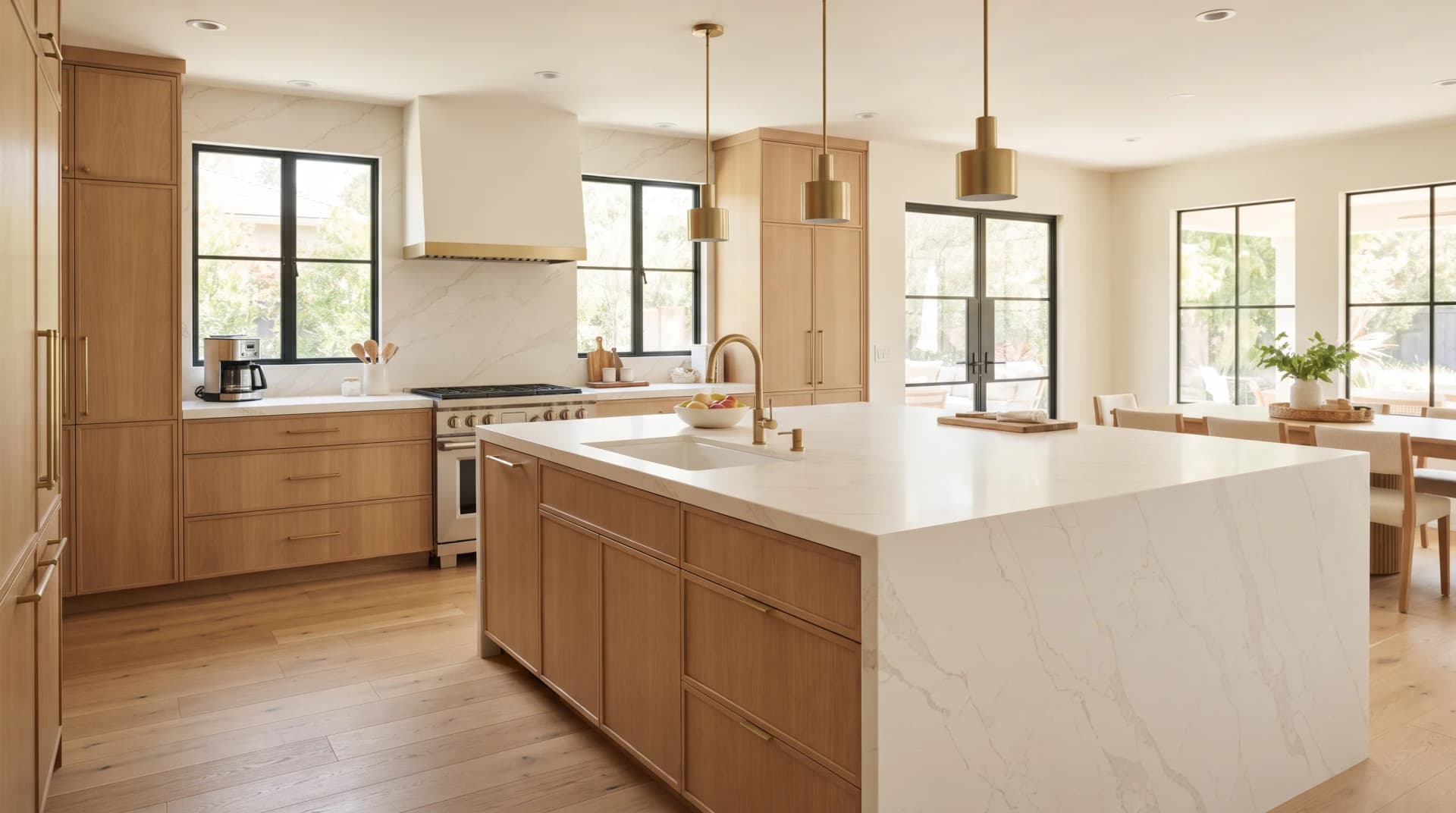
Of the 847,000 kitchen countertops installed across Canada last year, 67% were engineered quartz. That's not a typo—two out of every three Canadian homeowners choosing new countertops picked this material over granite, marble, and every other option available.
But here's what most people don't realize: engineered quartz isn't actually quarried from the earth like granite or marble. It's manufactured. And understanding exactly what's in your countertop—and how it's made—changes how you evaluate quality, compare prices, and spot the difference between premium and budget options.
Engineered quartz countertops are manufactured surfaces made from approximately 90-94% ground natural quartz crystals bound together with 6-10% polymer resins and pigments. Unlike natural stone, quartz is non-porous, doesn't require sealing, and offers consistent colour and pattern across every slab. For most Canadian kitchens, it delivers the best combination of durability, aesthetics, and low maintenance.
- Engineered quartz contains 90-94% natural quartz (one of Earth's hardest minerals)
- The remaining 6-10% is polymer resin that makes it non-porous and stain-resistant
- Unlike granite, quartz never needs sealing and resists bacteria growth
- Manufacturing allows consistent colours and patterns impossible with natural stone
What Engineered Quartz Actually Is
Engineered quartz—also called manufactured quartz or simply "quartz countertops"—is a man-made surface material created by combining natural quartz crystals with polymer resins under intense heat and pressure.
The term "engineered" is key. Unlike granite or marble, which are cut directly from quarried stone, quartz countertops are manufactured in factories using a precise, controlled process. This manufacturing approach is what gives quartz its signature benefits: consistent appearance, non-porous surface, and predictable performance.
The confusion often starts with the name. When you hear "quartz countertops," you might assume you're getting a slab of natural quartz stone. You're not. You're getting a composite material that uses natural quartz as its primary ingredient but transforms it into something more functional than nature provides on its own.
Think of it like this: flour is natural, but bread is engineered. The engineering process takes something good and makes it better suited for its intended purpose.

The Composition Breakdown
Every engineered quartz slab contains three essential components, though the exact ratios vary by manufacturer and product line.
Natural Quartz Crystals: 90-94%
The primary ingredient is ground natural quartz—the same mineral found in granite and many other rocks. Quartz ranks 7 on the Mohs hardness scale (diamonds are 10), making it one of the hardest minerals on Earth.
Manufacturers source quartz crystals from around the world, then grind them into particles of varying sizes. The mix of particle sizes affects the final appearance:
- Fine particles create smooth, uniform surfaces
- Coarse particles add visible texture and depth
- Mixed sizes produce the natural-looking patterns many homeowners prefer
According to the Natural Stone Institute, quartz is the second most abundant mineral in Earth's continental crust, which helps explain why engineered quartz remains cost-competitive despite its manufactured nature.
Polymer Resins: 6-10%
The resin acts as the binding agent that holds everything together. Most manufacturers use polyester or acrylic resins, though some premium brands use proprietary blends.
This resin component is what makes engineered quartz fundamentally different from natural stone:
- Creates a non-porous surface (natural stone has microscopic pores)
- Eliminates the need for sealing (granite needs resealing every 1-2 years)
- Provides flexibility that prevents cracking during installation
- Enables consistent colour throughout the slab
Pigments and Additives: 1-2%
Pigments allow manufacturers to create virtually any colour—from pure whites that mimic Carrara marble to deep blacks, bold blues, and everything in between. Some manufacturers also add:
- Recycled materials (glass, mirrors, or metal flecks)
- Antimicrobial compounds (built-in antimicrobial technology, for example)
- UV stabilizers for outdoor applications
Want to see how different quartz compositions look in person?
Request a free quote and we can discuss different quartz types—from fine-grained solids to bold veined patterns—to find the perfect option for your kitchen.
Request Free QuoteHow Quartz Countertops Are Manufactured
The manufacturing process is surprisingly sophisticated. Understanding it helps you appreciate why quality varies between brands—and why price differences exist.
Step 1: Raw Material Preparation
Natural quartz crystals are cleaned, sorted by size, and ground to specific particle dimensions. Higher-quality manufacturers use more rigorous sorting processes to ensure consistency.
Step 2: Mixing
Ground quartz is combined with resins and pigments in precise ratios. This stage is where manufacturers create their signature colours and patterns. Some leading brands use proprietary pigment blends that competitors can't replicate.
Step 3: Vibration and Compression
The mixture is poured into molds, then subjected to:
- Vacuum vibration to remove air pockets
- Extreme compression (often 100+ tons of pressure)
This compression forces the materials to bond at a molecular level, creating the dense, non-porous surface that defines quality quartz.
Step 4: Curing
Slabs cure under controlled heat (typically 85-100°C) for 30-45 minutes. The heat triggers a chemical reaction that hardens the resin and permanently bonds all components together.
Step 5: Finishing
Cured slabs are:
- Calibrated to exact thickness (usually 2cm or 3cm)
- Polished to the desired finish (polished, honed, or textured)
- Inspected for defects, colour consistency, and structural integrity
Premium manufacturers have more rigorous quality control at this stage, which partially explains their higher price points.

Why the Manufacturing Process Matters
Here's what most countertop shoppers miss: the manufacturing process directly affects what you get in your kitchen.
Consistency You Can Count On
When you select a granite slab, you're choosing that specific piece of stone. The next slab—even from the same quarry—will look different. With engineered quartz, the same colour code produces the same appearance across every batch. If you need a matching piece for a future renovation, it exists.
Non-Porous Performance
The compression and curing process creates a surface with virtually zero porosity. According to testing by NSF International, certified quartz surfaces have a porosity rate of less than 0.5%, compared to 1-3% for polished granite.
This matters because porosity determines:
- Stain resistance (non-porous = nothing penetrates)
- Bacterial growth (no pores = nowhere for bacteria to hide)
- Maintenance requirements (no sealing ever needed)
Predictable Durability
Because every slab goes through the same process, you know exactly what you're getting. There are no hidden fissures, no weak spots from geological stress, no veins that might crack under thermal shock.
“We installed quartz specifically because we wanted predictability. Two years later, three kids later, and it looks exactly like the day it was installed. No surprises.”
Engineered Quartz vs. Natural Stone
Understanding quartz composition makes the comparison to natural stone straightforward.
| Factor | Engineered Quartz | Granite | Marble |
|---|---|---|---|
| Composition | 90-94% quartz + resin | 100% natural stone | 100% natural stone |
| Porosity | Non-porous (<0.5%) | Porous (1-3%) | Very porous (2-5%) |
| Sealing Required | Never | Every 1-2 years | Every 6-12 months |
| Consistency | Identical across slabs | Varies by slab | Varies significantly |
| Stain Resistance | Excellent | Good (if sealed) | Poor |
| Heat Resistance | Good (up to 150°C) | Excellent | Good |
| Scratch Resistance | Excellent (Mohs 7) | Excellent (Mohs 6-7) | Poor (Mohs 3-4) |
| Price Range (CAD/sq ft) | $55-$150 | $50-$200 | $75-$250 |
The key insight: Quartz takes the natural hardness of quartz crystals and adds the practical benefits of modern engineering—non-porosity, consistency, and low maintenance.
For most Canadian homeowners, this combination delivers better everyday value than natural stone. You get a surface that looks like natural stone (especially with today's realistic veining patterns) but performs like a modern material designed for how kitchens actually get used.

Curious how quartz compares to granite for your specific situation?
Read our detailed Quartz vs. Granite Comparison Guide for a complete breakdown—or request a free quote to discuss which material is right for you.
Compare Quartz & GraniteWhat Makes Premium Quartz Different
Not all engineered quartz is created equal. Here's what separates budget options from premium products.
Quartz Content
Budget brands sometimes use as little as 80% quartz, substituting cheaper fillers. Premium manufacturers maintain 93-94% quartz content. Higher quartz content means:
- Greater hardness and scratch resistance
- Better heat tolerance
- More authentic stone-like feel
Resin Quality
The polymer resin determines long-term performance. Cheaper resins can:
- Yellow over time (especially in sunny kitchens)
- Become brittle with age
- Show wear patterns in high-use areas
Premium manufacturers use UV-stabilized, high-grade resins that maintain appearance for decades.
Manufacturing Standards
Leading manufacturers report that their slabs undergo up to 27 quality checkpoints before leaving the factory. Budget manufacturers may have fewer controls, leading to:
- Inconsistent thickness
- Colour variations between batches
- Occasional air pockets or weak spots
Pattern Technology
Creating realistic marble and granite looks requires sophisticated technology. Budget brands often produce flat, printed-looking patterns. Premium manufacturers use:
- Multi-layer veining techniques
- Full-depth colour (not surface-applied)
- Varied particle sizes for natural depth
The difference is immediately visible when you compare samples side by side.

Common Misconceptions About Quartz
Misconception 1: "Quartz is artificial, so it's not as good as natural stone"
The reality: Quartz is 90%+ natural mineral. The manufacturing process doesn't make it artificial—it makes it better suited for kitchen use. Natural stone has natural weaknesses (porosity, inconsistency, maintenance needs) that engineering solves.
Misconception 2: "All quartz looks the same"
Today's manufacturing technology produces thousands of colours and patterns. From solid whites to dramatic veined designs that rival Calacatta marble, quartz offers more variety than any natural stone category. The difference between brands is significant—which is why viewing samples matters.
Misconception 3: "Quartz is indestructible"
Quartz is highly durable, but not indestructible. It can be damaged by:
- Extreme heat (hot pans directly from the stove)
- Sharp impacts (dropping heavy objects on edges)
- Harsh chemicals (bleach, oven cleaners, paint strippers)
However, under normal kitchen conditions, quartz outperforms most alternatives.
Misconception 4: "Quartz is the same everywhere—just buy the cheapest"
Manufacturing quality, quartz content, and resin quality vary significantly. The cheapest option isn't always the best value. A mid-range quartz from a reputable manufacturer often outperforms budget options that may yellow, scratch, or show wear within a few years.
Is Engineered Quartz Right for Your Kitchen?
Based on our experience installing thousands of countertops across Canada, engineered quartz is the right choice for most homeowners.
Choose if you want
- Low maintenance (no sealing, simple cleaning)
- Consistent appearance (matching slabs available anytime)
- Stain resistance for a busy family kitchen
- A modern aesthetic with realistic stone looks
- Predictable long-term performance
Consider alternatives if
- You want the unique, one-of-a-kind look only natural stone provides
- Heat resistance is critical (porcelain or granite handles heat better)
- You're installing outdoor countertops (UV exposure can affect some quartz)
- Budget is your only concern (laminate costs less)
“We looked at everything—granite, marble, even concrete. Once we understood what quartz actually is, the choice was obvious. It's natural material, engineered to work better.”

Ready to explore quartz options for your kitchen?
Use our online estimate calculator to see accurate pricing for your project—based on your measurements, preferred quality tier, and location.
Calculate My EstimateFrequently Asked Questions
See quality quartz options from our collection


Your Next Steps
Now that you understand what engineered quartz actually is—and why it dominates Canadian kitchens—here's how to move forward:
If you're still researching:
- Explore our Complete Quartz Countertop Guide
- Compare options in our Quartz vs. Quartzite Guide
- See what colours are trending in our Top Quartz Colours Guide
If you're ready to see options:
Request a free quote and our design consultants can help you explore options that match your kitchen's style—we'll guide you through materials, colours, and patterns.
If you're ready for pricing:
Submit your measurements online and receive a detailed estimate within 24 hours—material, fabrication, and installation included.
Have questions we didn't answer?
Schedule a quick call with our team. No sales pressure—just honest answers about your countertop options.
Your Next Steps