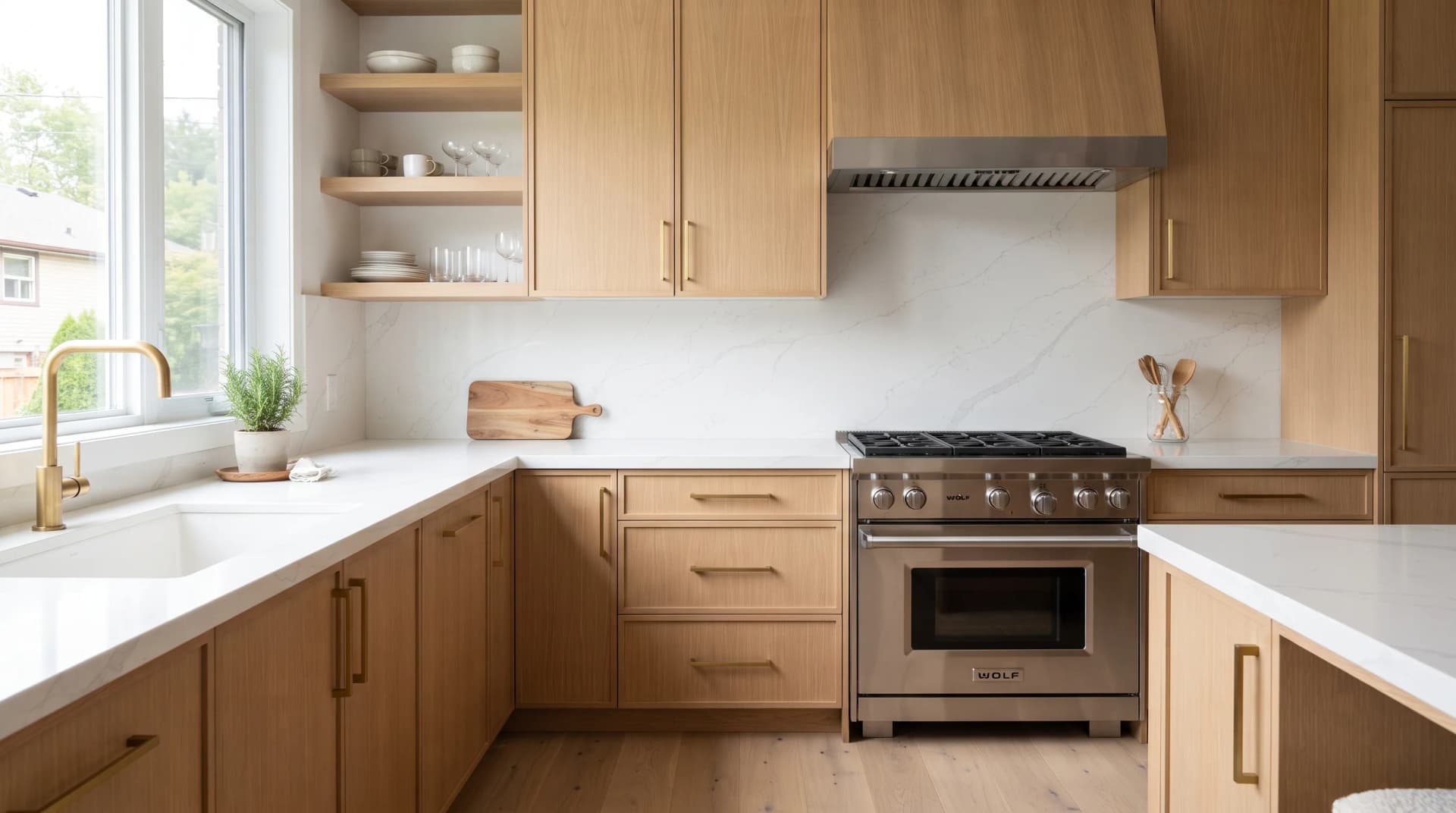
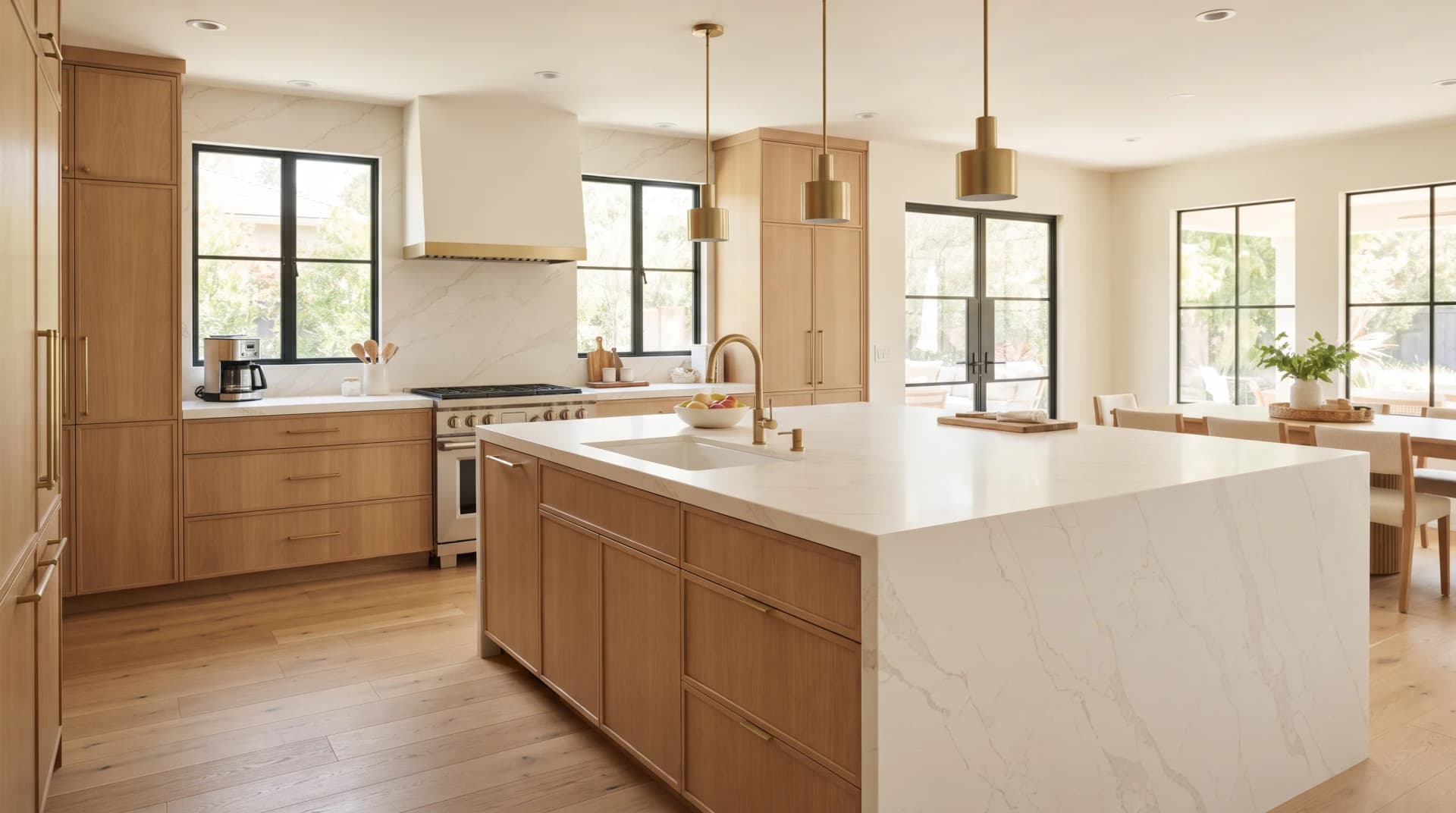
The porcelain slab on your countertop spent 47 minutes at 1,200°C—hot enough to melt aluminum. That extreme temperature isn't arbitrary. It's what transforms ordinary clay minerals into one of the most durable countertop surfaces available, with near-zero porosity and scratch resistance that rivals granite.
But here's what most homeowners don't realize: the manufacturing process for porcelain countertops has almost nothing in common with the ceramic tiles in your bathroom. Modern porcelain slabs are created using sintering technology borrowed from aerospace and advanced materials science—a process that fundamentally changes the material's molecular structure.
Understanding how your countertop is made helps you evaluate quality, compare brands, and know why some porcelain costs $65 per square foot while other options run $150+.
Porcelain countertop slabs are manufactured by compressing natural minerals (clay, feldspar, silica) under extreme pressure (up to 400 bar), then firing them at temperatures exceeding 1,200°C. This sintering process fuses particles at the molecular level, creating a non-porous, UV-stable surface that resists scratches, stains, heat, and fading better than most other countertop materials.
- Porcelain slabs are fired at 1,200°C+, creating a sintered surface harder than granite
- The manufacturing process makes porcelain virtually non-porous (water absorption <0.1%)
- Unlike quartz, porcelain contains no resins—it's 100% natural minerals
- Modern sintering technology allows slabs up to 3.2m x 1.6m in a single piece
What Makes Porcelain Slabs Different
When we talk about porcelain countertops, we're not discussing the material used in your grandmother's dinnerware—or even traditional porcelain floor tiles. Modern porcelain countertop slabs represent a category called sintered stone or ultra-compact surfaces.
The distinction matters because sintering fundamentally changes material properties. Traditional ceramics are porous and relatively fragile. Sintered porcelain achieves near-zero porosity and mechanical properties that compete with natural stone.
Industry Standards

The Raw Materials
Porcelain slabs start with natural minerals—the same materials that form rocks and clay deposits across the earth. Unlike engineered quartz (which includes polymer resins), porcelain contains no synthetic binders.
Primary Ingredients
- Clay (Kaolin): 20-30% — The foundation material that provides workability during forming and contributes to the final structure
- Feldspar: 30-40% — Acts as a flux during firing, helping other materials fuse at lower temperatures
- Silica (Quartz Sand): 20-30% — Provides structural strength and contributes to hardness
- Other Minerals: 10-20% — Including zirconium for hardness, metal oxides for colour, and recycled porcelain for sustainability
The purity and quality of these raw materials directly affect the finished product. Premium premium manufacturers source materials from specific deposits known for consistent quality.
“We tested six different porcelain brands before recommending them to clients. The differences in raw material quality showed up immediately in scratch testing—the premium options performed noticeably better.”
Step 1: Mixing and Preparation
Wet Milling
Raw materials are combined with water and ground in industrial ball mills for 8-12 hours. This process reduces particle size to microscopic dimensions (typically <50 microns), ensures uniform mixing of all components, and creates a homogeneous slurry called "slip."
Spray Drying
The liquid slip is sprayed into a heated chamber where it instantly dries into tiny granules. These granules have consistent moisture content and flow characteristics—critical for even pressing. Think of it like instant coffee: the spray-drying process creates granules that behave predictably during the next manufacturing stage.

Step 2: The Pressing Process
This is where porcelain slabs diverge dramatically from traditional ceramics.
Hydraulic Pressing
Prepared granules are fed into massive hydraulic presses that apply 300-500 bar of pressure (up to 7,000 tons of force). For context, that's roughly 100 times the pressure in a car tire. This extreme compression eliminates air pockets between particles, begins the densification process, and creates a "green body" strong enough to handle before firing.
Large-Format Technology
Modern pressing technology allows single-piece slabs up to:
- Standard large format: up to 3.2m x 1.5m (approximately 10.5 x 5 feet)
- Extended format: up to 3.2m x 1.6m depending on manufacturer
- Wide format: up to 3.0m x 1.5m from select producers
These large formats mean fewer seams in your kitchen—potentially covering an entire island in one piece.
Wondering which porcelain thickness is right for your project?
Our team can explain the practical differences and help you choose based on your kitchen layout and design goals.
Schedule a CallStep 3: Digital Printing and Decoration
One of the most significant advances in porcelain manufacturing is digital printing technology. This stage creates the visual appearance—marble veining, concrete textures, stone patterns, or solid colours.
How It Works
High-resolution inkjet printers apply ceramic inks directly to the pressed slab surface. Premium manufacturers use 8-12 print heads for colour depth, 40-60 megapixel resolution for realistic detail, and UV-stable ceramic inks that won't fade.
Full-Body vs. Surface Decoration
There are two approaches to porcelain decoration:
- Surface Decorated: Pattern applied only to the top surface. Edges and cuts reveal the base material colour.
- Full-Body (Through-Body): Colour and pattern extend through the entire thickness. Edges match the surface. This technology is more expensive but creates more authentic-looking results.
Premium porcelain manufacturers offer full-body options for their most popular designs—an important consideration if your design includes visible edges or waterfall applications.

Step 4: The Sintering Process
This is where the transformation happens—and what separates countertop-grade porcelain from everything else.
What Is Sintering?
Sintering is a heat treatment process that fuses particles together without fully melting them. At temperatures above 1,200°C, feldspar particles melt and flow into gaps, silica particles fuse at contact points, and clay minerals transform into mullite (an extremely hard ceramic).
The result is a material that's fundamentally different from its components—harder, denser, and virtually non-porous.
The Kiln Journey
Pressed slabs travel through tunnel kilns that can exceed 150 meters in length. The journey takes 45-90 minutes and includes:
- Pre-heating zone (200-600°C): Removes remaining moisture, prevents cracking
- Firing zone (1,200-1,250°C): Sintering occurs, material densifies
- Cooling zone: Gradual return to room temperature prevents thermal stress
Temperature Matters
Step 5: Finishing and Quality Control
After sintering, slabs undergo final processing before shipping.
Calibration
Industrial grinding machines ensure exact thickness across the entire slab. Premium manufacturers calibrate to tolerances of ±0.3mm—critical for seamless installations.
Surface Finishing
Slabs receive their final texture:
- Polished: High-gloss mirror finish
- Honed/Matte: Smooth but non-reflective
- Textured: Simulates natural stone feel
- Structured: Deep texture for visual interest
Quality Inspection
Every slab is checked for dimensional accuracy, colour consistency, surface defects, and structural integrity (often using ultrasonic testing). Premium manufacturers reject up to 15% of production due to quality issues.
“We installed porcelain specifically for the heat resistance. With three kids constantly leaving hot pans on the counter, we needed something bulletproof. Two years later, not a single mark.”

Why Manufacturing Method Matters for Your Kitchen
Understanding porcelain manufacturing helps you make better decisions. Here's why the process matters:
Heat Resistance
Because porcelain is fired at 1,200°C+, it handles heat far better than quartz (which contains resins that can discolour above 150°C). You can place hot pans directly on porcelain without trivets—though we still recommend protecting your cookware.
UV Stability
The sintering process permanently fuses pigments into the material. Unlike some quartz colours that can fade in direct sunlight, porcelain maintains its appearance indefinitely—making it suitable for outdoor kitchens where quartz isn't recommended.
Stain Resistance
Near-zero porosity means liquids can't penetrate. Wine, coffee, oil, and even harsh chemicals sit on the surface rather than absorbing—making cleanup effortless.
Porcelain vs. Quartz Manufacturing Compared
| Factor | Porcelain Slabs | Engineered Quartz |
|---|---|---|
| Primary Material | Clay, feldspar, silica (100% minerals) | Ground quartz (90-94%) + polymer resins (6-10%) |
| Binding Agent | None (sintered) | Polymer resin |
| Processing Temperature | 1,200°C+ | 85-100°C (curing) |
| Porosity | <0.1% | <0.5% |
| Heat Resistance | Excellent (1,200°C+ rated) | Good (avoid >150°C) |
| UV Stability | Excellent (outdoor suitable) | Variable (some fade) |
| Maximum Slab Size | 3.2m x 1.6m | 3.0m x 1.4m |
The key insight: Quartz is an engineered composite; porcelain is a transformed natural material. Both perform exceptionally well, but their manufacturing differences create distinct advantages.
Want to see how different porcelain slabs look and feel?
We'll show you samples of our most popular porcelain options—from marble-looks to concrete finishes—so you can compare them against your cabinets and lighting.
Book a ConsultationFrequently Asked Questions
See quality porcelain options from our collection


Your Next Steps
Now that you understand how porcelain slabs are manufactured—and why the process creates such durable, low-maintenance surfaces—here's how to move forward:
If you're still researching:
- Learn about What Are Porcelain Countertops — comprehensive overview
- Compare materials in our Heat Resistance: Quartz vs. Porcelain guide
If you're ready to see options:
Request a free quote and we can discuss different colours, textures, and finishes with you. Our design consultants help you visualize options in your specific kitchen setting—with your actual lighting and cabinets.
Your Next Steps