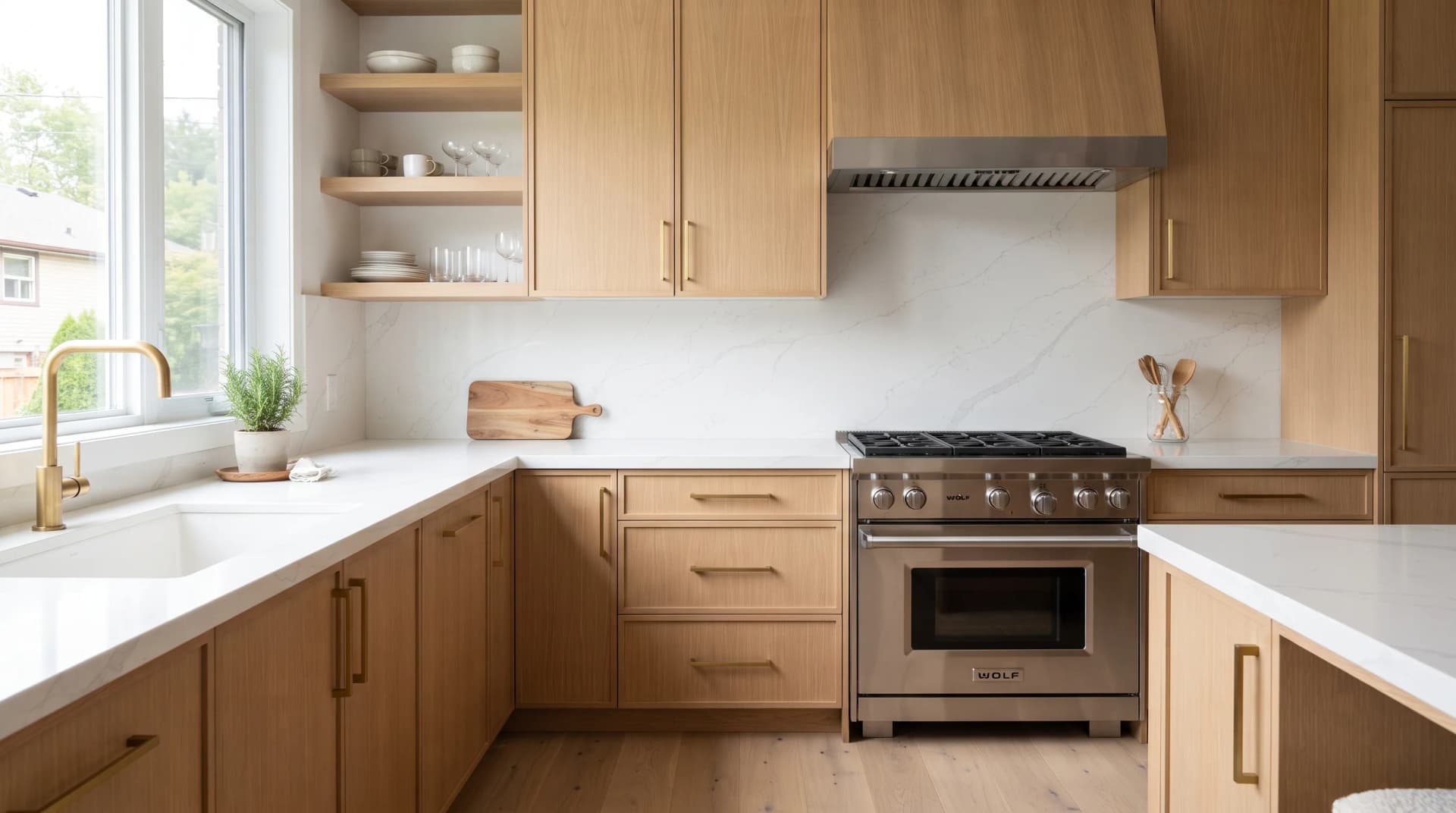
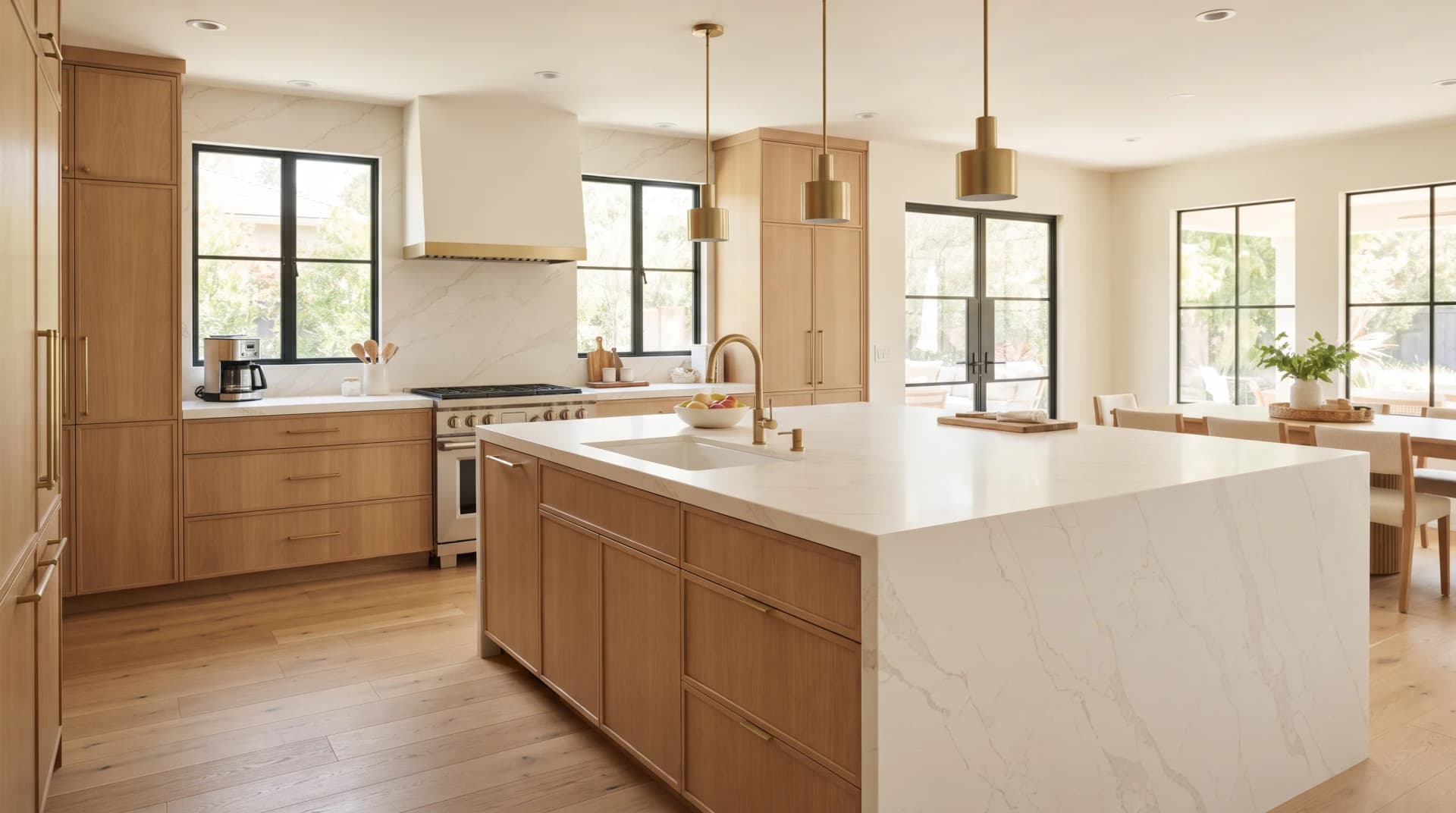
Here's a number that surprises most homeowners: porcelain countertops can withstand temperatures up to 316°C (600°F)—hot enough to place a pan directly from the oven without a trivet, without damage, without hesitation.
Compare that to quartz (which can discolour above 150°C) or granite (which handles heat well but requires sealing), and you start to understand why porcelain has become the fastest-growing countertop category in North American kitchens over the past five years.
But heat resistance is just the beginning. Porcelain countertops represent a fundamentally different approach to surface materials—one born from Italian ceramic innovation rather than the engineered stone tradition. Understanding what porcelain actually is, how it differs from other options, and where it excels (or falls short) helps you decide if this ultra-modern surface belongs in your kitchen.
Porcelain countertops are large-format slabs made from natural minerals (clay, feldspar, silica) fired at extremely high temperatures (1200°C+) to create a dense, non-porous surface. Unlike quartz, porcelain contains no resins—making it completely UV-stable, heat-resistant up to 316°C, and suitable for both indoor and outdoor applications.
- Porcelain is 100% natural minerals with zero resin content
- Withstands extreme heat (316°C) and UV exposure without damage
- Available in ultra-thin (6mm) to standard (20mm) thicknesses
- Harder and more scratch-resistant than quartz (Mohs 7-8)
- Ideal for outdoor kitchens, sunny rooms, and design-forward spaces
What Porcelain Countertops Actually Are
Porcelain countertops—also called sintered stone, ultra-compact surfaces, or ceramic slabs—are made from natural raw materials compressed and fired at temperatures exceeding 1200°C (2200°F).
The technology evolved from Italy's centuries-old ceramic tile tradition. In the early 2000s, Italian manufacturers developed techniques to produce massive porcelain slabs—large enough for kitchen countertops, bathroom vanities, wall cladding, and even flooring—using the same principles that make porcelain tiles so durable.
The Composition
Every porcelain slab contains a blend of natural minerals:
- Clays (provide plasticity and workability)
- Feldspar (acts as a flux, lowering melting temperature)
- Silica/Quartz sand (adds hardness and structure)
- Mineral pigments (create colour and pattern)
Unlike engineered quartz, porcelain contains zero polymer resins. The material is held together purely through sintering—a process where extreme heat fuses mineral particles at the molecular level without melting them completely.
This resin-free composition is what gives porcelain its unique performance characteristics: complete UV stability, extreme heat resistance, and a surface hardness that rivals natural granite.
The 'Ultra-Compact' Terminology

How Porcelain Differs from Quartz
Both porcelain and quartz are engineered surfaces, but they're engineered in fundamentally different ways.
| Factor | Porcelain | Quartz |
|---|---|---|
| Primary Material | Natural minerals (clay, feldspar, silica) | Ground quartz crystals |
| Binding Agent | None (sintering fuses materials) | Polymer resin (6-10%) |
| Manufacturing Temp | 1200°C+ (2200°F+) | 85-100°C (185-212°F) |
| Heat Resistance | Up to 316°C (600°F) | Up to 150°C (300°F) |
| UV Stability | Complete (no fading) | Limited (resins can yellow) |
| Hardness (Mohs) | 7-8 | 7 |
| Typical Thickness | 6mm, 12mm, or 20mm | 20mm or 30mm |
| Weight (20mm slab) | Similar to quartz | ~450kg |
| Outdoor Use | Yes | Not recommended |
| Price Range (CAD/sq ft) | $70-$180 installed | $55-$150 installed |
The critical difference is the resin. Quartz countertops contain 6-10% polymer resin that binds the quartz crystals together. This resin provides benefits (flexibility, consistent colouring) but also limitations (heat sensitivity, UV degradation potential).
Porcelain has no resin. The sintering process creates bonds between mineral particles that are, in some ways, closer to how natural stone forms—just accelerated and controlled in a factory environment.
“We switched our outdoor kitchen specification from quartz to porcelain three years ago. The UV exposure was fading quartz within 18 months. Porcelain in the same location still looks identical to installation day.”

The Sintering Process: Why Porcelain Performs Differently
Understanding sintering explains why porcelain behaves so differently from other countertop materials.
What Is Sintering?
Sintering is a manufacturing process that uses heat and pressure to fuse particles together without fully melting them. It's the same process used to create ceramics, certain metals, and even some plastics.
For porcelain countertops, the process works like this:
Step 1: Raw Material Preparation
Natural minerals are ground to fine powders and precisely mixed according to the manufacturer's formula. Pigments are added to create specific colours and patterns.
Step 2: Pressing
The powder mixture is spread into large molds and compressed under extreme pressure—typically 400-500 bars (5,800-7,250 PSI). This compaction eliminates air pockets and creates the "ultra-compact" density.
Step 3: Digital Decoration
For patterned designs (marble looks, wood grains, concrete effects), high-resolution digital printing applies pigments to the compressed surface. Advanced systems use multiple print heads and mineral-based inks that become permanent during firing.
Step 4: Sintering/Firing
Slabs enter kilns heated to 1200-1300°C (2200-2370°F). At these temperatures:
- Mineral particles fuse at their contact points
- Microscopic gaps close completely
- The surface becomes virtually non-porous
- Colour pigments bond permanently to the material
The sintering process effectively simulates the conditions that create natural stone over thousands of years—compressed into approximately 4 hours of controlled firing.
Step 5: Cooling and Finishing
Slabs cool gradually over 12-24 hours to prevent thermal shock. They're then calibrated to exact thickness, polished or textured to the desired finish, and inspected for quality.
Why Sintering Creates Superior Heat Resistance
For practical purposes, this means:
- Hot pans directly from stove or oven: no problem
- Curling irons and hair straighteners: no damage
- Outdoor BBQ stations: completely safe

Interested in seeing porcelain's heat resistance for yourself?
Request a free quote to learn more about porcelain's incredible heat resistance and discuss which options are best for your kitchen.
Request Free QuotePorcelain Slab Thickness Options
One of porcelain's unique advantages is the range of available thicknesses. This flexibility opens design possibilities that other materials can't match.
| Thickness | Weight (per sq ft) | Best Applications | Edge Options |
|---|---|---|---|
| 6mm (1/4") | ~3.5 kg | Walls, cladding, overlays | Limited |
| 12mm (1/2") | ~7 kg | Vanities, slim counters, modern designs | Moderate |
| 20mm (3/4") | ~11.5 kg | Full countertops, islands, heavy use | Full range |
6mm (1/4 inch) — Ultra-Thin
Best for:
- Wall cladding and backsplashes
- Cabinet door facing
- Overlay applications over existing countertops
- Feature walls
Considerations:
- Requires substrate support for countertop use
- Lighter weight (easier handling)
- Lower material cost per square foot
12mm (1/2 inch) — Slim Profile
Best for:
- Modern, minimalist kitchen designs
- Waterfall edges where thin lines are desired
- Bathroom vanities
- Furniture applications
Considerations:
- Creates a sleek, contemporary aesthetic
- May need edge reinforcement for overhangs
- Excellent for achieving a "floating" visual effect
20mm (3/4 inch) — Standard
Best for:
- Kitchen countertops (most common choice)
- Heavy-use applications
- Areas requiring structural strength
- Traditional thickness aesthetic
Considerations:
- Most similar to natural stone proportions
- Handles overhangs and unsupported spans well
- Full range of edge profile options
Some manufacturers also offer 30mm slabs for applications requiring maximum durability or dramatic edge profiles.

Key Benefits of Porcelain Countertops
1. Extreme Heat Resistance
Porcelain's most significant advantage. With tolerance up to 316°C (600°F), you can:
- Place hot pans directly on the surface
- Use it as a trivet-free zone next to the stove
- Install around cooktops without heat damage concerns
- Create outdoor kitchen surfaces near grills and fire pits
No other countertop material matches this practical heat tolerance.
2. Complete UV Stability
Because porcelain contains no organic resins, it won't fade, yellow, or degrade from sunlight exposure. This makes it ideal for:
- South-facing kitchens with large windows
- Outdoor kitchens and BBQ areas
- Sunrooms and conservatories
- Bright bathrooms with skylights
Quartz manufacturers often void warranties for outdoor or high-UV installations. Porcelain has no such limitations.
3. Superior Scratch Resistance
Porcelain typically rates 7-8 on the Mohs hardness scale—harder than quartz (7) and much harder than marble (3-4). In practical terms:
- Kitchen knives won't scratch the surface
- Ceramic and stoneware dishes slide without marking
- Daily wear produces no visible scratches
4. Stain Resistance
The sintering process creates a virtually non-porous surface. Common kitchen stains—wine, coffee, oil, turmeric—wipe away without penetrating. Unlike natural stone, porcelain never requires sealing.
5. Hygienic Surface
Near-zero porosity means bacteria, mold, and mildew have nowhere to grow. This makes porcelain particularly suitable for:
- Food preparation areas
- Bathroom surfaces
- Medical and dental offices
- Commercial food service
According to testing standards cited by NSF International, quality porcelain surfaces meet or exceed hygiene requirements for food contact surfaces.
6. Design Flexibility
Modern manufacturing creates remarkably realistic reproductions:
- Marble looks (Calacatta, Carrara, Statuario)
- Natural stone (granite, quartzite, onyx)
- Concrete and industrial effects
- Wood grain patterns
- Solid colours (matte, gloss, textured)
Large-format slabs (up to 320cm × 160cm) mean fewer seams and more dramatic visual impact than natural stone, which often comes in smaller pieces.
“The marble-look porcelain we installed fooled my mother-in-law—she's been complimenting our 'marble countertops' for two years. We don't correct her anymore.”
Limitations to Consider
Porcelain isn't perfect for every situation. Understanding its limitations helps you make the right choice.
1. Impact Vulnerability
While extremely hard, porcelain is also more brittle than quartz. Sharp impacts—dropping a heavy cast iron pan, for example—can cause chips or cracks. Quartz's resin content gives it more flex and impact absorption.
Mitigation: Handle heavy objects carefully. Most damage occurs during fabrication and installation, not daily use.
2. Edge Chipping
The hardness that resists scratches also makes edges more vulnerable to chipping during fabrication. This requires skilled fabricators and sometimes limits edge profile options.
Mitigation: Choose experienced fabricators. Simple edge profiles (flat, pencil, bullnose) are more reliable than complex ogee or waterfall edges.
3. Fabrication Complexity
Cutting, drilling, and finishing porcelain requires specialized equipment and expertise. Not all countertop fabricators have the tools or training for porcelain work. This can:
- Limit fabricator options in some regions
- Add to installation costs
- Extend project timelines
4. Repair Difficulty
Chips or cracks in porcelain are more difficult to repair invisibly than damage to quartz. While repair is possible, it's often more noticeable and may require professional intervention.
5. Higher Price Point
Premium porcelain typically costs more than mid-range quartz:
- Premium porcelain: $90-$200/sq ft installed
- Budget quartz: $55-$80/sq ft installed
However, porcelain competes directly with premium quartz on price, and the performance benefits often justify the investment.
6. Seam Visibility
While porcelain slabs are large, seams are sometimes more visible than with quartz. The hardness of the material makes achieving perfectly flush seam joints more challenging.
Weighing porcelain against other options?
Our comparison guide breaks down Quartz vs. Porcelain feature by feature—or request a free quote to discuss which material is right for your kitchen.
Compare MaterialsWhat to Look for in Premium Porcelain
Not all porcelain countertops are created equal. When evaluating options, focus on these quality indicators:
- Full-body colour: The pattern extends through the entire slab thickness, not just the surface—critical for mitered edges and waterfall installations
- Slab dimensions: Larger slabs (up to 3240mm × 1620mm) mean fewer seams in your finished countertop
- Thickness options: Look for availability in multiple thicknesses (6mm to 20mm) for versatility across applications
- Realistic patterning: The best porcelain features multi-layer printing technology that creates convincing natural stone reproductions
- Warranty coverage: Premium porcelain typically comes with residential lifetime warranties
Porcelain Pricing (Installed, CAD/sq ft)
| Tier | Price Range | What You Get |
|---|---|---|
| Entry-Level | $90-$110 | Solid colours, standard sizes |
| Mid-Range | $110-$150 | Marble-look patterns, full-body options |
| Premium | $150-$200 | Ultra-realistic patterns, large format, full-body |
We work with all major porcelain manufacturers and can recommend the best option for your specific colour preferences and performance requirements.

Is Porcelain Right for Your Kitchen?
Based on our experience installing countertops across Canada, here's when porcelain makes sense—and when other options might serve you better.
Choose if you want
- You prioritize heat resistance and want to place hot pans directly
- You're installing an outdoor kitchen (UV stability, freeze-thaw resistance)
- Your kitchen gets significant sun exposure through large windows
- You want ultra-thin or ultra-modern aesthetics (6mm or 12mm options)
- You prefer specific patterns only available in porcelain
Consider alternatives if
- Budget is a primary concern (mid-range quartz offers better value)
- You're worried about impact damage (quartz has better impact resistance)
- Your fabricator lacks porcelain experience
- You want complex edge profiles (easier to achieve in quartz)

Ready to explore porcelain options?
Use our estimate calculator to see pricing for porcelain countertops based on your kitchen measurements, preferred brand tier, and location.
Get My EstimateFrequently Asked Questions
Advanced surfaces for modern kitchens


Your Next Steps
Now that you understand what porcelain countertops are and how they perform, here's how to continue:
Learn more about your options:
- How Porcelain Slabs Are Made — Deep dive into the sintering process
- Quartz vs. Porcelain Comparison — Feature-by-feature breakdown
- Porcelain Countertop Costs in Canada — Detailed pricing guide
See porcelain in person:
Request a free quote and our team can walk you through porcelain options. Feel the weight, see the patterns under your actual kitchen lighting, and test the heat resistance yourself.
Get a personalized quote:
Submit your project details and receive a detailed estimate within 24 hours—including porcelain options at different price points.
Have specific questions?
Book a quick phone consultation. We'll discuss whether porcelain is the right choice for your situation.
Your Next Steps

We fabricate and install what this article describes — see our Winnipeg showroom and service area and Fredericton countertop installation.