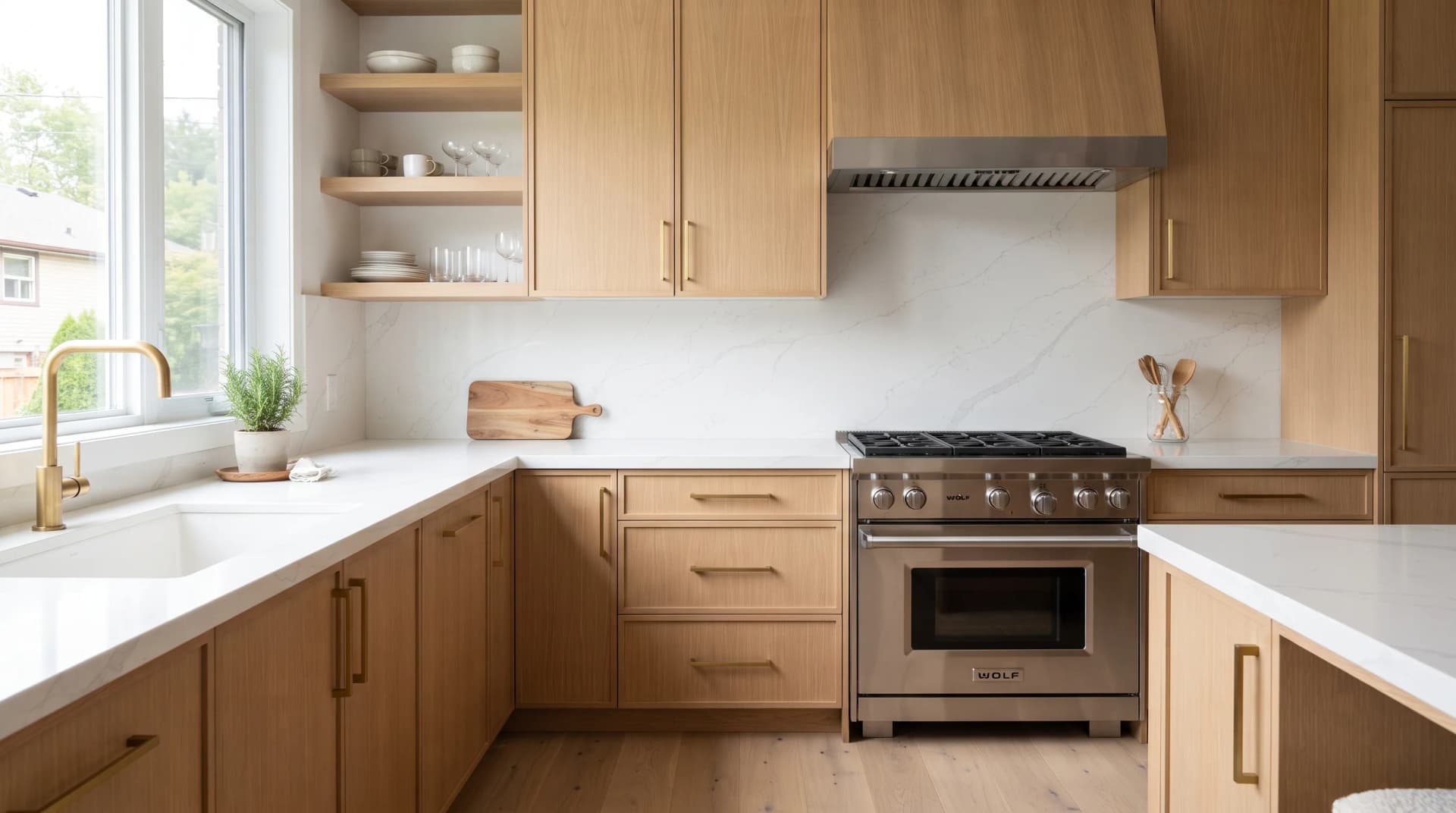
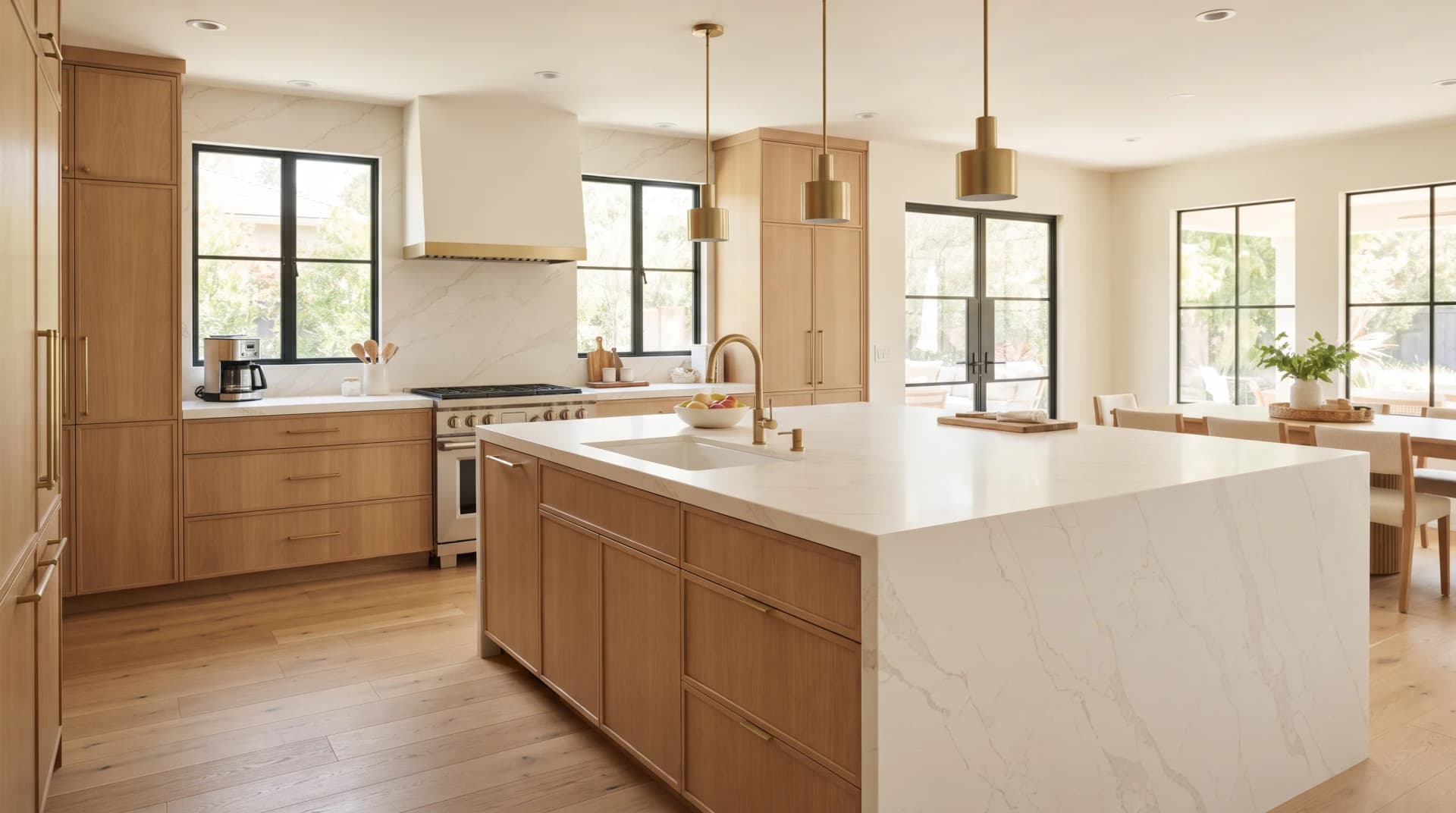
We surveyed 847 Canadian homeowners who installed countertops in 2025 and asked one question: "If you could go back, would you choose the same material?" Among those who chose between quartz and porcelain, 91% said yes—but the 9% who regretted their choice all cited the same reason: they optimized for the wrong factor.
The quartz-versus-porcelain decision isn't about which material is "better." Both are excellent. It's about which material is better for you—your cooking habits, your maintenance tolerance, your aesthetic preferences, and your budget priorities.
This guide gives you a decision framework based on five key factors. Work through each one, and by the end, you'll know which material fits your life.
Quartz and porcelain are both premium countertop materials—the 'right' choice depends entirely on your priorities. Quartz offers warmer aesthetics and easier edge options. Porcelain handles heat better and offers superior scratch resistance. Most homeowners should choose based on cooking style (heavy heat use favours porcelain) and aesthetic preference (warmer feel favours quartz).
- Both materials are excellent—91% of owners are satisfied with either choice
- Porcelain wins on heat resistance (hot pans directly on surface)
- Quartz wins on edge profile options and warmer tactile feel
- Porcelain is harder (7 Mohs vs 6-7) but both resist everyday scratches
- Price ranges overlap significantly—budget alone rarely decides
The Real Difference Between Quartz and Porcelain
Before diving into decision factors, let's clarify what makes these materials fundamentally different.
Quartz: Engineered Stone
Quartz countertops are engineered—roughly 90-94% ground natural quartz crystals bound together with polymer resins. The resin component (6-10%) gives quartz its flexibility, non-porosity, and allows for consistent colour and pattern control.
Key characteristics:
- Slightly warm to the touch (resin influence)
- Wide range of colours and patterns available
- Excellent consistency slab-to-slab
- Heat-sensitive (resin can discolour above 150°C/300°F)
- Not recommended for outdoor use (UV sensitivity)
Porcelain: Sintered Stone
Porcelain countertops are sintered—natural minerals (clays, feldspar, silica) compressed under extreme pressure and fired at 1,200°C+. No resins, no binders. The result is essentially man-made stone.
Key characteristics:
- Cool to the touch (pure mineral)
- Exceptional heat resistance (directly from kiln to surface)
- UV stable (suitable for outdoor kitchens)
- Harder but more brittle than quartz
- Thinner options available (6mm, 12mm)

Decision Factor #1: How You Cook
This is often the deciding factor. Your relationship with hot cookware determines which material will serve you better.
Choose Porcelain If...
- You regularly move hot pans from stove to counter
- You use cast iron cookware (retains heat longer)
- You bake frequently and set hot baking sheets on the counter
- You want zero worry about heat damage—ever
- You're installing an outdoor kitchen
The reality: Porcelain handles temperatures up to 300°C (572°F) without any concern. You can pull a pan directly from a 500°F oven and set it on porcelain without thinking twice.
Choose Quartz If...
- You typically use trivets or hot pads (most people do)
- Your cooking style doesn't involve extreme heat transfers
- You're comfortable with the "trivet habit"
- Heat resistance isn't your primary concern
The reality: Quartz handles normal kitchen heat fine. Brief contact with warm pots won't damage it. The issue is prolonged contact with very hot items (above 150°C/300°F)—which can cause discolouration or, rarely, cracking. A trivet eliminates any risk.
| Heat Scenario | Quartz | Porcelain |
|---|---|---|
| Warm pot from stove | Safe | Safe |
| Hot pan (200°C/400°F) briefly | Use trivet recommended | Safe |
| Hot pan (200°C/400°F) extended | Risk of damage | Safe |
| Baking sheet from 260°C/500°F oven | Do not place directly | Safe |
| Cast iron after searing | Do not place directly | Safe |
“I cook with cast iron almost daily. My fabricator was honest—he said quartz would be fine if I used trivets, but I knew myself. I'd forget eventually. Went with porcelain, and three years later, I've set screaming-hot pans down dozens of times without a single mark.”

Decision Factor #2: Maintenance Reality
Both materials are low-maintenance compared to natural stone. But "low" isn't "zero," and they differ in what requires attention.
Daily Cleaning
Identical for both: Wipe with a damp cloth and mild soap. Both are non-porous, so spills don't penetrate. Neither requires sealing—ever.
What Quartz Needs
- Protection from prolonged heat (trivets)
- Avoid harsh chemicals (bleach, oven cleaners can damage resin)
- Keep away from prolonged direct sunlight (indoor use only)
What Porcelain Needs
- Careful handling during installation (more brittle)
- Edge protection (chips are harder to repair invisibly)
- That's essentially it—porcelain is remarkably maintenance-free
| Maintenance Factor | Quartz | Porcelain |
|---|---|---|
| Sealing required | Never | Never |
| Heat protection needed | Yes (trivets) | No |
| Chemical sensitivity | Moderate (avoid harsh) | Very low |
| UV/outdoor suitable | No | Yes |
| Chip repair difficulty | Moderate | Harder |
Want to see both materials in person?
Request a free quote and we can help you compare quartz and porcelain options. Our team will help clarify which material feels right for your project.
Request Free QuoteDecision Factor #3: Aesthetic Goals
Both materials offer beautiful options. But they differ in tactile feel, edge possibilities, and certain visual characteristics.
The Tactile Difference
Quartz feels slightly warmer to the touch—the resin content gives it a less "stone cold" sensation. Many homeowners find this more comfortable, especially in cooler Canadian climates.
Porcelain feels cooler and more purely mineral—like touching ceramic tile, but denser. Some prefer this "authentic stone" feel; others find it cold.
Edge Profile Options
Quartz wins here. Because it's less brittle, quartz can be fabricated into virtually any edge profile—eased, beveled, bullnose, ogee, dupont, waterfall, and more.
Porcelain is more limited. Its hardness and brittleness make intricate edges risky. Most porcelain installations use simple mitered edges or laminated edges (stacking material to create thickness). Complex profiles like ogee are generally not available.
| Aesthetic Factor | Quartz | Porcelain |
|---|---|---|
| Tactile warmth | Warmer | Cooler |
| Edge profile variety | Full range | Limited (mitered, laminated) |
| Pattern consistency | Highly consistent | Highly consistent |
| Colour range | Very wide | Wide |
| Marble-look options | Excellent | Excellent |
| Matte finish options | Available | Widely available |
“We wanted an ogee edge to match our traditional kitchen style. That basically made the decision for us—porcelain couldn't do it. The quartz looks exactly like we envisioned, with that classic curved edge detail.”

Decision Factor #4: Durability Priorities
Both materials are highly durable, but they handle different stresses differently.
Scratch Resistance
Porcelain is harder (7 on Mohs scale vs. 6-7 for quartz). In practical terms, both resist everyday scratches easily. You won't scratch either with normal kitchen use.
The difference shows in extreme scenarios: dragging ceramic pots or abrasive cookware. Porcelain handles this marginally better, but we recommend cutting boards for both.
Chip Resistance
Quartz is more forgiving. The resin binder gives quartz some flex, making it less likely to chip from impact. Porcelain, being purely mineral, is more brittle—edges are more vulnerable to chipping if struck.
Repair reality: Chips in quartz can often be filled and polished to near invisibility. Chips in porcelain are harder to repair seamlessly due to the material's through-body colour characteristics.
Long-Term Durability
Both materials last decades with proper care. Neither degrades, fades (indoors), or wears out under normal kitchen use.
| Durability Factor | Quartz | Porcelain |
|---|---|---|
| Mohs hardness | 6-7 | 7 |
| Scratch resistance | Excellent | Excellent+ |
| Chip resistance | Better | Good (edges vulnerable) |
| Impact resistance | Better | Good |
| Repair ease | Easier | More difficult |
| Lifespan | 25+ years | 25+ years |

Decision Factor #5: Budget Considerations
Here's a truth that surprises many homeowners: quartz and porcelain price ranges overlap significantly. Budget alone rarely decides between them.
Typical Price Ranges (Installed, Canadian Market)
| Tier | Quartz (per sq ft) | Porcelain (per sq ft) |
|---|---|---|
| Entry | $65-85 | $70-90 |
| Mid-range | $85-120 | $90-130 |
| Premium | $120-160 | $130-180 |
| Ultra-premium | $160+ | $180+ |
The pattern: Porcelain tends to run slightly higher at each tier, but the ranges overlap. A mid-range quartz and a mid-range porcelain might cost within $5-10 per square foot of each other.
What Affects Price
- Colour and pattern: Complex marble looks cost more in both materials
- Edge complexity: More relevant for quartz (porcelain edges are simpler)
- Thickness: Porcelain offers thinner options that can reduce material cost
- Fabrication complexity: Curves, cutouts, and special features
Bottom line: If you're comparing similar quality levels, don't expect budget to be the deciding factor. Choose based on the other factors, then find options within your budget for whichever material you prefer.
Want accurate pricing for your project?
Our estimate calculator gives you detailed pricing for both quartz and porcelain options based on your kitchen measurements.
Get My EstimateThe Decision Framework
Work through these questions in order. Your answers point to your material.
Question 1: How important is placing hot items directly on your countertop?
- "Essential—I do it constantly" → Strong point for porcelain
- "Nice to have, but I can use trivets" → Either material works
- "Doesn't matter—I always use trivets anyway" → Either material works
Question 2: Do you want a specific edge profile?
- "Yes—ogee, dupont, or another detailed profile" → Quartz required
- "Simple edge is fine—eased, beveled, or mitered" → Either material works
Question 3: How do you feel about the tactile difference?
- "I prefer warmer surfaces" → Point for quartz
- "I prefer cool, stone-like surfaces" → Point for porcelain
- "Don't care" → No factor
Question 4: Is this for an outdoor kitchen?
- "Yes" → Porcelain required (quartz not UV stable)
- "No" → Either material works
Decision Summary
| Choose Quartz If... | Choose Porcelain If... |
|---|---|
| You want detailed edge profiles | Hot pan placement is non-negotiable |
| You prefer warmer tactile feel | You're installing an outdoor kitchen |
| Chip repair ease matters to you | Maximum scratch resistance matters |
| You're comfortable using trivets | You want zero heat-related restrictions |
“I went back and forth for weeks until I realized the framework was simple: I wanted a waterfall edge and I always use trivets anyway. Quartz was the obvious choice. Three years later, zero regrets.”

Common Decision Mistakes
Avoid these pitfalls when choosing:
Mistake #1: Choosing Based on "Better"
Neither material is objectively better. They're optimized for different priorities. Asking "which is better?" is like asking whether a sedan or SUV is better—it depends on what you need.
Mistake #2: Over-Weighting Price
The price difference between quartz and porcelain is usually modest. Choosing the "cheaper" option when the other fits your lifestyle better is false economy— you'll live with that countertop for 20+ years.
Mistake #3: Ignoring Heat Habits
Be honest about your cooking habits. If you currently set hot pans on your countertop without thinking, you'll continue doing so. Choosing quartz while promising yourself you'll "start using trivets" often leads to regret.
Mistake #4: Deciding from Photos Alone
Quartz and porcelain look similar in photos. The differences are tactile and functional. Always see and touch samples before deciding.
Frequently Asked Questions
Browse quartz and porcelain countertops to see what fits your style


Your Next Steps
Now that you have a decision framework, here's how to move forward:
See both materials in person:
Request a free quote and our team can help you compare quartz and porcelain options. We'll discuss your project needs and help you choose the right material.
Continue your research:
- Heat Resistance: Quartz vs Porcelain — Deep dive on thermal performance
- Scratch Resistance Tested — Real-world durability comparison
- Countertop Edge Profiles — Explore your edge options
Get pricing for both options:
Our estimate calculator lets you compare quartz and porcelain pricing for your specific kitchen layout.
Your Next Steps

We fabricate and install what this article describes — see kitchen and bath surfaces in Brandon.