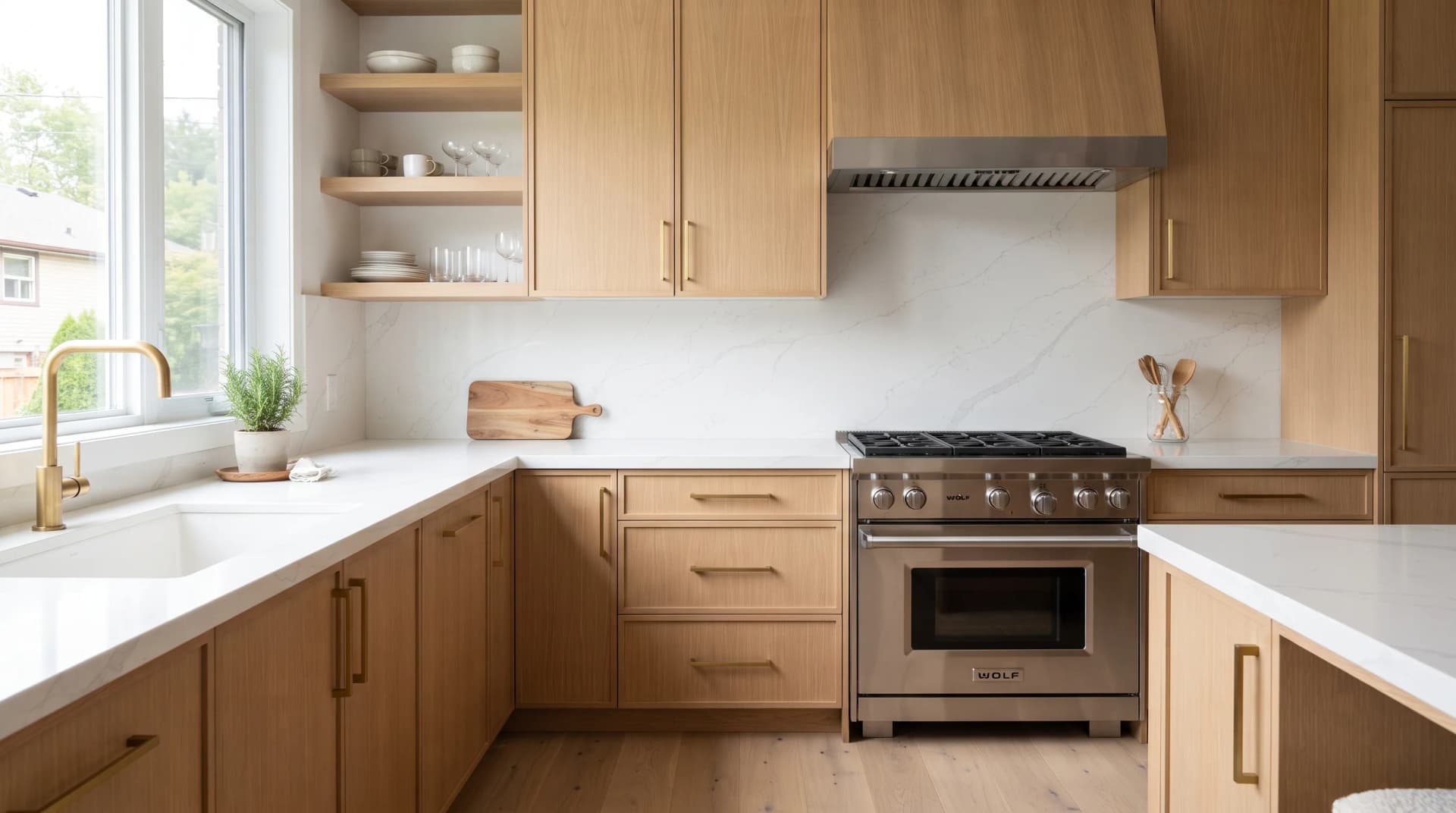
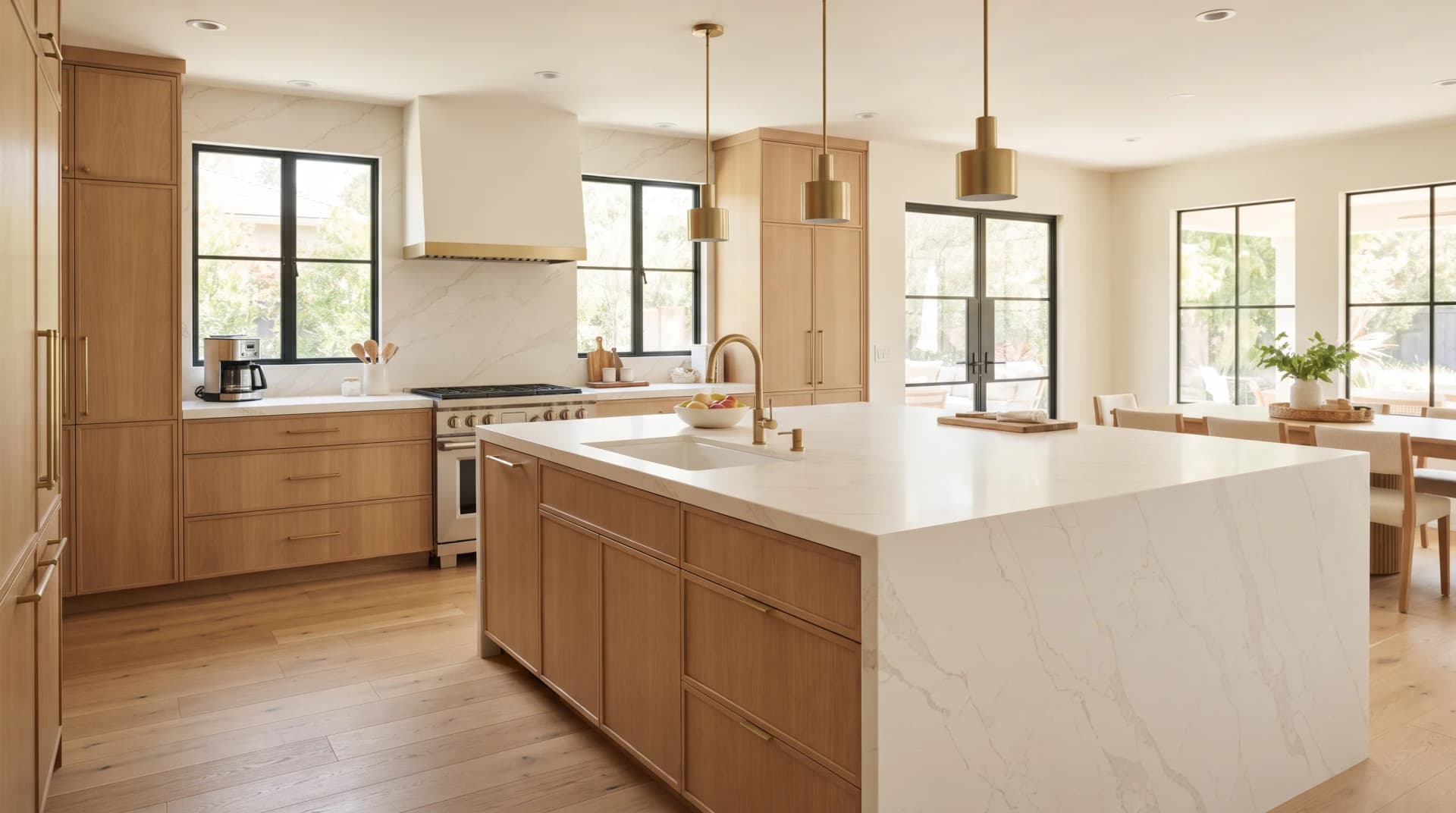
Canadian homes are getting brighter. Floor-to-ceiling windows, skylights, sunrooms, and open-concept designs flood our kitchens with natural light—which we love. But that same sunlight that makes your space feel warm and inviting can quietly damage certain countertop materials.
The issue isn't dramatic. You won't see fading overnight. But over months and years, UV exposure can cause discolouration in quartz countertops—particularly in areas that receive direct, prolonged sunlight. Understanding which materials handle UV well (and which don't) is essential for sun-filled spaces.
Quartz countertops contain polymer resins that can discolour with prolonged UV exposure—a concern for kitchens with large south-facing windows, sunrooms, and especially outdoor installations. Porcelain is inherently UV-stable and won't fade. For outdoor kitchens, porcelain is the recommended choice; for bright indoor spaces, either material works with appropriate precautions.
- Quartz resin binders can yellow or discolour with prolonged UV exposure
- Porcelain is completely UV-stable—ideal for outdoor and sun-filled spaces
- Indoor quartz rarely shows UV damage with normal window filtration
- Direct, prolonged sun exposure (6+ hours daily) increases quartz risk
- Outdoor kitchens require porcelain or specialty UV-stable quartz formulations
Why UV Stability Matters
UV stability describes a material's ability to maintain its colour and structural integrity when exposed to ultraviolet radiation from sunlight. For countertops, this matters in two scenarios:
- Indoor spaces with significant sun exposure: Large windows, skylights, sunrooms, and kitchens oriented toward the south
- Outdoor installations: Outdoor kitchens, covered patios, pool houses, and any exterior application
A UV-unstable countertop can develop yellowing, fading, or uneven discolouration over time—often most visible where direct sunlight falls compared to shaded areas. The contrast becomes the tell-tale sign.

The Science of UV Damage
Ultraviolet radiation carries enough energy to break chemical bonds in certain materials. When UV light hits a susceptible surface repeatedly over time, it causes photodegradation—the breakdown of molecular structures that results in colour changes.
What Gets Damaged
In countertops, the vulnerable component is typically organic compounds—specifically the polymer resins used as binders in engineered materials like quartz. Natural stone (granite, marble, quartzite) and sintered materials (porcelain) don't contain organic binders and are inherently UV-stable.
The Time Factor
UV damage is cumulative. Brief exposure causes no visible change. But hours become days, days become months, and months become years. The damage accumulates gradually, often going unnoticed until you compare sun-exposed areas to shaded areas—or until you move an appliance that's been blocking the sun.
Quartz and UV: Understanding the Limitations
Quartz countertops are engineered from approximately 90-94% ground natural quartz crystals bound together with 6-10% polymer resins. The quartz crystals themselves are UV-stable—it's the resin binder that's vulnerable.
What Happens to Quartz in Sunlight
When quartz countertops receive prolonged, direct UV exposure, the resin component can undergo photodegradation. The visible result is typically:
- Yellowing: The most common manifestation, particularly on white and light-coloured surfaces
- Fading: Colour intensity may diminish in affected areas
- Uneven appearance: Contrast between sun-exposed and shaded areas
Risk Factors for Quartz
| Factor | Higher Risk | Lower Risk |
|---|---|---|
| Window orientation | South/west facing | North/east facing |
| Sun exposure duration | 6+ hours direct daily | Indirect or brief |
| Window type | Single-pane, no UV film | Double-pane, UV-filtering |
| Countertop colour | White, light colours | Dark colours (hide changes better) |
| Location | Near large windows/skylights | Away from direct light |
The Indoor Reality
Here's the important context: most indoor quartz installations never show UV damage. Modern windows filter a significant portion of UV radiation, and typical kitchen layouts don't place countertops in prolonged direct sunlight. The risk is real but often overstated for normal indoor applications.
Where indoor UV damage does occur:
- Sunrooms with extensive glass
- Kitchens with floor-to-ceiling south-facing windows
- Spaces with skylights directly above countertops
- Areas where countertops receive 6+ hours of direct sun daily
“We have a white quartz countertop under a large skylight. After three years, you can see a slight yellowing where the sun hits most intensely. It's subtle—most visitors don't notice—but we see it. If I were doing it again, I'd choose porcelain for that section.”

Porcelain and UV: The Stable Alternative
Porcelain countertops are manufactured through sintering—natural minerals fired at 1,200°C+ until they fuse into a solid mass. No polymer resins, no organic binders, nothing that UV radiation can degrade.
Why Porcelain Is UV-Stable
The minerals that compose porcelain—clays, feldspars, silica—are inherently stable against UV radiation. The same sunlight that can degrade quartz resin has no effect on porcelain's mineral structure. The colour is permanent, whether the surface sees zero sun or full outdoor exposure.
Ideal Applications for UV Stability
- Outdoor kitchens: Full sun exposure, no concerns
- Pool houses and cabanas: Wet, sunny environments
- Sunrooms: Extensive glass, significant UV exposure
- South-facing kitchens: Large windows, prolonged direct sun
- Commercial spaces: Storefront windows, display areas
Planning a sun-filled space?
Book a consultation to discuss your specific lighting conditions. We'll help you determine whether UV stability is a factor and which materials suit your installation.
Book ConsultationIndoor Scenarios Where UV Matters
Let's be specific about when indoor UV exposure becomes a legitimate concern versus when it's not worth worrying about.
Low Concern (Quartz Is Fine)
- Standard kitchen windows (especially north or east facing)
- Modern double-pane windows with UV coating
- Countertops that receive indirect light only
- Kitchens where direct sun hits for less than 2-3 hours daily
- Any installation away from windows
Moderate Concern (Consider Precautions)
- Large south or west-facing windows without UV film
- Skylights above countertop areas
- Bright white quartz in sunny orientations
- Direct sun exposure of 4-6 hours daily
Precautions: Apply UV-filtering window film, use blinds during peak sun hours, or consider porcelain for the most exposed sections.
High Concern (Consider Porcelain)
- Sunrooms and conservatories
- Floor-to-ceiling south-facing glass walls
- Direct sun exposure exceeding 6 hours daily
- Any outdoor or covered patio application

Outdoor Kitchens: Non-Negotiable UV Stability
For outdoor kitchen installations in Canada, UV stability isn't optional—it's essential. Even covered outdoor kitchens receive significant UV exposure from reflected and ambient light.
Material Recommendations for Outdoors
| Material | Outdoor Suitability | Notes |
|---|---|---|
| Standard quartz | Not recommended | Will discolour over time |
| UV-stable quartz | Acceptable | Specialty formulation, limited colours |
| Porcelain | Excellent | Inherently UV-stable, widest options |
| Granite | Excellent | Natural stone, fully UV-stable |
| Premium porcelain | Excellent | Sintered surface, fully UV-stable |
Canadian Climate Considerations
Beyond UV stability, outdoor countertops in Canada must handle:
- Freeze-thaw cycles: Porcelain excels here due to near-zero porosity
- Temperature extremes: Both porcelain and granite handle this well
- Snow and ice: Non-porous surfaces prevent water infiltration
Porcelain is the most common recommendation for Canadian outdoor kitchens—UV-stable, freeze-thaw resistant, heat-proof, and available in extensive design options.
“We built an outdoor kitchen at our cottage near Muskoka. The fabricator was clear: quartz wouldn't hold up to the sun. We went with porcelain, and after four summers of full sun exposure, it looks exactly like the day it was installed.”

Solutions for Sun-Filled Quartz Kitchens
Already have quartz in a sunny kitchen, or prefer quartz despite UV concerns? Here are practical solutions:
Window Treatments
- UV-filtering window film: Blocks 99%+ of UV while maintaining visibility; professional installation recommended
- Blinds or shades: Close during peak sun hours (typically 10am-4pm)
- UV-filtering glass: Consider when replacing windows
Design Strategies
- Mixed materials: Use porcelain for sun-exposed sections, quartz elsewhere
- Darker colours: Dark quartz hides UV changes better than white
- Strategic placement: Position quartz away from direct sun paths
Specialty Products
Some quartz manufacturers offer UV-enhanced formulations for outdoor or high-exposure applications. Certain outdoor-rated quartz collections, for example, use modified resins designed to resist UV degradation. These come at premium pricing and limited colour selection, but provide an option for those who prefer quartz aesthetics.
Frequently Asked Questions
Browse porcelain countertops ideal for sun-filled spaces


Your Next Steps
UV stability is one factor among many in countertop selection. For most indoor installations, it's not the deciding factor. For outdoor kitchens and sunrooms, it's essential.
Assess your space:
Consider your window orientation, sun exposure patterns, and whether any countertop areas receive prolonged direct sunlight. If in doubt, book a consultation—we can help assess your specific situation.
Continue your research:
- What Are Porcelain Countertops? — Understanding the UV-stable alternative
- Quartz vs. Porcelain Decision Guide — Complete comparison
- Heat Resistance Comparison — Another key performance factor
Your Next Steps