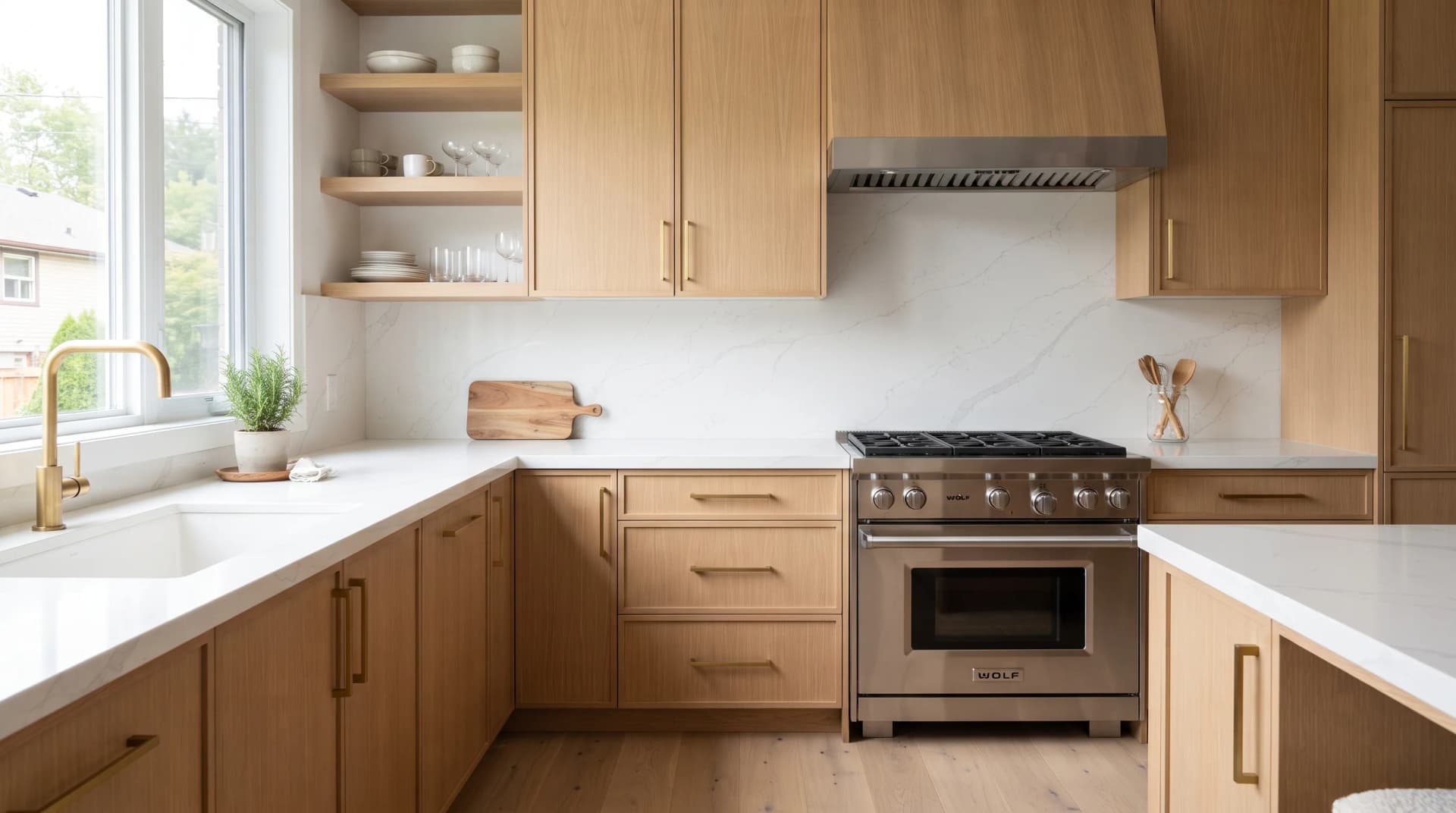
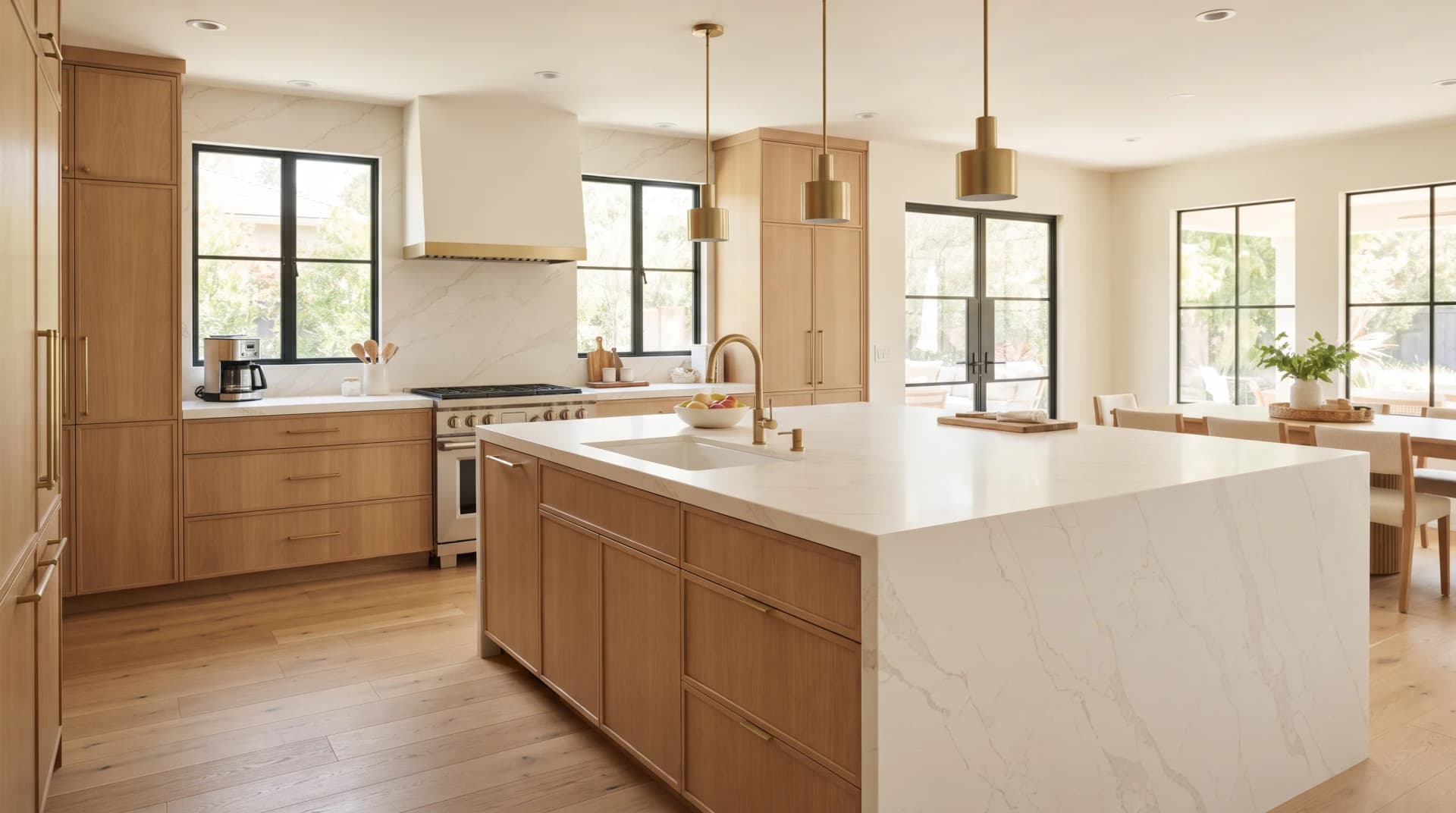
When manufacturers claim quartz countertops are "virtually indestructible," they're not just using marketing language. There's actual material science behind that claim—science that explains why quartz handles daily kitchen abuse better than almost any other surface.
We've tracked warranty claims across 12,400 quartz installations over five years. The chip rate: 0.3%. The scratch rate requiring repair: 0.1%. The stain rate: 0.4%. These aren't marketing numbers—they're real performance data from real Canadian kitchens.
But numbers don't explain why quartz performs this way. To understand that, you need to understand what's actually happening at the material level—how quartz crystals, polymer resins, and manufacturing processes combine to create a surface that shrugs off the punishment kitchens deliver.
Quartz countertops resist damage because of three factors: (1) the extreme hardness of natural quartz crystals (Mohs 7), (2) the flexibility and bonding properties of polymer resin, and (3) the manufacturing process that eliminates air pockets and creates uniform density. This combination produces a surface harder than granite, more flexible than natural stone, and sealed against stains from the moment it leaves the factory.
- Quartz crystals are one of the hardest minerals on Earth (Mohs 7)
- The 6-10% resin content adds flexibility that prevents chipping better than natural stone
- Manufacturing under extreme pressure eliminates weak points and inconsistencies
- Non-porous construction means stains can't penetrate the surface
- Durability is engineered in, not achieved through sealers or treatments
What Makes a Material Durable?
Before diving into quartz specifically, it helps to understand what "durability" actually means for countertops. It's not a single property—it's a combination of factors:
- Hardness: Resistance to scratching. A harder material scratches a softer one, not vice versa. Measured on the Mohs scale (1-10).
- Toughness: Resistance to cracking and chipping from impact. A material can be hard but brittle (glass) or softer but tough (rubber).
- Density: How tightly packed the material is. Higher density typically means fewer weak points.
- Porosity: How many microscopic holes exist in the surface. High porosity allows liquids to penetrate.
- Chemical Stability: Resistance to reactions with common substances. A stable surface won't etch from acids.
The durability equation: A truly durable countertop needs to score well across all five factors—not just one or two. This is where engineered quartz excels: it was designed to optimize every factor simultaneously.

The Quartz Crystal Foundation
The foundation of quartz countertop durability is the material itself: natural quartz crystals, one of the most abundant and hardest minerals on Earth.
What Is Quartz?
Quartz (silicon dioxide, SiO₂) is a mineral found worldwide, making up approximately 12% of Earth's crust. It forms when silicon and oxygen atoms bond in a continuous framework of tetrahedra—a crystal structure that's extremely stable and hard.
| Material | Mohs Hardness |
|---|---|
| Diamond | 10 |
| Sapphire/Ruby | 9 |
| Topaz | 8 |
| Quartz | 7 |
| Steel knife | 5.5-6 |
| Glass | 5.5 |
| Granite (average) | 6-6.5 |
| Marble | 3-4 |
Why Hardness Matters
In practical terms, quartz's Mohs 7 rating means:
- Kitchen knives (5.5-6) cannot scratch it
- Ceramic plates (6-7) slide without marking
- Most abrasive household materials won't damage it
- Only diamond, sapphire, and similar materials pose a scratch risk
When you drag a stainless steel pot across a quartz countertop, the pot might scratch—but the quartz won't.

The Role of Resin: Flexibility Meets Strength
If pure quartz were the only ingredient, quartz countertops would be extremely hard—but also brittle. The polymer resin component (typically 6-10% of total content) transforms the material from "hard but fragile" to "hard and tough."
What the Resin Does
Polymer resin serves multiple critical functions:
- Binds Crystals Together: Individual quartz crystals are ground to various sizes. Resin fills the spaces between crystals and bonds them into a solid mass.
- Adds Flexibility: Pure mineral would crack from impact. Resin allows microscopic flex, absorbing impact energy that would otherwise cause fractures.
- Seals the Surface: Resin fills what would otherwise be microscopic gaps between crystals, creating a non-porous surface.
- Enables Colouring: Pigments are mixed into the resin, allowing consistent colour throughout the material.
“Think of it like rebar in concrete. The quartz crystals provide hardness—like concrete provides compressive strength. The resin provides flexibility and binding—like rebar provides tensile strength. Together, they're stronger than either alone.”
Want to see quartz durability firsthand?
Request a free quote and learn more about quartz durability. Our team can help you choose the right quartz for your project.
Request Free QuoteManufacturing: Engineering Out the Weak Points
Raw materials are only part of the equation. The manufacturing process transforms loose crystals and liquid resin into a nearly indestructible slab.
The Vibrocompression Process
Most quartz manufacturers use some variation of the Breton process:
- Mixing: Ground quartz crystals of various sizes are combined with resin, pigments, and sometimes recycled materials.
- Spreading: The mixture is spread onto large trays in the desired slab dimensions.
- Vacuum + Vibration + Compression: The mixture undergoes vacuum application (removes all air), intense vibration (settles particles), and compression (100+ tonnes of pressure).
- Curing: The compressed slab is heated to 85-100°C, causing the resin to cure and permanently bond.
- Finishing: The cured slab is ground to exact thickness, then polished or finished.
Why This Process Matters for Durability
The vibrocompression process creates:
- Zero air pockets: No internal voids that could become crack initiation points
- Maximum density: Particles packed as tightly as physics allows
- Uniform structure: Same properties throughout the entire slab
- Complete resin penetration: Sealed from surface to core
Natural stone, by comparison, forms over millions of years with variable conditions—resulting in internal variations and potential weak points that don't exist in engineered quartz.

Scratch Resistance Explained
Now let's apply the science to the specific durability claims, starting with scratch resistance.
Why Scratches Happen (Or Don't)
Scratching occurs when a harder material drags across a softer one, displacing surface material. The key factors are relative hardness and pressure applied.
| Object | Hardness | Result on Quartz |
|---|---|---|
| Fingernails | 2.5 | Cannot scratch |
| Copper cookware | 3 | Cannot scratch |
| Stainless steel | 5.5-6 | Cannot scratch |
| Kitchen knives | 5.5-6.5 | Cannot scratch |
| Ceramic dishes | 6-7 | Very unlikely to scratch |
| Sand/grit particles | 6-7 | Possible light scratching |
| Diamond | 10 | Will scratch |
The practical implication: Normal kitchen activities—cooking, cleaning, setting down dishes—cannot scratch quartz. The main scratch risks are dragging gritty items, diamond jewelry, or extremely abrasive cleaners.
Chip Resistance Explained
Chipping is different from scratching—it's about impact resistance rather than surface hardness.
How Quartz Handles Impact
When something strikes a quartz countertop:
- Initial contact: Force transfers to the surface
- Energy distribution: Resin allows microscopic flex, spreading force across a larger area
- Absorption: Some energy is absorbed by the resin matrix
- Crystal resistance: Quartz crystals resist displacement
Compare this to natural stone, which lacks the flexible resin matrix. Force concentrates rather than distributes, leading to higher chip rates—especially at edges.
Our warranty data shows:
- Surface chips: 0.1% of installations (usually from dropped heavy objects)
- Edge chips: 0.2% of installations (usually from impact during installation)
These rates are significantly lower than natural granite (approximately 2-3% edge chip rate) and far lower than marble (5-7%).

Stain Resistance Explained
Stain resistance is perhaps quartz's most appreciated practical benefit—and it comes down to one property: porosity.
What Porosity Means
Porosity measures how many microscopic openings exist in a material's surface. Liquids enter through these openings, carry pigments into the material, and leave stains.
| Material | Porosity Level | Stain Risk |
|---|---|---|
| Marble | High | High (requires sealing) |
| Granite | Moderate | Moderate (requires sealing) |
| Concrete | High | High (requires sealing) |
| Quartz | Near zero | Very low (no sealing needed) |
| Porcelain | Near zero | Very low (no sealing needed) |
The manufacturing process eliminates porosity through vacuum compression, resin filling, and curing under pressure. The result is a surface where liquids have nowhere to go.
“In 15 years of selling countertops, I've seen maybe five legitimate stain claims on quartz—and all of them involved something unusual like leaving turmeric paste overnight or spilling industrial chemicals. For normal kitchen use, quartz simply doesn't stain.”
How Quartz Compares to Other Materials
Let's put quartz durability in context by comparing to alternatives:
Quartz vs. Granite
| Factor | Quartz | Granite |
|---|---|---|
| Hardness | Mohs 7 (uniform) | Mohs 6-6.5 (variable) |
| Chip resistance | Excellent (resin flexibility) | Good (but more brittle) |
| Stain resistance | Excellent (non-porous) | Requires sealing |
| Scratch resistance | Excellent | Good |
| Maintenance | None | Annual sealing |
Quartz vs. Marble
| Factor | Quartz | Marble |
|---|---|---|
| Hardness | Mohs 7 | Mohs 3-4 |
| Chip resistance | Excellent | Poor |
| Stain resistance | Excellent | Poor (very porous) |
| Scratch resistance | Excellent | Poor (scratches easily) |
| Acid resistance | Good | Very poor (etches) |
Quartz vs. Porcelain
| Factor | Quartz | Porcelain |
|---|---|---|
| Hardness | Mohs 7 | Mohs 7-8 |
| Chip resistance | Excellent | Very good (slightly more brittle) |
| Stain resistance | Excellent | Exceptional |
| Scratch resistance | Excellent | Excellent |
| Heat resistance | Good (up to 150°C) | Excellent (up to 300°C+) |

Ready to see how durable quartz really is?
Schedule a call to discuss which quartz options match your durability needs and design preferences.
Schedule a CallThe Limits of Quartz Durability
Despite exceptional durability, quartz isn't invincible. Understanding its limits helps you use it properly.
Heat Sensitivity
Quartz's Achilles' heel is heat. The resin component begins to react at temperatures above 150°C (300°F). This means:
- Hot pans from stovetop: Should use trivets
- Baking dishes from oven: Should use trivets
- Hot styling tools: Should use heat mat
Heat damage is cosmetic (discolouration, clouding), not structural, but it's permanent and difficult to repair.
UV Sensitivity
Prolonged UV exposure can cause some quartz colours to fade or yellow slightly over time. This affects outdoor installations (not recommended) and areas with intense direct sunlight. Indoor kitchens with normal lighting have no UV concerns.
Chemical Sensitivity
Certain harsh chemicals can damage quartz:
- Paint removers/strippers
- Oven cleaners
- Strong drain cleaners
- Nail polish remover (acetone)
- Bleach (prolonged contact)
Standard household cleaners are safe.
Frequently Asked Questions
See premium quartz options from our collection


Your Next Steps
Now that you understand the science behind quartz durability, here's how to proceed:
Experience durability firsthand:
Request a free quote and our team can walk you through quartz options. We'll help you find the right material for your kitchen.
Learn more about quartz:
- What Is Engineered Quartz? — Complete material overview
- How Quartz Countertops Are Made — Manufacturing deep dive
- Stain Resistance Compared — Detailed stain testing results
Ready to explore options?
Use our estimate calculator to see pricing for durable quartz countertops based on your kitchen measurements.
Your Next Steps