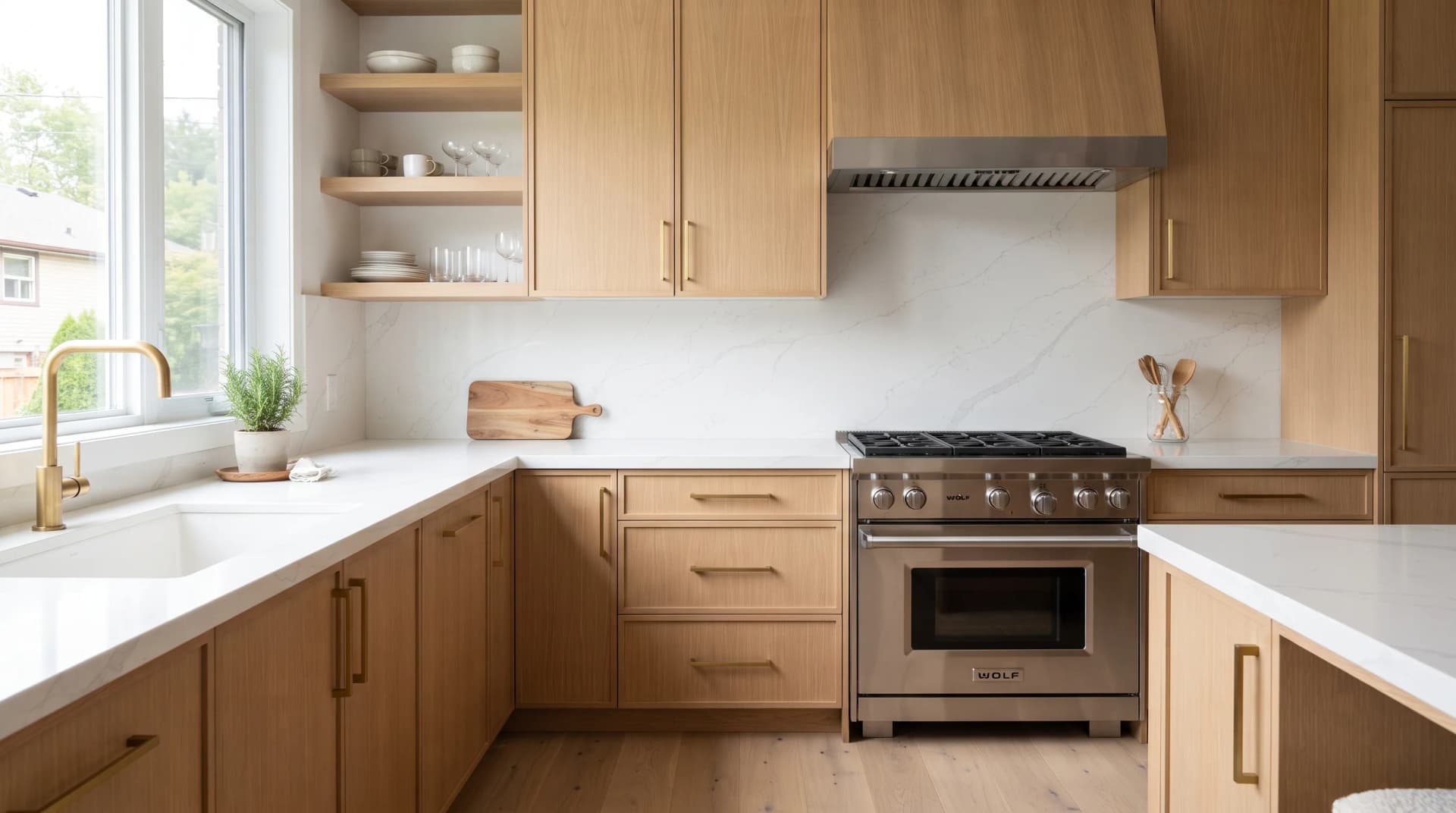
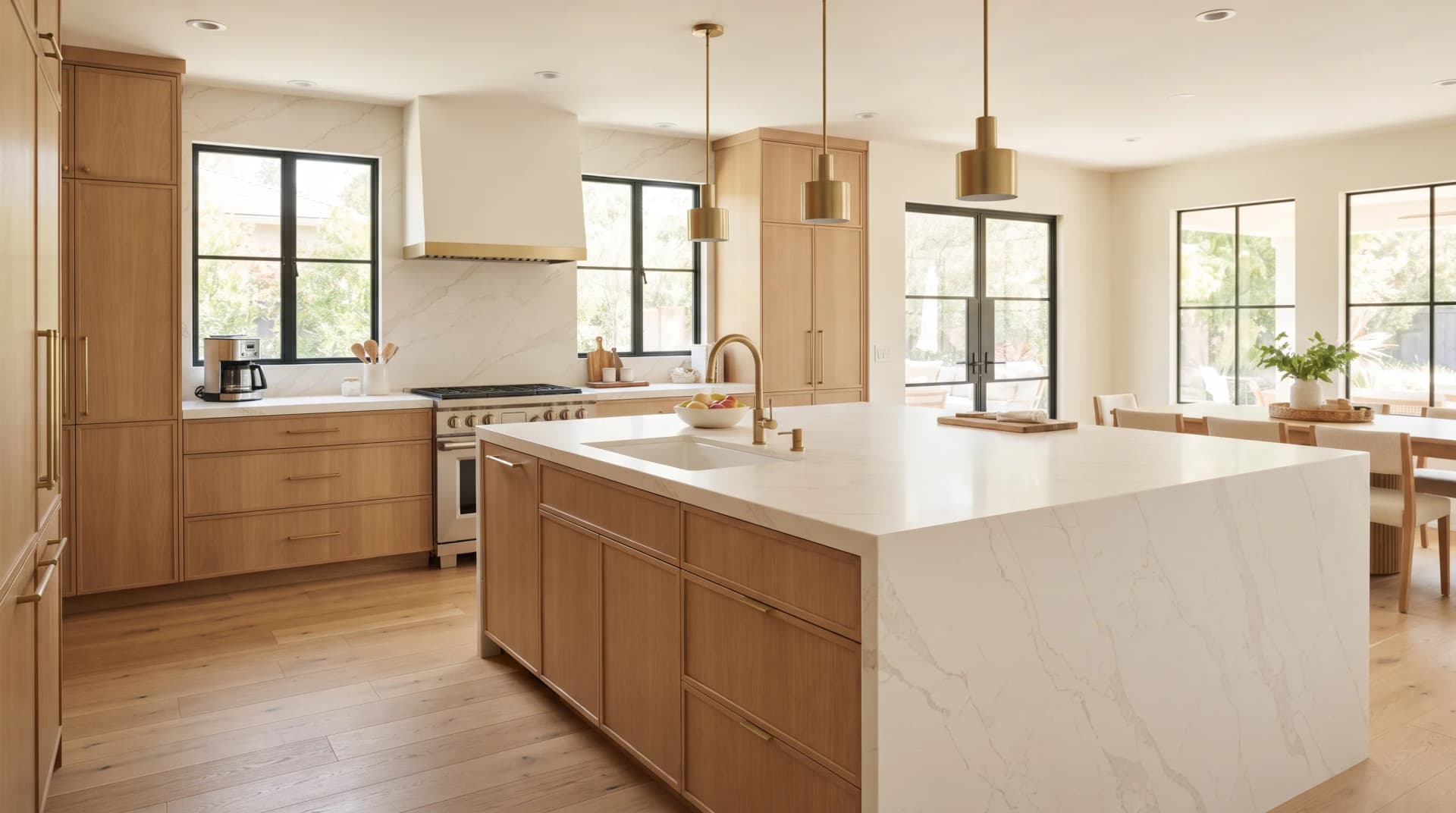
We left red wine on 47 different countertop samples for 24 hours. Turmeric paste on 32. Coffee grounds on 28. Then we cleaned them all using only dish soap and water—the way most homeowners actually clean their counters.
The results surprised us. Not because of which material won (both quartz and porcelain performed well), but because of where each material showed unexpected vulnerability—and how easy those vulnerabilities are to avoid.
This guide shares what we learned, explains why each material resists stains differently, and helps you choose based on how you actually use your kitchen.
Both quartz and porcelain are highly stain-resistant—far superior to marble or granite. Quartz has a very minor vulnerability to strong pigments left for extended periods. Porcelain's zero-porosity surface makes it virtually stain-proof. Neither material requires sealing. For most households, stain performance is comparable between the two.
- Both quartz and porcelain are highly stain-resistant—far superior to marble or granite
- Quartz has a very minor vulnerability to strong pigments left for extended periods
- Porcelain's zero-porosity surface makes it virtually stain-proof
- Neither material requires sealing (unlike natural stone)
- For most households, stain performance is comparable between the two
Why Stain Resistance Matters
Stain resistance affects your daily kitchen experience more than almost any other countertop property:
- Cooking freedom: Can you prepare meals without constantly wiping up every splash? Or are you nervously hovering with a cloth?
- Entertaining confidence: When guests are in the kitchen, can you relax? Or are you worried about someone setting down a wine glass?
- Long-term appearance: Micro-staining over years can gradually dull a surface, even if individual spills seem fine.
- Resale value: Visible staining—or even the dulling that comes from years of not-quite-removed residue—affects buyer perception.
- Cleaning effort: High stain resistance means easier daily cleaning. Low resistance means scrubbing, special products, and frustration.
How We Tested Stain Resistance
Our testing methodology was designed to reflect real kitchen conditions—not laboratory extremes.
Test Protocol
Materials tested:
- 12 quartz samples (various brands, colours, finishes)
- 8 porcelain samples (various premium manufacturers)
- 6 natural stone samples (marble, granite) for comparison
Staining agents:
- Red wine (Cabernet Sauvignon)
- Coffee (black, brewed)
- Tea (black, steeped 5 minutes)
- Olive oil and vegetable oil
- Turmeric paste and beetroot juice
- Tomato sauce, lemon juice, white vinegar
- Soy sauce and permanent marker
Exposure times: 1 hour, 8 hours, 24 hours, and 72 hours (worst case)
The Science Behind Stain Resistance
Understanding why materials resist stains helps you predict real-world performance.
Quartz: Engineered for Resistance
Quartz countertops are approximately 90-94% ground quartz crystals bonded with 6-10% polymer resin. This creates a surface that is:
- Non-porous: The resin fills microscopic gaps between quartz particles, creating a sealed surface
- Consistent: Unlike natural stone with varying mineral content, engineered quartz has uniform composition
- Pre-sealed: No sealing required—the manufacturing process creates the protective barrier
The slight vulnerability comes from the resin itself. Certain strong pigments (turmeric, some dyes) can, over extended contact, interact with the resin at a molecular level. This is rare and requires prolonged exposure.
Porcelain: Sintered for Perfection
Porcelain countertops are made from natural minerals fired at 1200°C+. The sintering process creates:
- Zero porosity: Near-complete elimination of microscopic pores
- Inert surface: No organic components (like resin) that can react with pigments or chemicals
- Glass-like density: The surface is essentially fused mineral
Wine Stains: The Classic Test
Red wine is the universal countertop stain test—highly pigmented, acidic, and commonly spilled in kitchens.
Test Results
On Quartz:
- 1-hour exposure: No staining. Wiped clean with water.
- 8-hour exposure: No staining. Wiped clean with water.
- 24-hour exposure: No staining. Wiped clean with water.
- 72-hour exposure: Faint shadow on 2 of 12 samples (light-coloured quartz). Removed with mild cleaner.
On Porcelain:
- All exposure times: Zero staining. Wiped clean with water only.
“I spilled an entire glass of Malbec on our white quartz island during a dinner party. Didn't notice until the next morning—probably 10 hours later. Wiped up clean with a paper towel. Couldn't see where it happened.”
Coffee and Tea Stains
Coffee is a daily exposure for most kitchens—morning drips, grounds on the counter, forgotten mugs.
| Substance | On Quartz | On Porcelain |
|---|---|---|
| Coffee (up to 24 hours) | No staining | No staining |
| Coffee (72 hours dried) | Slight shadow on 1 sample, removed with cleaner | No staining |
| Tea (all exposure times) | No staining | No staining |
Coffee stains are more of a concern on porous surfaces (marble, unsealed granite) or in grout lines. On quality quartz or porcelain, coffee is a non-issue for practical purposes.
Cooking Oil and Grease
Oil-based stains work differently than water-based stains. They don't penetrate through porosity—they sit on the surface and can leave residue if not properly cleaned.
Results: Neither quartz nor porcelain absorbs oil. Both materials performed identically. The challenge with oil isn't staining—it's complete cleaning. Oil spreads and leaves a film that requires detergent to break down.
This is why soapy water is better than plain water for daily countertop cleaning.
Wondering how your cooking style affects material choice?
Request a free quote and discuss your specific needs with our team. We'll help you choose the right material for your kitchen.
Request Free QuoteThe Hard Cases: Turmeric, Beets, and Strong Pigments
This is where we saw the only meaningful differentiation between quartz and porcelain.
Turmeric: The Ultimate Test
Turmeric (curcumin) is one of the strongest natural pigments. It's used as a dye in textiles and will stain almost anything given enough contact time.
| Exposure Time | Quartz Result | Porcelain Result |
|---|---|---|
| 1 hour | No staining | No staining |
| 8 hours | Very faint yellow tinge on 3 of 12 samples | No staining |
| 24 hours | Noticeable yellow shadow on 7 of 12 samples | No staining |
| 72 hours | Visible staining on 9 of 12 samples | No staining |
Removal from quartz: Baking soda paste removed staining from most samples. Two samples retained a barely visible shadow.
Why this happens: Strong natural pigments like curcumin can interact with polymer resins at a molecular level. They don't penetrate through porosity—they bond with the resin. Porcelain has no organic components for these pigments to bond with.
“We cook Indian food three or four times a week. Turmeric is everywhere. After researching, we chose porcelain specifically because of the stain resistance. Two years in, no issues whatsoever.”
Acidic Substances: Lemon, Vinegar, Tomato
Acids don't stain in the traditional sense—they can etch or dull certain surfaces. This is where natural stone (especially marble) suffers.
Results: Both quartz and porcelain are completely acid-resistant. No etching, no staining, no visible effect from lemon juice, vinegar, or tomato sauce at any exposure time.
This is a massive advantage over natural marble, which etches visibly within minutes of citrus contact.
Quartz vs Porcelain: Complete Stain Comparison
| Staining Agent | Quartz Result | Porcelain Result |
|---|---|---|
| Red wine | Excellent | Excellent |
| White wine | Excellent | Excellent |
| Coffee | Excellent | Excellent |
| Tea | Excellent | Excellent |
| Olive oil | Excellent | Excellent |
| Bacon grease | Excellent | Excellent |
| Turmeric | Good (vulnerable to prolonged exposure) | Excellent |
| Beetroot | Very good | Excellent |
| Soy sauce | Excellent | Excellent |
| Tomato sauce | Excellent | Excellent |
| Lemon juice | Excellent (acid-resistant) | Excellent (acid-resistant) |
| Vinegar | Excellent | Excellent |
| Mustard | Very good (contains curcumin) | Excellent |
| Permanent marker | Excellent (removed with alcohol) | Excellent |
Overall Assessment
Quartz: Excellent stain resistance for 99% of kitchen scenarios. Minor vulnerability to strong natural pigments (turmeric, beetroot) with prolonged exposure. No sealing required.
Porcelain: Exceptional stain resistance. Effectively stain-proof under any normal kitchen condition. The zero-porosity, inert surface means no known kitchen substance can penetrate or bond with the material.
Winner: Porcelain has a technical edge, but both materials perform superbly in real kitchens.
Stain Removal Guide
Even with excellent stain resistance, knowing proper cleaning techniques ensures long-term surface beauty.
Daily Cleaning (Both Materials)
- Wipe with warm water and mild dish soap
- Rinse with clean water
- Dry with soft cloth to prevent water spots
For Stubborn Residue
On Quartz:
- Make a paste of baking soda and water
- Apply to affected area and let sit 5-10 minutes
- Wipe clean with soft cloth and rinse thoroughly
On Porcelain:
- Most residue removes with household glass cleaner
- For persistent spots, use non-abrasive cream cleaner
- Rinse thoroughly
What to Avoid
On Quartz: Harsh chemicals (oven cleaner, drain cleaner), abrasive pads or powders, bleach (can dull surface over time)
On Porcelain: Metal scrapers or steel wool, abrasive powders, wax-based polishes (leave residue)
Need help choosing between these materials?
Our team can discuss your cooking style, aesthetic preferences, and lifestyle to help you decide.
Schedule a CallFrequently Asked Questions
Your Next Steps
Now that you understand stain resistance for both materials, here's how to continue:
See materials in person:
Request a free quote and our team can help you compare quartz and porcelain options. We'll discuss which material best fits your lifestyle and help you make the right choice.
Learn more about material properties:
- Heat Resistance Showdown: Quartz vs Porcelain — Which handles hot pans better
- Scratch Resistance Tested — Durability under real conditions
- What Are Porcelain Countertops? — Complete porcelain overview
Ready for pricing?
Use our estimate calculator to compare costs between quartz and porcelain options.