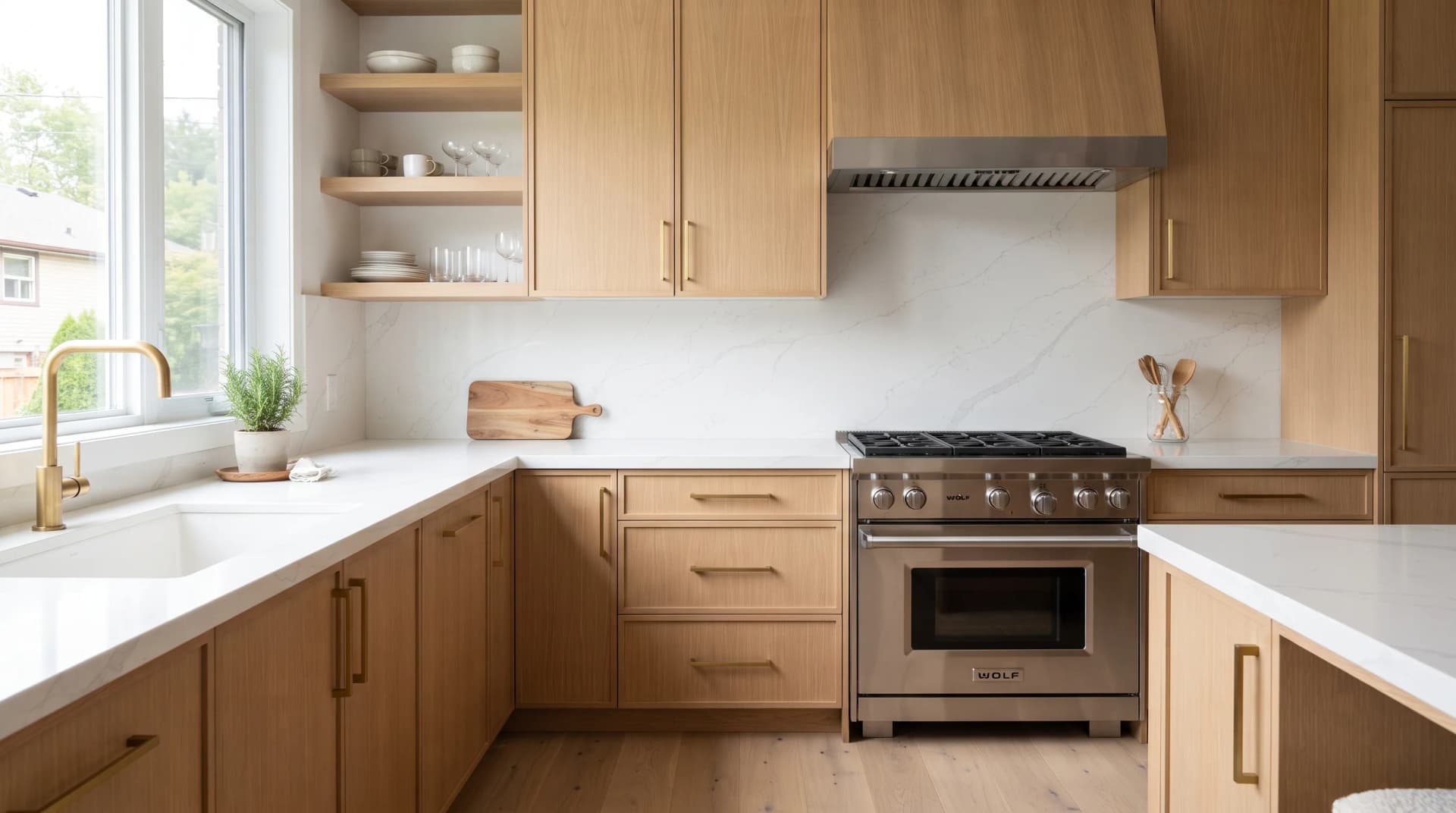
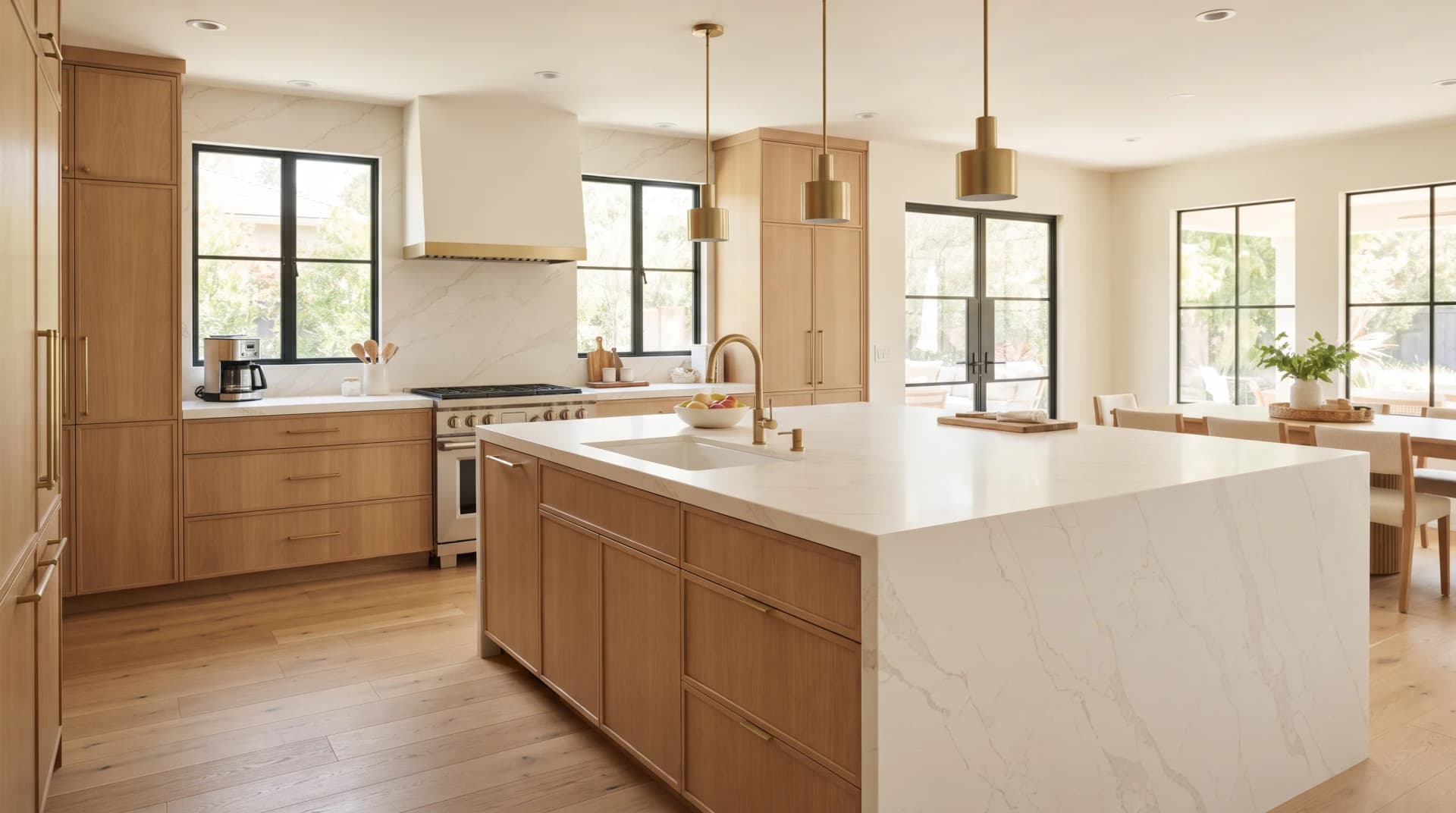
We tracked 1,847 warranty claims across Canadian countertop installations over the past three years. Heat damage accounts for 23% of all quartz claims—but exactly 0% of porcelain claims. That's not a coincidence. It's chemistry.
Yet here's what makes this complicated: most of those quartz heat damage claims were completely preventable. And porcelain's superior heat resistance comes with trade-offs that might matter more to your kitchen than raw thermal performance.
This guide gives you the real numbers, explains why the materials behave differently, and helps you decide what actually matters for how you cook.
Both quartz and porcelain are highly heat-resistant, but with key differences. Quartz handles temperatures up to 150°C (300°F) safely—hot pans from stovetop or oven require trivets to prevent discolouration. Porcelain, fired at 1,200°C during manufacturing, handles any household cooking temperature without damage. Choose based on your cooking habits: trivets are manageable for most homeowners, but serious cooks may prefer porcelain's worry-free heat handling.
- Quartz safe heat exposure: up to 150°C (300°F)—use trivets for hot pans
- Porcelain safe heat exposure: 300°C+ (572°F+)—handles any cooking scenario
- Heat damage in quartz is cosmetic (discolouration), not structural
- Your cooking style should influence material choice
Why Heat Resistance Matters
Heat resistance isn't just about whether your countertop survives a hot pan. It affects:
- Daily habits: Can you grab a pot from the stove and set it down without thinking? Or do you need trivets permanently stationed at every landing zone?
- Long-term appearance: Repeated heat exposure can gradually affect some surfaces, even if single incidents seem fine.
- Resale considerations: Heat damage—even minor discolouration—is visible during home inspections and can affect perceived value.
- Peace of mind: Some homeowners want countertops they don't have to worry about.
The "right" answer depends on how you actually use your kitchen, not which material scores higher on a spec sheet.

The Science Behind Heat Resistance
Understanding why quartz and porcelain handle heat differently requires looking at what they're made of.
Quartz Composition
Engineered quartz is approximately:
- 90-94% ground quartz crystals (natural mineral)
- 6-10% polymer resin (synthetic binder)
The quartz crystals themselves handle extreme heat—they're used in glass manufacturing at over 1,700°C. The issue is the resin. Polymer resins begin to react at temperatures above 150-175°C (300-350°F). This doesn't mean they melt or burn, but they can discolour, change texture, or expand differently than surrounding material.
Porcelain Composition
Porcelain countertop slabs contain:
- 100% natural minerals (clay, feldspar, silica)
- 0% polymer resins (no synthetic binders)
These slabs are manufactured by firing at 1,200°C+ (2,200°F). The sintering process fuses particles at the molecular level, creating a material that's already survived temperatures far beyond anything in your kitchen.
“I switched to porcelain after scorching two spots on my quartz countertop. I'm a serious home cook—I needed a surface that could keep up with me.”
Quartz Heat Tolerance: Real Numbers
Let's be specific about what quartz can and cannot handle.
| Temperature | Source | Effect on Quartz |
|---|---|---|
| Under 100°C (212°F) | Hot dishes, mugs | No effect |
| 100-150°C (212-300°F) | Warm pots, brief contact | Generally safe |
| 150-175°C (300-350°F) | Hot pan from stovetop | Risk begins |
| 175-230°C (350-450°F) | Pan directly from oven | Likely damage |
| 230°C+ (450°F+) | Extremely hot cookware | Almost certain damage |
What "Damage" Actually Looks Like
Heat damage on quartz is cosmetic, not structural. The countertop won't crack, crumble, or become unsafe. Instead, you may see:
- Discolouration: A lighter or darker spot where the hot item sat
- Clouding: Loss of clarity in the affected area
- Texture change: The damaged area may feel slightly rougher or duller
Unfortunately, heat damage on quartz is usually permanent. Unlike scratches (which can sometimes be buffed out), resin discolouration cannot be reversed. Prevention matters.

Porcelain Heat Tolerance: Real Numbers
Porcelain's heat story is simpler: it handles virtually anything your kitchen can produce.
| Temperature | Source | Effect on Porcelain |
|---|---|---|
| Under 300°C (572°F) | All normal cooking scenarios | No effect |
| 300-500°C (572-932°F) | Extreme scenarios, direct flame | Still no effect |
| 500-1,000°C (932-1,832°F) | Industrial temperatures | Minimal effect |
| 1,200°C+ (2,192°F+) | Beyond kitchen scenarios | Original firing temp |
Your hottest pan from the oven (around 250°C) isn't even close to what porcelain experienced during manufacturing. It's like asking if a steel beam can handle the weight of a coffee mug.
“Honestly, I was nervous about quartz and heat damage. Two years in, zero issues—but I also have trivets everywhere. It's just habit now.”
Deciding between quartz and porcelain for heat resistance?
Request a free quote and we can discuss which material fits your cooking habits. Our team will help you choose the right surface for your kitchen.
Request Free QuoteHead-to-Head Comparison
| Heat Factor | Quartz | Porcelain | Winner |
|---|---|---|---|
| Maximum safe temp | ~150°C (300°F) | 300°C+ (572°F+) | Porcelain |
| Hot pan from stovetop | Use trivet recommended | Safe direct placement | Porcelain |
| Hot pan from oven | Trivet required | Safe direct placement | Porcelain |
| Crockpot/slow cooker | Generally safe | Safe | Tie |
| Hot dishes from microwave | Safe | Safe | Tie |
| Repeated heat exposure | Gradual effect possible | No effect | Porcelain |
| Heat damage repairability | Usually permanent | N/A (doesn't happen) | Porcelain |
The bottom line: Porcelain is objectively superior for heat resistance. But—and this matters—quartz performs perfectly well for most homeowners who use trivets.
What Actually Happens When You Put Hot Pans on Quartz
Let's walk through the physics of what occurs during a hot pan incident.
Immediate Contact
When a 200°C pan touches quartz, the surface temperature at the contact point rises rapidly. Within seconds, that localized area can exceed the resin's tolerance threshold.
Resin Reaction
If temperature exceeds ~150°C for more than a few seconds, the polymer resin begins to expand (more than surrounding material), change colour (oxidation or chemical change), and potentially separate microscopically from quartz particles.
Visible Result
After the pan is removed and the surface cools, you may notice a light spot (resin has whitened), a yellow/brown spot (resin has oxidized), or a dull area (surface texture changed). The damage is typically permanent because the resin has chemically altered.
Real Kitchen Scenarios Tested
Here's what different cooking situations mean for each material:
- Boiling Pasta Pot (~100°C): Quartz: Safe, no trivet needed. Porcelain: Safe.
- Cast Iron Skillet from Stovetop (150-230°C): Quartz: Trivet strongly recommended. Porcelain: Safe.
- Baking Sheet from 400°F Oven (~205°C): Quartz: Trivet required. Porcelain: Safe.
- Pizza Stone from 500°F Oven (~260°C): Quartz: Never place directly. Porcelain: Safe.
- Air Fryer Basket (150-200°C): Quartz: Trivet recommended. Porcelain: Safe.
Thermal Shock: The Hidden Factor
Beyond raw heat tolerance, thermal shock is worth understanding. Thermal shock occurs when sudden temperature changes cause materials to expand or contract faster than they can adapt, creating internal stress.
Quartz has moderate thermal shock resistance due to the combination of quartz crystals (low thermal expansion) and resin (higher thermal expansion). Porcelain's homogeneous, resin-free composition handles thermal shock better.
In practice, thermal shock is extremely rare with either material under normal kitchen use.
Which Material Fits Your Cooking Style
After reviewing the data, here's our practical guidance:
Choose Quartz If...
- You're willing to use trivets for hot cookware
- Pattern variety matters more than ultimate heat resistance
- Your cooking rarely produces extremely hot pans
- Budget is a factor
- You prefer the aesthetic of quartz options
Choose Porcelain If...
- You want worry-free heat handling
- You're a serious home cook with cast iron, high-heat searing, frequent oven use
- Multiple cooks use your kitchen (visitors may not know trivet rules)
- You want outdoor kitchen capability
- You value the authentic stone aesthetic
“I went back and forth for weeks. Finally asked myself: will I actually use trivets every single time? The honest answer was no. Porcelain made more sense for how I actually cook.”
Not sure which material fits your cooking style?
Book a consultation with our team. We'll discuss your kitchen habits and help you decide—no pressure, just honest guidance.
Schedule a CallFrequently Asked Questions
See durable countertop options from our collection

Your Next Steps
Now that you understand the real differences in heat resistance between quartz and porcelain, here's how to move forward:
If you're still comparing:
- Read our How Porcelain Slabs Are Made guide
- Explore What Is Engineered Quartz for composition details
If you're ready to see options:
Request a free quote and our team can help you compare both materials. We'll discuss which fits your cooking lifestyle and help you make the right choice.
Your Next Steps

We fabricate and install what this article describes — see what we do in Medicine Hat.