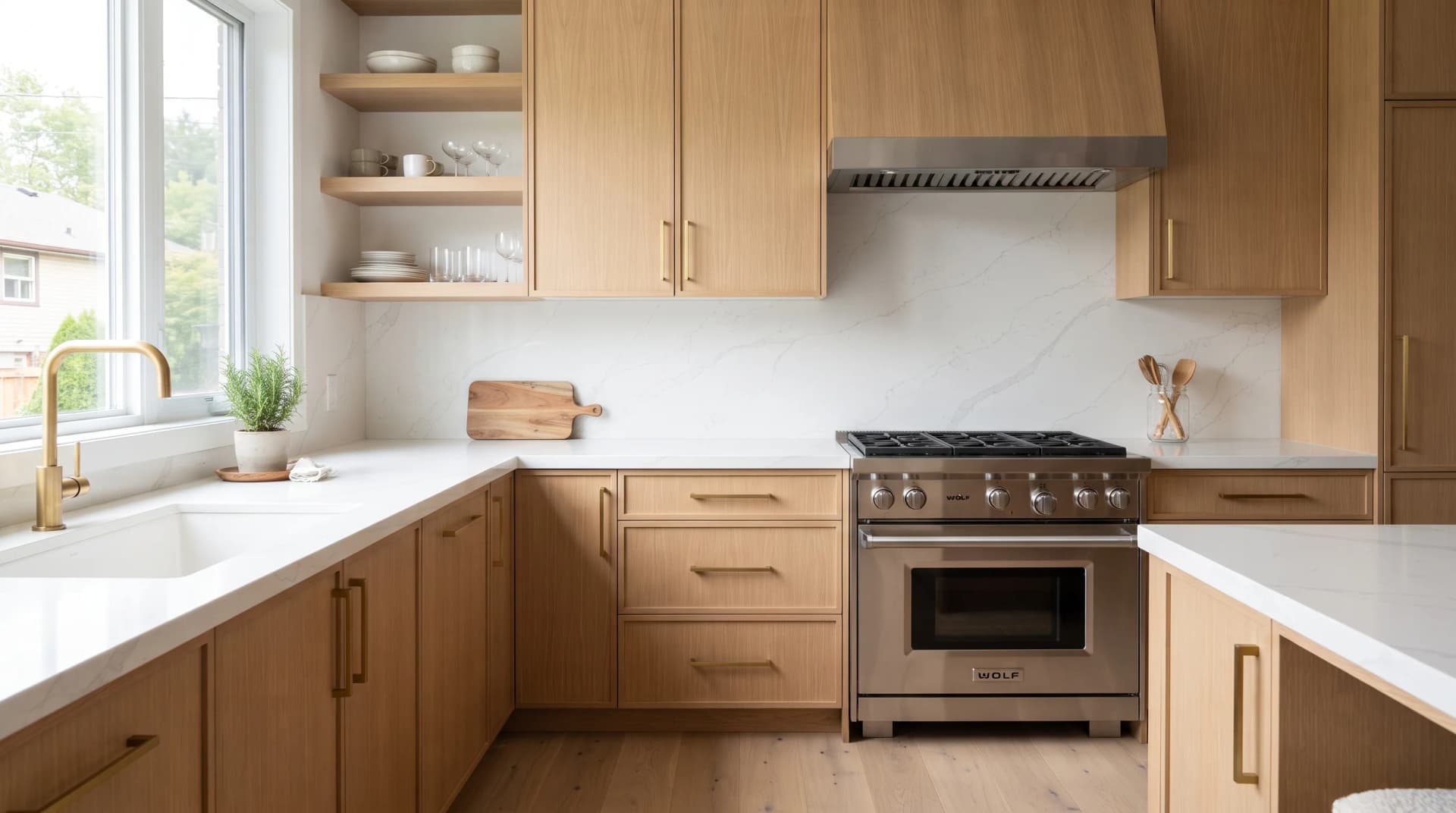
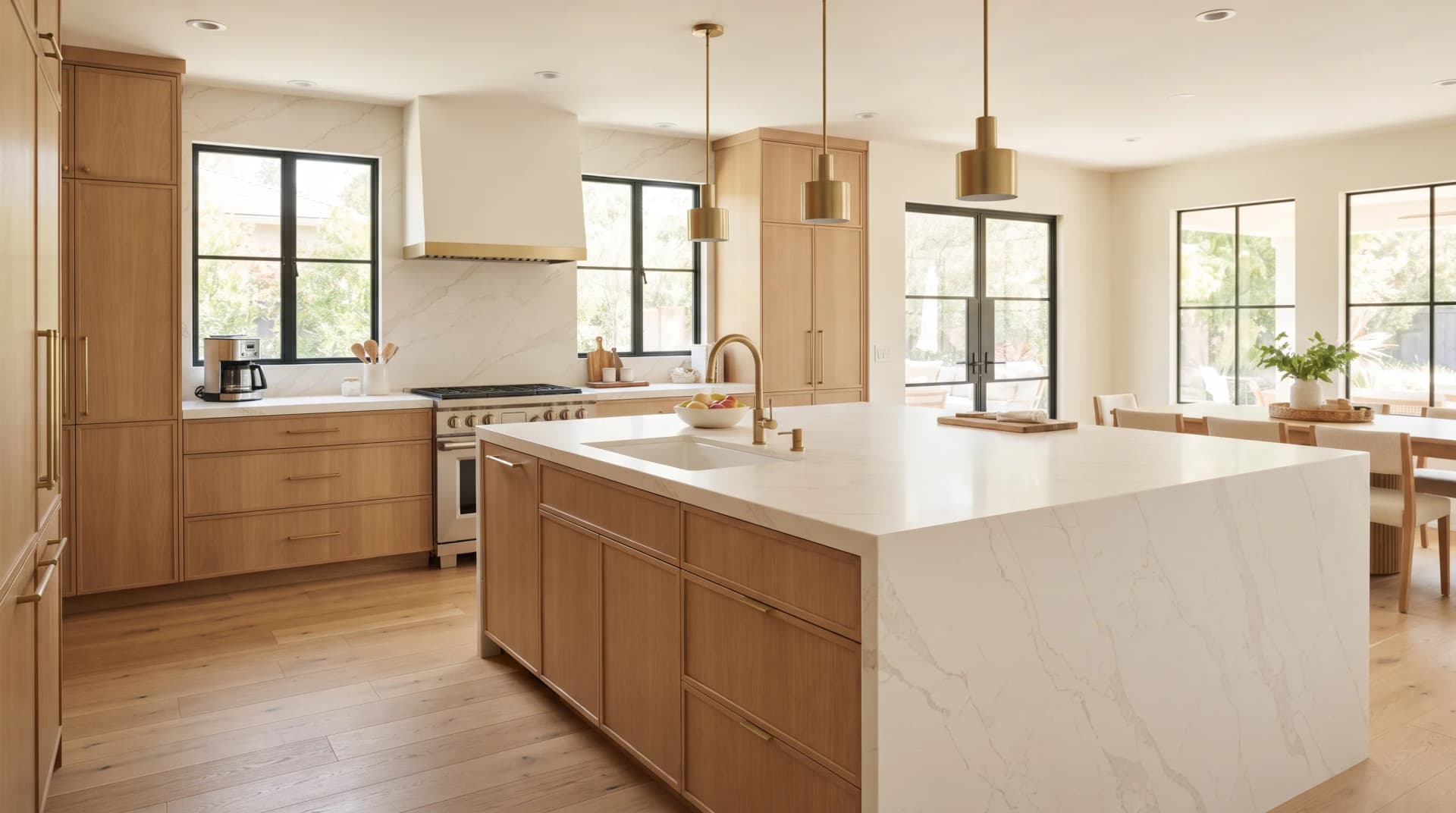
Walk into any Canadian kitchen showroom and you'll hear the same question within five minutes: granite or quartz? For two decades granite was the default premium countertop. Today quartz outsells it in most new kitchen installs—and the reasons have very little to do with looks.
Both are excellent, durable surfaces. But they behave very differently once they're living in your kitchen, soaking up coffee rings, hot pans, and a decade of daily use. The right choice comes down to how you actually live—not which one sounds fancier.
This guide compares granite vs quartz countertops honestly: where each one wins, where each one compromises, and why quartz is the better fit for most Canadian homes.
Granite is 100% natural quarried stone—porous, requires sealing every 1-2 years, and offers excellent heat resistance with one-of-a-kind slabs. Quartz is an engineered surface (about 90% ground quartz + resin)—non-porous, never needs sealing, more stain- and bacteria-resistant, with consistent patterns. For most Canadian kitchens, quartz is the lower-maintenance, more practical choice; granite's main edge is direct heat tolerance and natural authenticity.
- Quartz never needs sealing; granite needs resealing every 1-2 years
- Quartz is non-porous and more hygienic; granite is porous
- Granite handles direct heat better; quartz needs trivets
- Quartz has consistent patterns; granite is unique slab to slab
- Pricing overlaps ($55-150 vs $60-160/sq ft); quartz often costs less long-term
The Real Difference Between Granite and Quartz
The fundamental distinction is simple: granite is natural, quartz is engineered.
Granite is quarried from the earth as solid stone, cut into slabs, and polished. Every slab is a unique snapshot of geology. Quartz countertops are manufactured—ground natural quartz is combined with resin and pigment, then compressed into slabs with consistent, designed patterns.
That one difference—quarried versus engineered—drives nearly everything else: how each one is maintained, how it resists stains and bacteria, how consistent it looks, and how it's priced.

What Is Granite?
Granite is an igneous rock formed as molten material cooled and crystallized deep underground over millions of years. It's composed of natural minerals—mostly quartz, feldspar, and mica— which give each slab its distinctive flecking and movement.
Key Characteristics
| Property | Natural Granite |
|---|---|
| Origin | Quarried natural stone |
| Porosity | Porous (requires sealing) |
| Sealing Required | Every 1-2 years |
| Pattern Consistency | Every slab unique |
| Heat Resistance | Excellent |
| Scratch Resistance | Excellent (Mohs 6-7) |
| Outdoor Use | Suitable |
Granite's genuine strengths are real and worth stating plainly: outstanding heat tolerance, true natural authenticity, and a one-of-a-kind appearance no two kitchens will share. For some homeowners, that natural character is exactly the point.
Where granite genuinely shines
If you frequently set hot pans straight from the stove onto the counter, or you specifically want a natural, unrepeatable stone with full outdoor durability, granite has a real edge. We'd rather you know that up front than oversell you.
What Is Engineered Quartz?
Engineered quartz—what most people mean by "quartz countertops"—is a manufactured composite that combines the beauty of natural stone with modern performance.
Composition
- 90-94% ground natural quartz crystals (one of Earth's hardest minerals)
- 6-10% polymer resins (the binder that makes it non-porous)
- Pigments and additives (precise colour and pattern)
Because it's engineered, quartz is consistent slab to slab and—critically—non-porous. There are no microscopic pores for liquids or bacteria to penetrate, which is why quartz never needs sealing. Learn more in our guide to what engineered quartz is.
Key Characteristics
| Property | Engineered Quartz |
|---|---|
| Origin | Factory-manufactured |
| Porosity | Non-porous (<0.5%) |
| Sealing Required | Never |
| Pattern Consistency | Identical across slabs |
| Heat Resistance | Good (use trivets, ~150°C limit) |
| Scratch Resistance | Excellent (Mohs 7) |
| Outdoor Use | Not recommended |
“We almost went with granite out of habit. Then our installer asked how often we really wanted to reseal a counter. The answer was never. Two years in, the quartz still looks like the day it went in—and I've never thought about maintenance once.”
Granite vs. Quartz: Head-to-Head
| Factor | Granite | Engineered Quartz |
|---|---|---|
| Material Type | Natural stone | Manufactured composite |
| Composition | 100% natural stone | ~90% quartz + resin |
| Porosity | Porous | Non-porous |
| Sealing | Every 1-2 years | Never needed |
| Stain Resistance | Good (when sealed) | Excellent |
| Bacteria Resistance | Good (when sealed) | Excellent (NSF food safe) |
| Heat Resistance | Excellent | Good (use trivets) |
| Scratch Resistance | Excellent | Excellent |
| Pattern | Unique/natural | Consistent/designed |
| Price (CAD/sq ft installed) | $60-160 | $55-150 |
| Outdoor Use | Suitable | Not recommended |
| Slab Selection | Choose specific slab | Choose colour code |
The short version
Granite wins on heat and natural authenticity. Quartz wins on maintenance, stain resistance, hygiene, and consistency. For most kitchens, the things quartz wins are the things you deal with every single day.
Maintenance: Where Quartz Pulls Ahead
For most homeowners, maintenance is the deciding factor—and it's where the two diverge most.
Granite Maintenance
Granite is porous, so it needs to be sealed at installation and resealed periodically. The Natural Stone Institute recommends testing natural stone for sealing regularly—typically every 1-2 years for granite. Sealing fills the microscopic pores that would otherwise absorb liquids. Skip it, and oil, wine, or coffee can soak in and stain permanently. Daily cleaning calls for a pH-neutral stone cleaner—acidic substances can etch or degrade the sealer.
Quartz Maintenance
Daily care: wipe with a damp cloth and mild dish soap. That's the entire routine.
Sealing: never. The resin makes the surface permanently non-porous, so spills sit on top until you wipe them away. Our daily quartz care guide covers it in full—and it's short.
Over a 15-year lifespan, that difference adds up to a dozen-plus sealing sessions avoided. For busy households—and for anyone who'd simply rather not think about their counters—quartz is the practical winner.

Want a maintenance-free counter that looks like natural stone?
Tell us about your kitchen and our team will help you compare quartz patterns that capture the granite or marble look you love—without the sealing.
Request Free QuoteHeat Resistance: Granite's Strong Suit
Here's where we give granite its due. As a natural stone formed under extreme heat, granite tolerates direct contact with hot cookware better than quartz. A pan straight off the burner won't harm it.
Quartz is heat-resistant to roughly 150°C (300°F), but sustained or sudden high heat can scorch or discolour the resin binder. The fix is simple—use trivets or hot pads—but it is a habit you have to keep. If you cook hard and routinely move hot pots directly onto the counter, factor that in.
If heat tolerance is your top priority
Consider porcelain. It withstands up to 900°F and is the most heat-proof surface we fabricate—while still being non-porous and maintenance-free. See our heat resistance comparison for the full breakdown.
Appearance and Design Options
Granite Looks
Granite offers genuine natural variation—flecks, movement, and depth that no two slabs share. The trade-off is unpredictability: you have to select your exact slab in person, what you see is what you get, and you can't reorder matching material later.
Quartz Looks
Engineered quartz offers:
- Consistent patterns: the same design across every slab, so large kitchens match
- Designed looks: convincing marble, granite, and concrete styles—including bright whites and bold veining
- Colour control: predictable, repeatable colour you can plan a whole room around
Modern quartz mimics natural stone so well that most people can't tell premium quartz from marble at a glance. If you love the granite look but want certainty and matchability, quartz delivers the aesthetic without the surprises. Browse current directions in our 2026 countertop colour trends.

Cost Comparison in Canada
Installed pricing for the two materials overlaps almost entirely, so cost alone rarely decides it.
| Material | Price Range (CAD/sq ft installed) | Typical 40 sq ft kitchen |
|---|---|---|
| Engineered Quartz | $55-150 | $2,200-$6,000 |
| Granite | $60-160 | $2,400-$6,400 |
The hidden difference is ongoing cost. Granite's resealing—whether you DIY or hire it out—recurs every year or two for the life of the counter. Quartz has no such cost. Over time, quartz often ends up the better value for comparable looks. For a full breakdown, see our quartz countertop cost guide for Canada.
Which Should You Choose?
Choose quartz if you want:
- Zero sealing and genuinely low-maintenance daily care
- Maximum stain resistance and hygiene (great for busy, food-prep kitchens)
- Consistent colour that matches across a large kitchen
- The natural-stone look with predictable, plannable results
- Strong long-term value
Granite may suit you better if:
- You routinely place hot cookware directly on the counter
- Natural, one-of-a-kind authenticity matters more than consistency
- You're building an outdoor kitchen with full sun exposure
- You don't mind resealing every year or two
For the way most Canadians actually use their kitchens, quartz checks more of the everyday boxes—which is exactly why it has become the most-requested surface we install.
Still weighing granite against quartz?
Book a quick call. We'll talk through how you cook, clean, and live—then point you to the surface that genuinely fits, with no pressure.
Schedule a CallFrequently Asked Questions
Explore our collection of premium quartz countertops


Your Next Steps
Now that you've seen granite and quartz side by side, here's how to move forward:
If you're leaning toward quartz:
We specialize in quartz countertops across every budget. Request a free quote and our team will help you compare colours and patterns—including granite- and marble-look options—for your kitchen.
If you want to keep exploring:
- Read What Is Engineered Quartz? for full composition details
- Compare Quartz vs. Porcelain if heat resistance is a priority
- Check the 2026 quartz cost guide to budget your project
If you've decided on granite:
We focus on quartz and porcelain, but we're happy to recommend reputable stone yards where you can select a granite slab in person.
Your Next Steps

We fabricate and install what this article describes — see St. John's countertop installation and our Halifax showroom and service area.