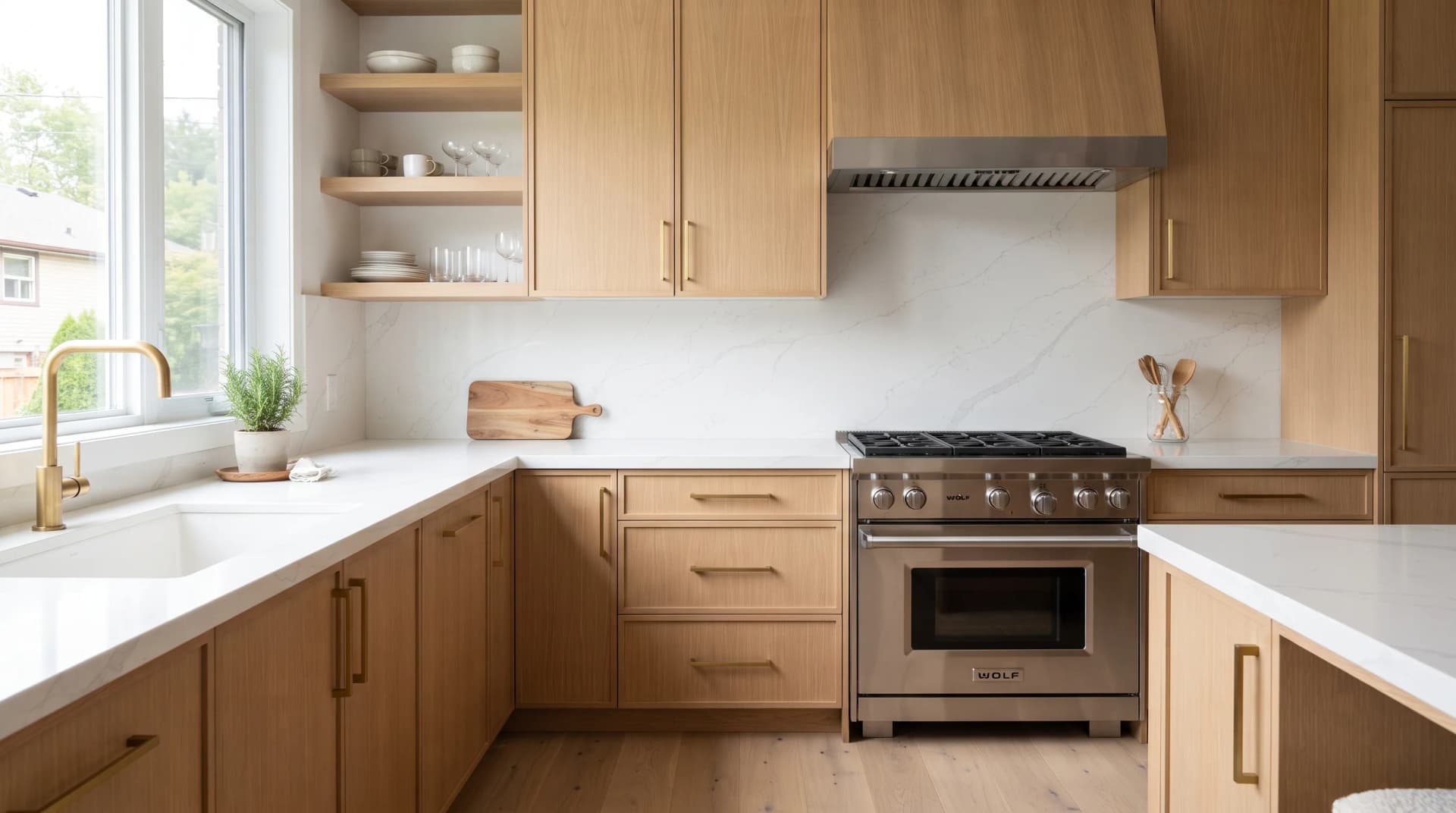
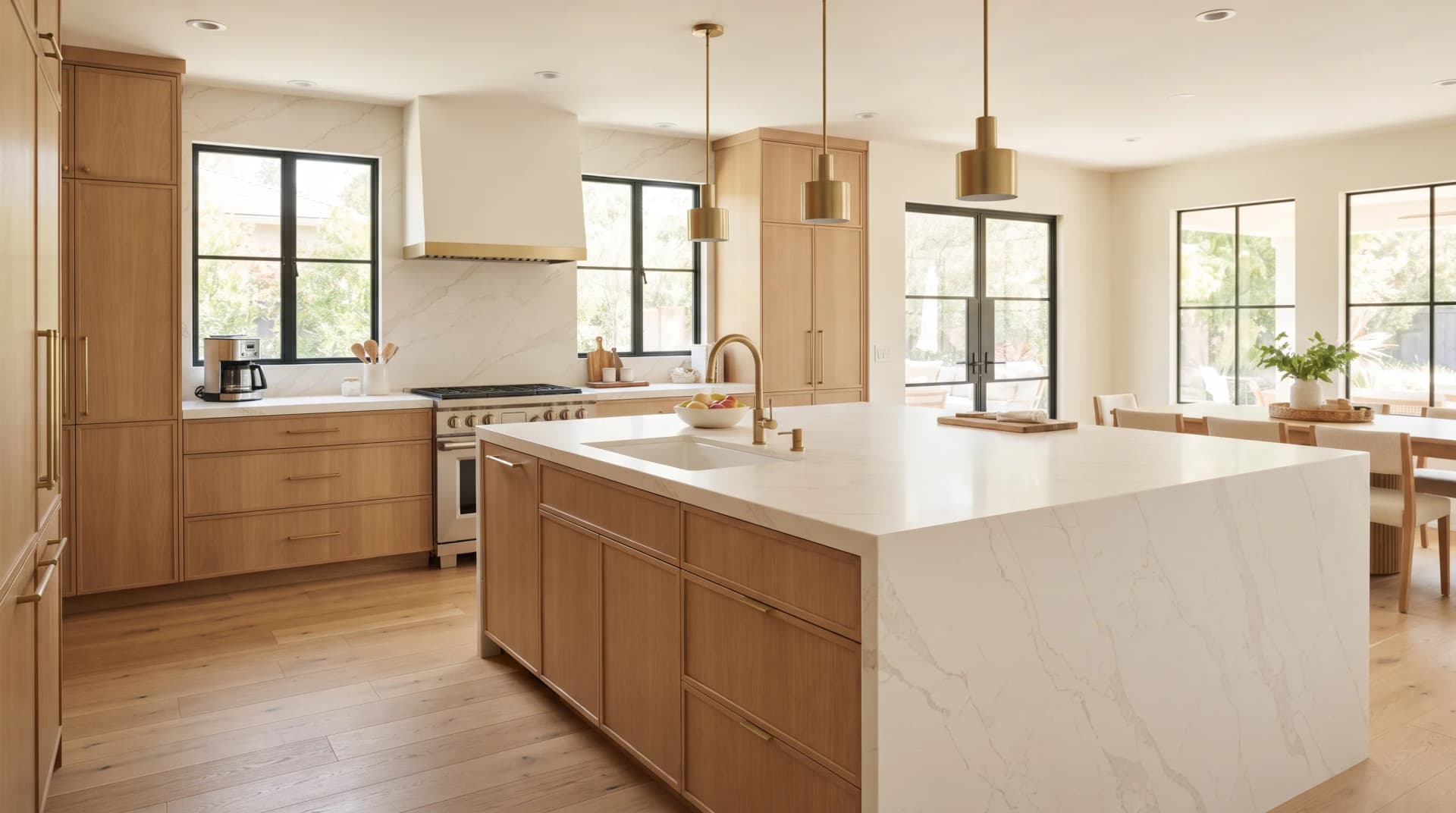
Marble is the surface every other countertop gets compared to. It's the look of luxury—soft white fields, dramatic grey or gold veining, a sense of timeless elegance. So why do so many designers quietly steer clients away from putting it in a working kitchen?
Because marble is beautiful and high-maintenance in equal measure. It etches, it stains, it scratches, and it never stops needing care. The good news: modern quartz now captures the marble look so well that you can have the elegance without the anxiety.
This guide compares marble vs quartz countertops honestly—where marble's beauty is real, where it falls short in daily use, and why marble-look quartz is the better choice for most Canadian kitchens.
Marble is a natural stone (mostly calcium carbonate)—luxurious and unique, but soft, porous, and prone to etching and staining, requiring ongoing sealing and care. Quartz is engineered (about 90% ground quartz + resin)—non-porous, etch-proof, scratch-resistant, and maintenance-free. Marble-look quartz reproduces Calacatta and Statuario veining convincingly, so for most kitchens quartz delivers the marble aesthetic without the upkeep.
- Marble etches from acids (lemon, wine) even when sealed; quartz does not
- Marble is porous and needs sealing; quartz is non-porous and never does
- Marble is soft (Mohs 3-4) and scratches; quartz is hard (Mohs 7)
- Marble-look quartz captures Calacatta/Statuario veining convincingly
- Marble runs $75-250/sq ft; quartz $55-150 with no ongoing costs
Marble vs Quartz: The Core Difference
The fundamental distinction is the same one behind every natural-versus-engineered comparison: marble is quarried natural stone; quartz is manufactured.
But marble has a second, more important quirk: its chemistry. Marble is made largely of calcium carbonate, which reacts with acids. That single fact is responsible for marble's biggest day-to-day frustration—etching—and it's something no amount of sealing fully prevents.

What Is Marble?
Marble is a metamorphic rock formed when limestone is subjected to heat and pressure, causing its calcite crystals to recrystallize. The result is the luminous, veined stone prized for centuries in sculpture and architecture—Carrara, Calacatta, and Statuario among the most famous.
Key Characteristics
| Property | Natural Marble |
|---|---|
| Origin | Quarried natural stone |
| Porosity | Porous (requires sealing) |
| Acid Reaction | Etches easily (calcium carbonate) |
| Hardness | Soft (Mohs 3-4) |
| Pattern | Unique, natural veining |
| Heat Resistance | Good (can scorch/discolour) |
| Maintenance | High |
Marble's strengths are genuine: unmatched natural beauty, a cool surface bakers love, and a prestige no engineered material fully replicates. For a powder room, a fireplace surround, or a dedicated pastry station, marble can be wonderful.
Where marble genuinely shines
In low-traffic spaces—or for serious bakers who want a naturally cool surface for dough and chocolate—marble's character is hard to beat. We'd rather tell you that honestly than pretend marble has no place.
What Is Engineered Quartz?
Engineered quartz is a manufactured composite that pairs the beauty of natural stone with modern performance.
- 90-94% ground natural quartz crystals (one of Earth's hardest minerals)
- 6-10% polymer resins (the binder that makes it non-porous)
- Pigments and patterning (including realistic marble veining)
Because it's non-porous and acid-resistant, quartz sidesteps marble's two biggest weaknesses— staining and etching—entirely. For the full breakdown, see What Is Engineered Quartz?
| Property | Engineered Quartz |
|---|---|
| Origin | Factory-manufactured |
| Porosity | Non-porous (<0.5%) |
| Acid Reaction | Etch-resistant |
| Hardness | Hard (Mohs 7) |
| Pattern | Consistent, designed (marble looks available) |
| Heat Resistance | Good (use trivets) |
| Maintenance | Minimal (no sealing) |
“I wanted Calacatta marble so badly. Our designer showed us a marble-look quartz next to the real thing and asked which we could live with after a year of lemons and red wine. We chose quartz and I have zero regrets—it still looks like the showroom.”
Marble vs. Quartz: Head-to-Head
| Factor | Marble | Engineered Quartz |
|---|---|---|
| Material Type | Natural stone | Manufactured composite |
| Porosity | Porous | Non-porous |
| Sealing | Regularly required | Never needed |
| Etching (acids) | Etches easily | Etch-resistant |
| Stain Resistance | Poor without care | Excellent |
| Hardness / Scratch | Soft (Mohs 3-4) | Hard (Mohs 7) |
| Heat Resistance | Good | Good (use trivets) |
| Pattern | Unique/natural | Consistent/designed |
| Price (CAD/sq ft installed) | $75-250 | $55-150 |
| Best Use | Low-traffic, baking | Everyday kitchens |
The short version
Marble wins on natural prestige and a cool baking surface. Quartz wins on everything that matters in a working kitchen—no etching, no staining, no sealing, and far better scratch resistance.
Etching and Staining: Marble's Weak Point
This is the section that changes most homeowners' minds. There are two separate problems with marble, and people often confuse them.
Staining is absorption—oil, wine, or coffee soaking into marble's pores and discolouring it. Sealing helps with this. Etching is different: it's a chemical reaction where acids dissolve a microscopic layer of the marble, leaving a dull spot. A splash of lemon juice, a glass of wine, even some cleaning products can etch marble—and sealing does not prevent it.
Quartz has neither problem. It's non-porous, so nothing absorbs, and it's acid-resistant, so nothing etches. For a kitchen where citrus, vinegar, wine, and tomato are everyday realities, that difference is decisive.
Love the marble look but worried about etching?
Tell us about your kitchen and we'll show you marble-look quartz that captures Calacatta and Statuario veining—without the staining, etching, or sealing.
Request Free QuoteGetting the Marble Look in Quartz
For most people choosing marble, it's the look they're after—not the geology. And that look is exactly what modern quartz reproduces best.
- Calacatta-style quartz: bright white fields with bold, flowing grey or gold veins
- Statuario-style quartz: crisp white with finer, dramatic veining
- Carrara-style quartz: soft white-grey with subtle, feathery movement
Because the veining is engineered, you also get consistency—what you approve on the slab is what runs across your whole kitchen, with no surprises at the seams. Explore current directions in our 2026 countertop colour trends, or see how the warm palette is shifting in warm neutral countertops.

Cost Comparison in Canada
Marble generally costs more than quartz, and premium marbles climb well beyond it—before you account for ongoing maintenance.
| Material | Price Range (CAD/sq ft installed) | Typical 40 sq ft kitchen |
|---|---|---|
| Engineered Quartz | $55-150 | $2,200-$6,000 |
| Marble | $75-250+ | $3,000-$10,000+ |
Marble also carries hidden lifetime costs—regular sealing, professional etch repair (honing), and the risk of permanent staining. Quartz has none of these. For a full quartz budget, see our quartz countertop cost guide for Canada.
Which Should You Choose?
Choose quartz if you want:
- The marble look without etching, staining, or sealing
- A surface that stands up to real, daily cooking
- Consistent veining that matches across the kitchen
- Strong long-term value
Marble may suit you if:
- You want genuine natural stone and accept its patina over time
- The space is low-traffic (powder room, fireplace surround)
- You bake often and want a naturally cool surface
- You're comfortable with sealing and the occasional etch mark
For the way most Canadians cook and live, marble-look quartz is the choice that delivers the beauty you want and the durability you need.
Still torn between marble and quartz?
Book a quick call. We'll talk through how you use your kitchen and show you quartz options that capture the marble look you love—no pressure.
Schedule a CallFrequently Asked Questions
Explore our collection of premium quartz countertops


Your Next Steps
Now that you've seen marble and quartz side by side, here's how to move forward:
If you're leaning toward quartz:
We specialize in quartz countertops, including a wide range of marble-look Calacatta and Statuario patterns. Request a free quote and our team will help you find the right one for your kitchen.
If you want to keep exploring:
- Read Granite vs Quartz Countertops for another natural-stone comparison
- Compare Quartz vs. Porcelain if heat resistance is a priority
- Check the 2026 quartz cost guide to budget your project
If you've decided on marble:
We focus on quartz and porcelain, but we're happy to recommend reputable stone yards where you can select a marble slab in person.
Your Next Steps

We fabricate and install what this article describes — see kitchen and bath surfaces in Langley and what we do in Nanaimo.