Here's the number that catches Canadian homeowners off guard: the porcelain slab itself is often the smallest part of the bill. In the projects we've quoted, the finished install typically runs 2 to 3 times the raw material price — and the gap is almost entirely fabrication.
That's why "how much do porcelain countertops cost?" has such a frustrating answer online. A slab price tells you almost nothing about your final invoice. Porcelain is harder and more brittle than quartz, so cutting, mitring, and finishing it takes specialized tooling and skill — and that labour is where budgets quietly blow up.
This guide gives you the real porcelain countertops cost picture for Canada in 2026: honest per-square-foot ranges, what a typical kitchen actually totals, the hidden costs most quotes bury, and how porcelain stacks up against quartz on price.
Porcelain countertops in Canada cost between $65 and $200 per square foot installed in 2026, depending on slab tier, thickness, and fabrication complexity. For a typical kitchen (35–50 sq ft), expect a total of roughly $3,000 to $8,500 installed. Fabrication and edge work — not the slab — drive most of the price, because porcelain requires specialized cutting.
- Installed price, not slab price, is the number that matters
- Fabrication complexity (mitred edges, cutouts, waterfall) is the biggest cost lever
- Full-body porcelain and thicker 20mm slabs cost more than thin 6–12mm panels
- Porcelain often overlaps premium quartz on price — sometimes higher, sometimes comparable
- The right quote is itemized, so you can see exactly what you're paying for
Porcelain Countertop Cost Overview
Porcelain is priced the same way as other slab countertops — per square foot, installed — but its cost curve is shaped differently because of how it's fabricated. Across Canada in 2026, installed porcelain generally falls in the $65–$200 per square foot range, and where you land depends far more on the work than the stone:
- The slab material itself is often $25–$70 per square foot wholesale.
- Fabrication, edge profiling, templating, and installation make up the rest.
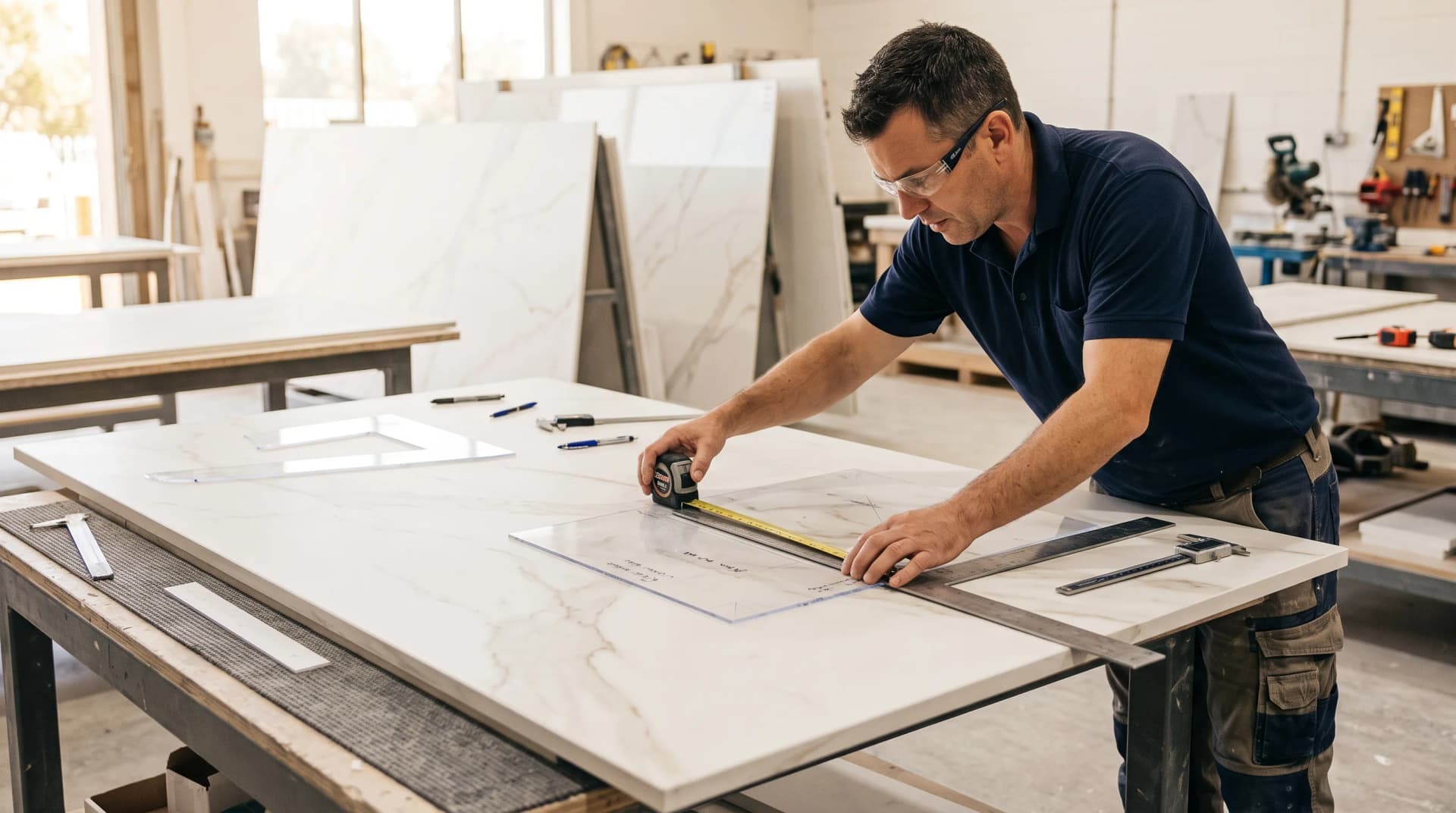
Because porcelain is dense and brittle, fabricators use specialized bridge saws, waterjets, and diamond tooling, and they work more slowly to avoid chipping. That skilled labour is real value — the difference between crisp, chip-free edges and a disappointing install — but it's also why two quotes for the "same" slab can differ by thousands.
Price Breakdown by Tier
Porcelain countertops sort into three practical price tiers. The tier reflects slab quality, pattern realism, thickness, and finish — not a brand name.
| Tier | Installed (CAD/sq ft) | What You Get |
|---|---|---|
| Entry-level | $65–$90 | Thinner panels (6–12mm), simple solid colours or basic patterns, standard edges |
| Mid-range | $90–$135 | 12–20mm slabs, realistic marble/stone looks, more colour choice, mitred edge options |
| Premium | $135–$200+ | Full-body 20mm slabs, book-matched veining, complex edges, large-format seamless runs |
Mid-range is where most kitchen projects land — the sweet spot of durability, looks, and cost. Premium buys the dramatic, seamless result: full-body colour that runs through the slab, mitred waterfall edges, and matched veining.
“We were quoted all over the map for the same look. Once we understood we were really paying for the fabrication — the mitred edges and the seamless run — the pricing finally made sense. We picked mid-range and never looked back.”
What Affects Your Final Price
Six factors move a porcelain quote up or down. Understanding them lets you control the number instead of being surprised by it.
- Square footage. More counter and island area means more slab and more labour.
- Thickness. Thin 6–12mm panels cost less per square foot; standard 20mm slabs cost more but handle full countertops and richer edges.
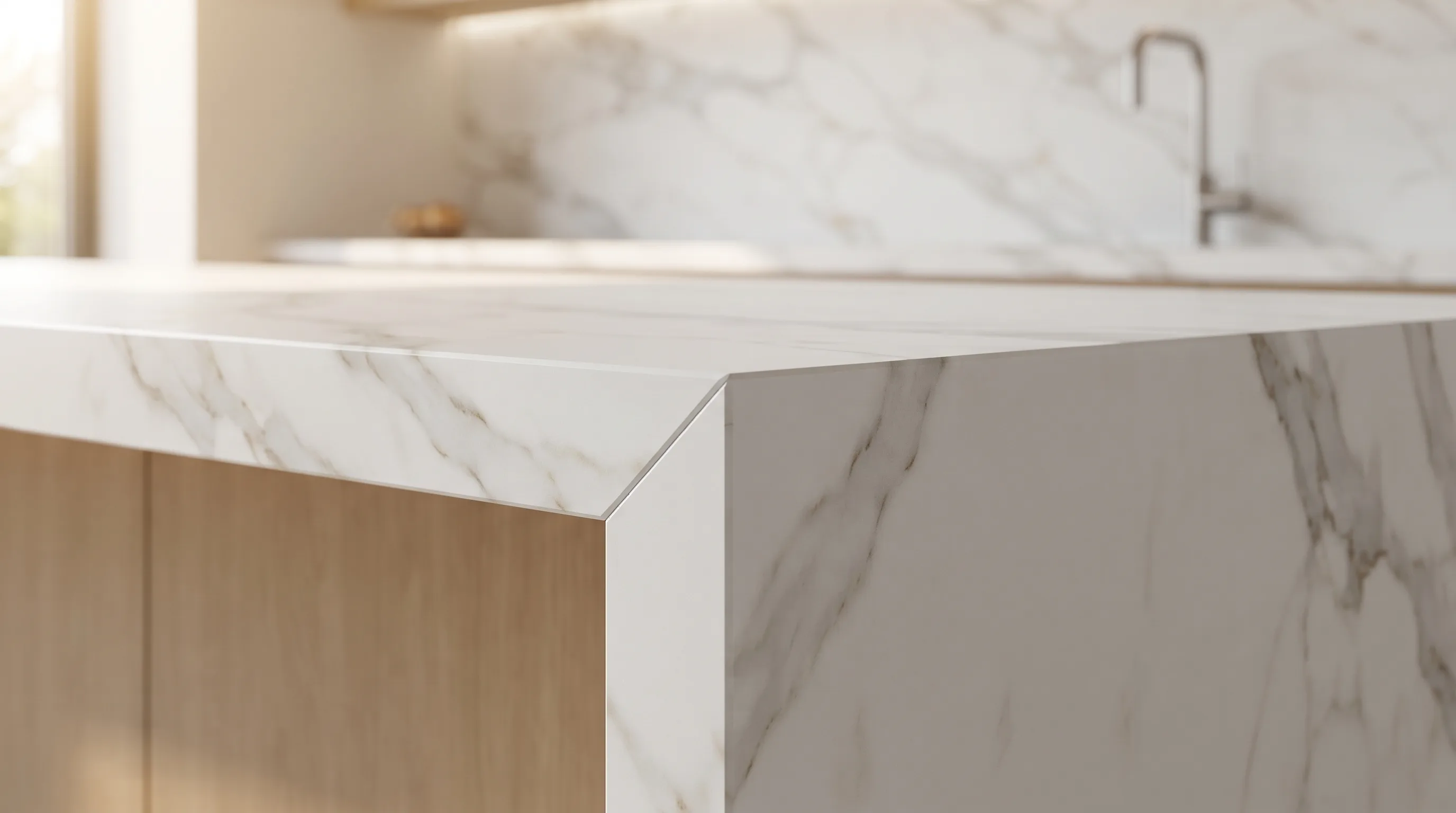
- Edge profile. A simple eased edge is affordable. Mitred edges and waterfall ends require extra slab and precise fabrication — a significant add.
- Cutouts. Sink openings, cooktop cutouts, faucet holes, and outlet notches each take fabrication time.
- Pattern & finish. Book-matched veining and full-body porcelain cost more than solid colours.
- Fabrication complexity overall. Porcelain's brittleness means skilled fabricators price in the extra care it demands — the factor that most separates a low quote from a realistic one.
Total Cost for a Typical Canadian Kitchen
Per-square-foot numbers are abstract. Here's what porcelain actually totals for a real kitchen. A typical Canadian kitchen has 35–50 square feet of countertop.
| Tier | Total Installed (35 sq ft) | Total Installed (50 sq ft) |
|---|---|---|
| Entry-level | $2,275–$3,150 | $3,250–$4,500 |
| Mid-range | $3,150–$4,725 | $4,500–$6,750 |
| Premium | $4,725–$7,000+ | $6,750–$10,000+ |
Add an island, a full-height backsplash, or waterfall edges and the total climbs from there. The takeaway: budget by your actual layout, not by a single per-foot number you saw online.
Want your real number, not a range?
Use our estimate calculator to price porcelain for your exact kitchen — square footage, edges, and tier included. No sales calls, no pressure.
Get My EstimateHidden Costs to Budget For
This is where budgets quietly break. These costs are legitimate — but they're often missing from the headline quote, so ask about each one upfront.
- Edge upgrades. A mitred or waterfall edge can add hundreds to over a thousand dollars.
- Old countertop removal & disposal. Tear-out is sometimes billed separately.
- Plumbing & electrical disconnect/reconnect. Sinks, faucets, and cooktops usually need a trade.
- Seam work on large layouts. Big kitchens may need more than one slab; each seam is skilled work.
- Substrate or cabinet reinforcement. Thin panels sometimes need support; heavy runs may need bracing.
- Repairs from a low-bid install. Porcelain's brittleness punishes inexperience.
Your protection is an itemized quote
A trustworthy fabricator gives you an itemized quote so none of these appear as a surprise. If a quote is a single lump number with no breakdown, that's your cue to ask what's included.
Porcelain vs. Quartz: The Cost Comparison
Most people pricing porcelain are also weighing quartz — both are engineered surfaces we fabricate, so this is an in-house comparison, not a sales pitch for one over the other.
| Factor | Porcelain | Quartz |
|---|---|---|
| Installed range (CAD/sq ft) | $65–$200 | $55–$150 |
| Typical kitchen (35–50 sq ft) | $3,000–$8,500+ | $2,800–$6,500+ |
| Fabrication cost | Higher (specialized tooling) | Lower (widely fabricated) |
| Heat & UV resistance | Excellent — outdoor-capable | Very good indoors; UV-limited |
| Best value use | Sunny rooms, outdoor, ultra-thin looks | Most indoor kitchens & baths |
The honest summary: porcelain often costs a little more than comparable quartz, mostly because of fabrication. But the gap narrows at the premium end, and porcelain earns its price where quartz can't follow — sun-drenched kitchens and outdoor cooking spaces. If your kitchen is a standard indoor layout, quartz frequently delivers the same look for slightly less (see our quartz countertop cost guide). Our quartz vs. porcelain decision guide walks through which fits your space.
“Porcelain cost us a bit more than the quartz quote, but our kitchen faces due south and gets blasted with sun all afternoon. Two years in, zero fading. Worth every dollar for us.”
Is Porcelain Worth the Cost?
Cost only means something next to value. Here's how to decide whether porcelain's price earns its place in your budget.
Choose if you want
- Your kitchen gets heavy sun, or you're building an outdoor kitchen (UV stability)
- You want to place hot pans directly on the surface without a second thought
- You love an ultra-thin, modern profile quartz can't match
- You want a virtually zero-maintenance, never-seal surface for the long haul
Consider alternatives if
- You have a standard indoor kitchen and want the same look for a little less
- Impact resistance matters (young kids, heavy daily use)
- Your budget is fixed and every dollar counts
Either way, the material outlives the price memory. Both porcelain and quartz are decades-long surfaces, so framing the choice as an investment — cost per year of use — usually makes the "worth it" question answer itself.
Frequently Asked Questions
We fabricate and install what this article describes — see quartz and porcelain countertops in Grande Prairie, quartz and porcelain countertops in Lethbridge and our Winnipeg showroom and service area.