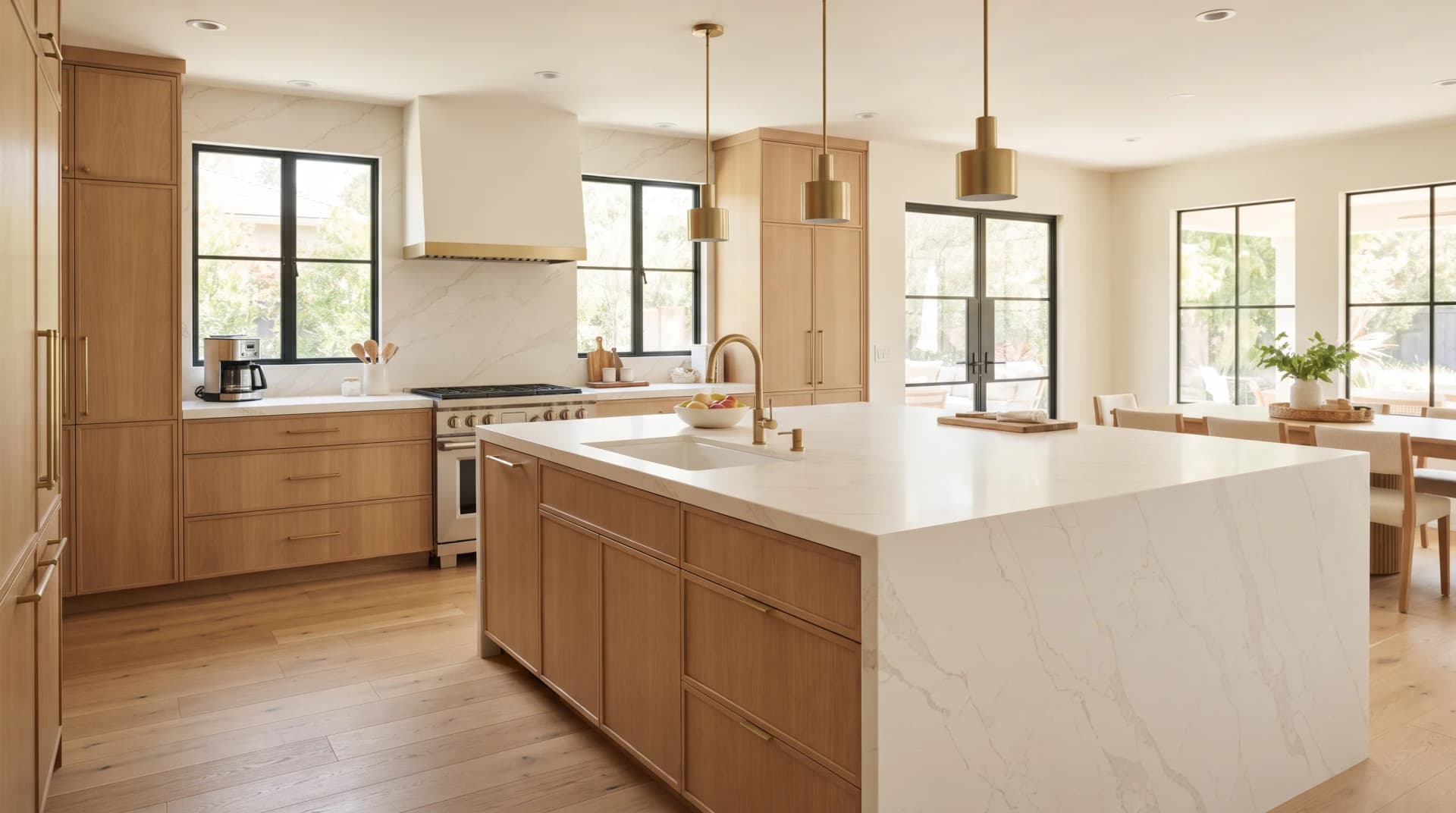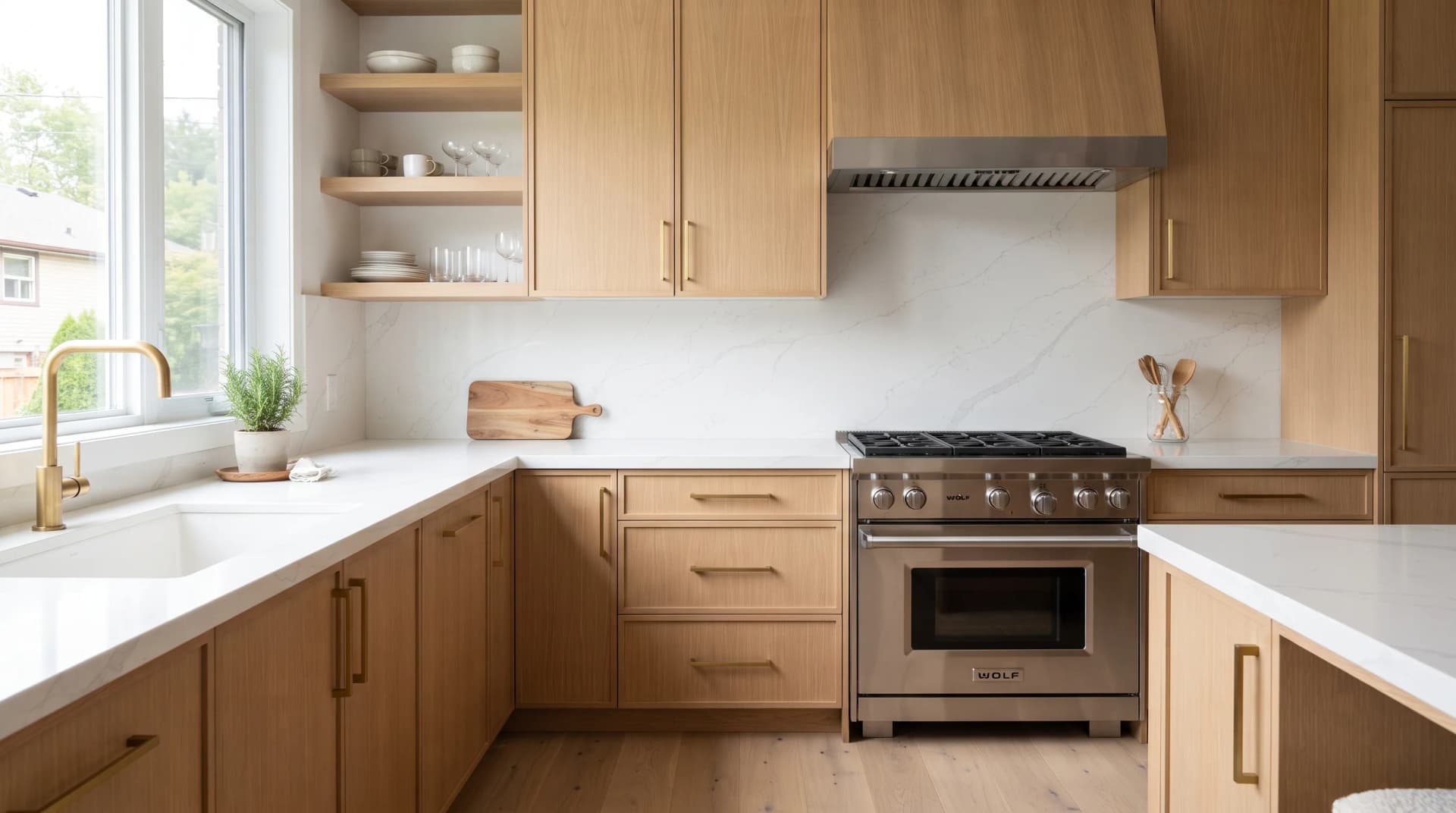
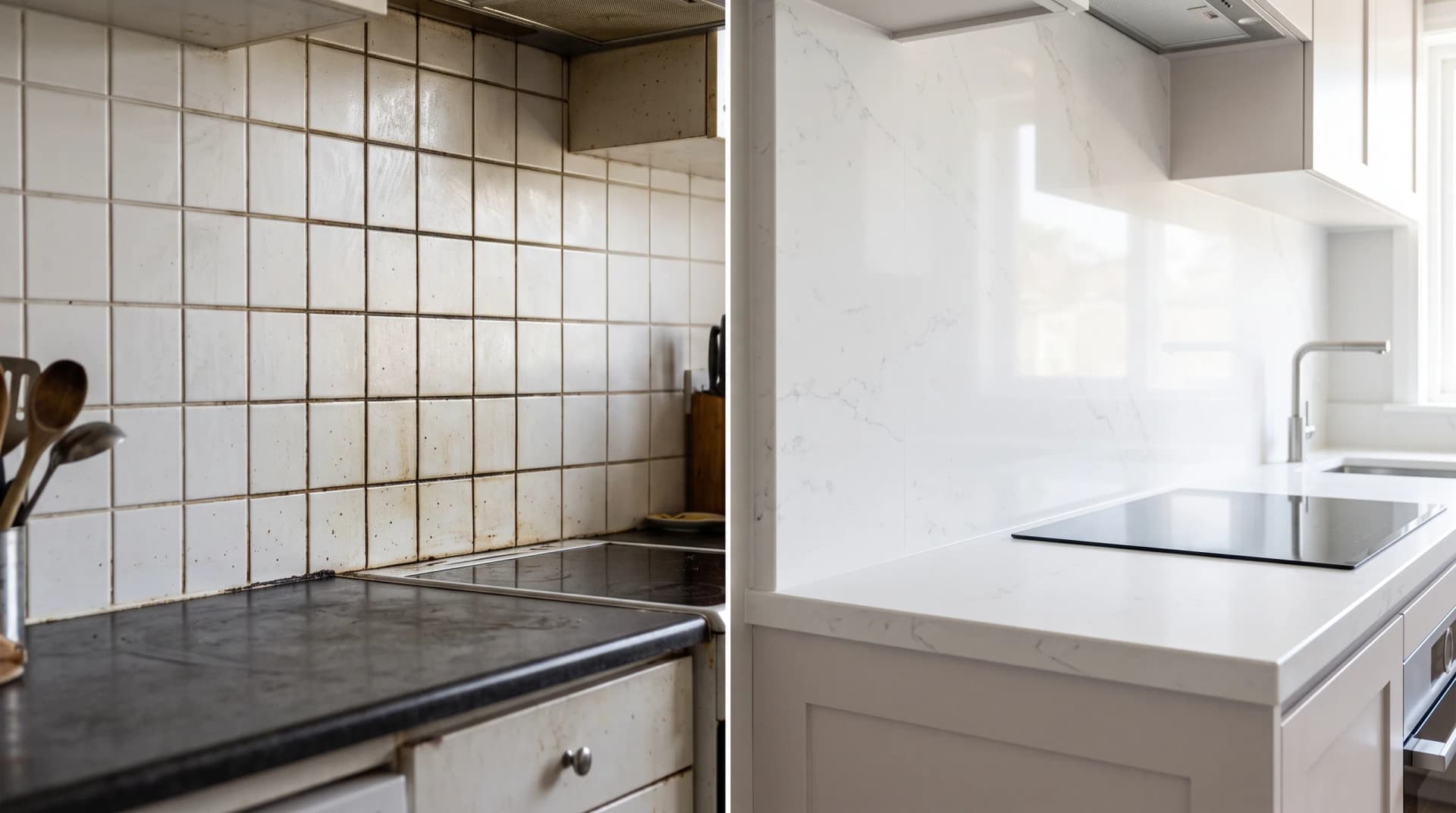
In the kitchens we've fabricated across Canada, one regret comes up more than almost any other — and it's never about the countertop. It's the tile backsplash. Specifically, the grout: 43 thin lines behind a cooktop that trap grease, darken within a year, and never quite scrub back to white.
A quartz backsplash solves that problem before it starts. Instead of dozens of grout seams, you get a single continuous slab of the same engineered stone as your countertop — one uninterrupted surface you wipe down in seconds. No sealing, no scrubbing, no dated tile pattern to regret in five years.
This guide covers exactly what a quartz backsplash is, how full-height and standard heights compare, what it costs in Canada in 2026, and the handful of situations where tile still makes sense.
A quartz backsplash is a continuous piece of engineered quartz installed on the wall behind your countertop, in place of tile. Because it's one solid slab with no grout lines, it's non-porous, hygienic, and cleans with a damp cloth. Options range from a standard 4-inch (10 cm) upstand to a dramatic full-height slab running to the underside of the cabinets. Expect roughly $45–$95 per square foot installed in Canada.
- Zero grout lines means nothing to seal, scrub, or watch discolour
- Full-height quartz backsplashes create a seamless, book-matched look with the counter
- The non-porous surface resists grease, tomato sauce, and steam behind the stove
- Costs less drama than premium tile once labour and grout maintenance are factored in
- Works in kitchens, bathrooms, bar areas, and laundry rooms
Planning your backsplash as part of a full kitchen?
Book a free in-home consultation. We bring quartz samples to your space so you can see the slab against your actual cabinets and lighting before you decide.
Book Free ConsultationWhat Is a Quartz Backsplash?
A quartz backsplash is a solid panel of engineered quartz mounted on the wall behind your countertop — the same material, cut from the same slab family, extended vertically up the wall. It comes in two main formats:
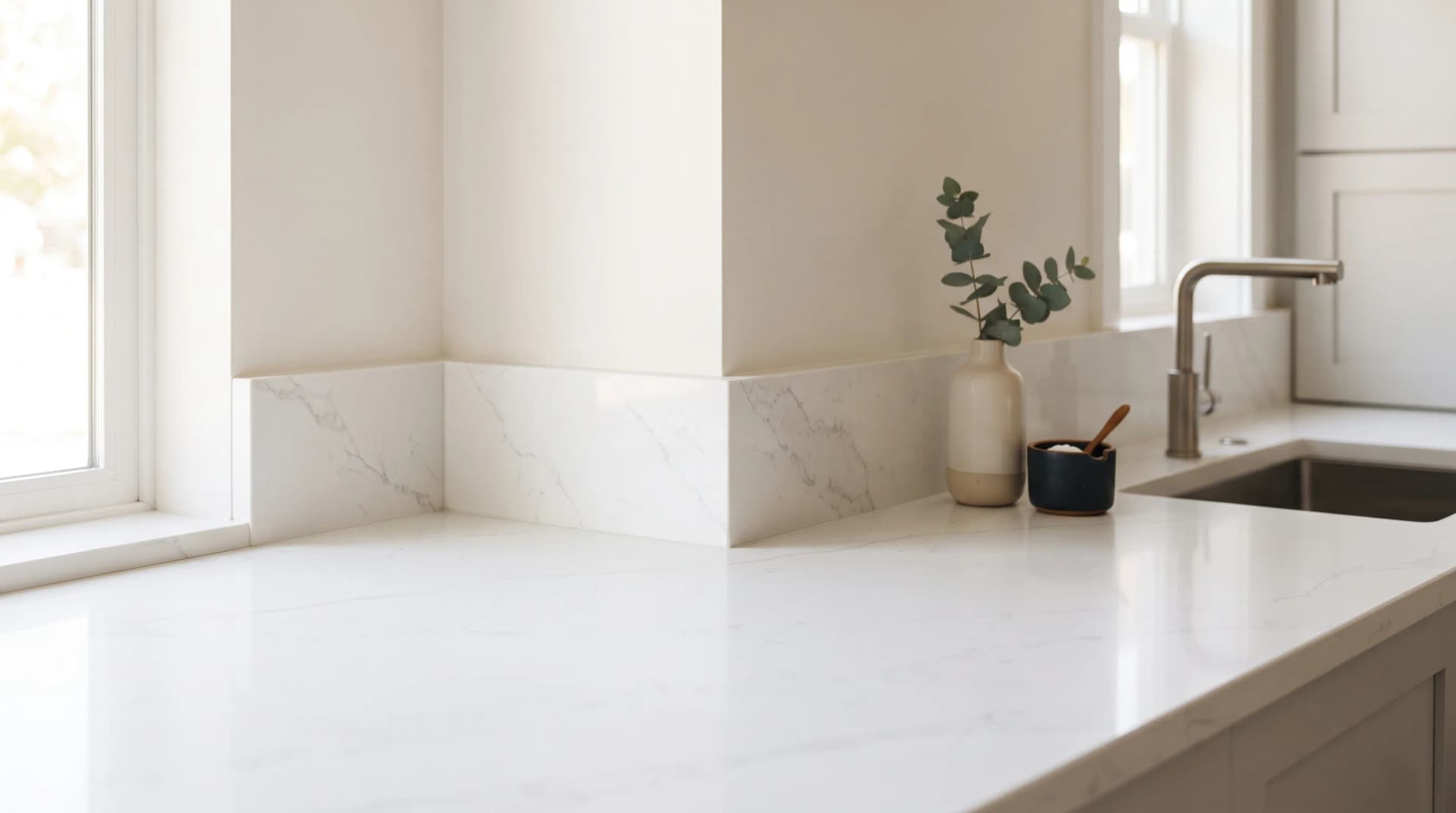
- Standard upstand (4 inch / 10 cm): A short strip of quartz that continues up from the counter, protecting the wall from splashes at the counter line.
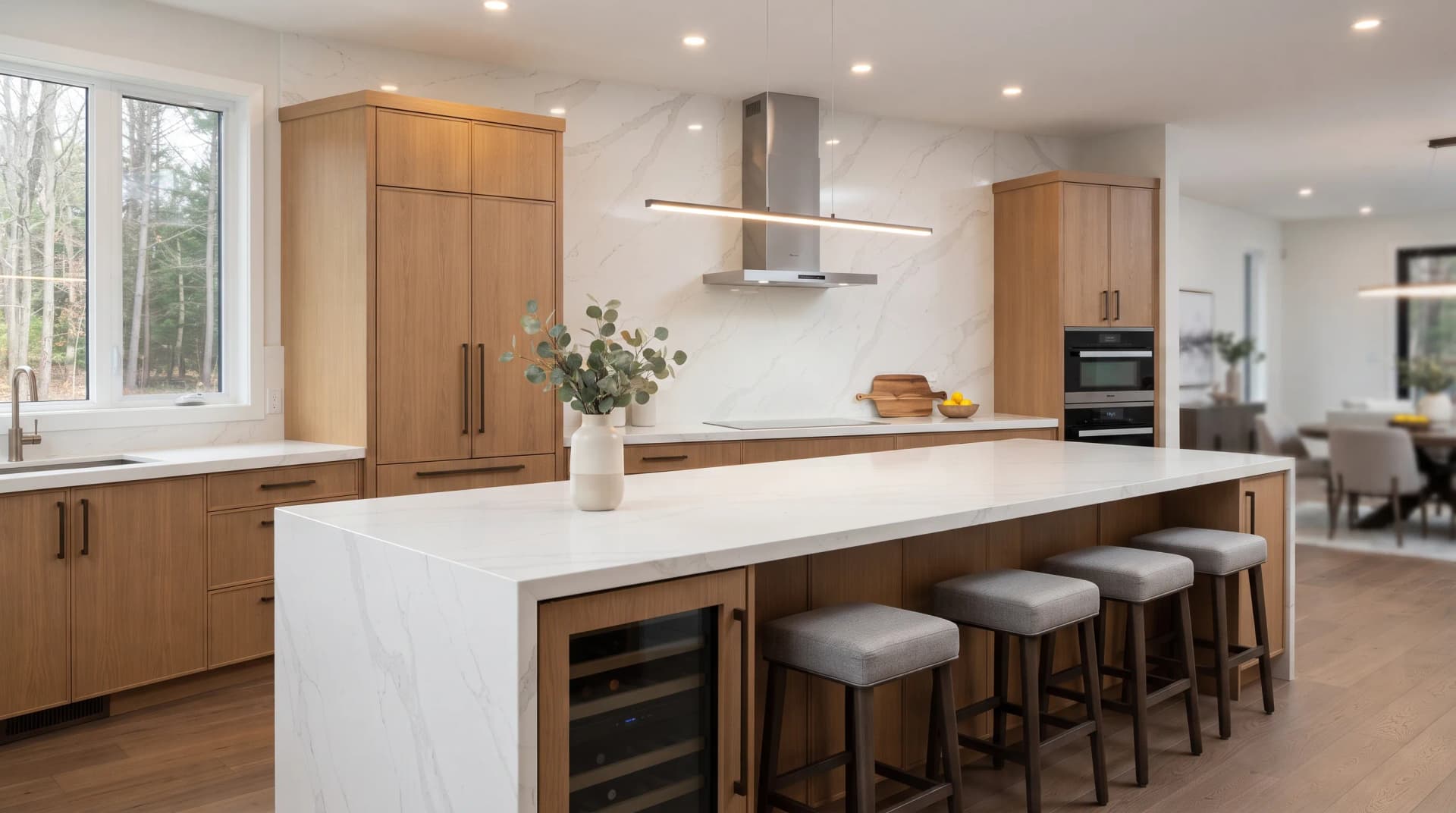
- Full-height slab: A continuous panel running from the countertop to the underside of the upper cabinets — typically 15 to 18 inches — with no seams across the run.
Because engineered quartz is roughly 90% ground natural quartz bound with a small percentage of resin, the surface is non-porous. That single property is what makes it behave so differently from tile: liquids sit on top instead of soaking into seams, and there's no grout to seal or replace.
Why Homeowners Are Trading Tile for Slab
Tile isn't going away, but the reasons people choose quartz behind the counter are practical and specific. In renovation after renovation, the same three pain points drive the switch.
1. Grout is the maintenance you didn't sign up for. Grout is porous. Behind a stove, it absorbs cooking grease and steam, then darkens unevenly. Sealing slows this down but doesn't stop it, and re-grouting is a messy job most homeowners only discover after the fact. A quartz backsplash has no grout at all.
2. Seams collect what you cook. Every tile joint is a tiny ledge. Tomato sauce, oil, and turmeric find those ledges. A single quartz slab gives splatter nowhere to hide — one wipe and it's gone.
3. Busy tile dates a kitchen. Trend-driven tile can make a kitchen read "last renovation." A quartz backsplash that matches the countertop reads as timeless because it's quiet — the surface, not a pattern, is the statement.
“We had a mosaic backsplash in our old house and I spent Sunday afternoons with a toothbrush on the grout. Our new quartz backsplash gets wiped with the same cloth I use on the counter. That's the whole routine.”
Full-Height vs. Standard 4-Inch vs. No Backsplash
Height is the first real decision. Each option changes the look, the cost, and how much wall you protect.
| Option | Look | Best For | Relative Cost |
|---|---|---|---|
| No backsplash | Painted wall meets counter | Budget builds, tile planned later | Lowest |
| Standard 4" upstand | Subtle quartz strip at counter line | Traditional kitchens, paint or tile above | Low |
| Full-height slab | Dramatic, seamless counter-to-cabinet | Modern kitchens, statement veining, easy cleaning | Highest |
Standard 4-inch is the classic, budget-friendly choice. It protects the most splash-prone zone and pairs with paint or a separate tile above. Full-height is where quartz earns its reputation: the slab climbs to the cabinets with no grout anywhere in the splash zone. A common hybrid is full-height behind the cooktop only — the messiest wall — with a standard upstand elsewhere.
The Seamless Look: Matching Backsplash to Countertop
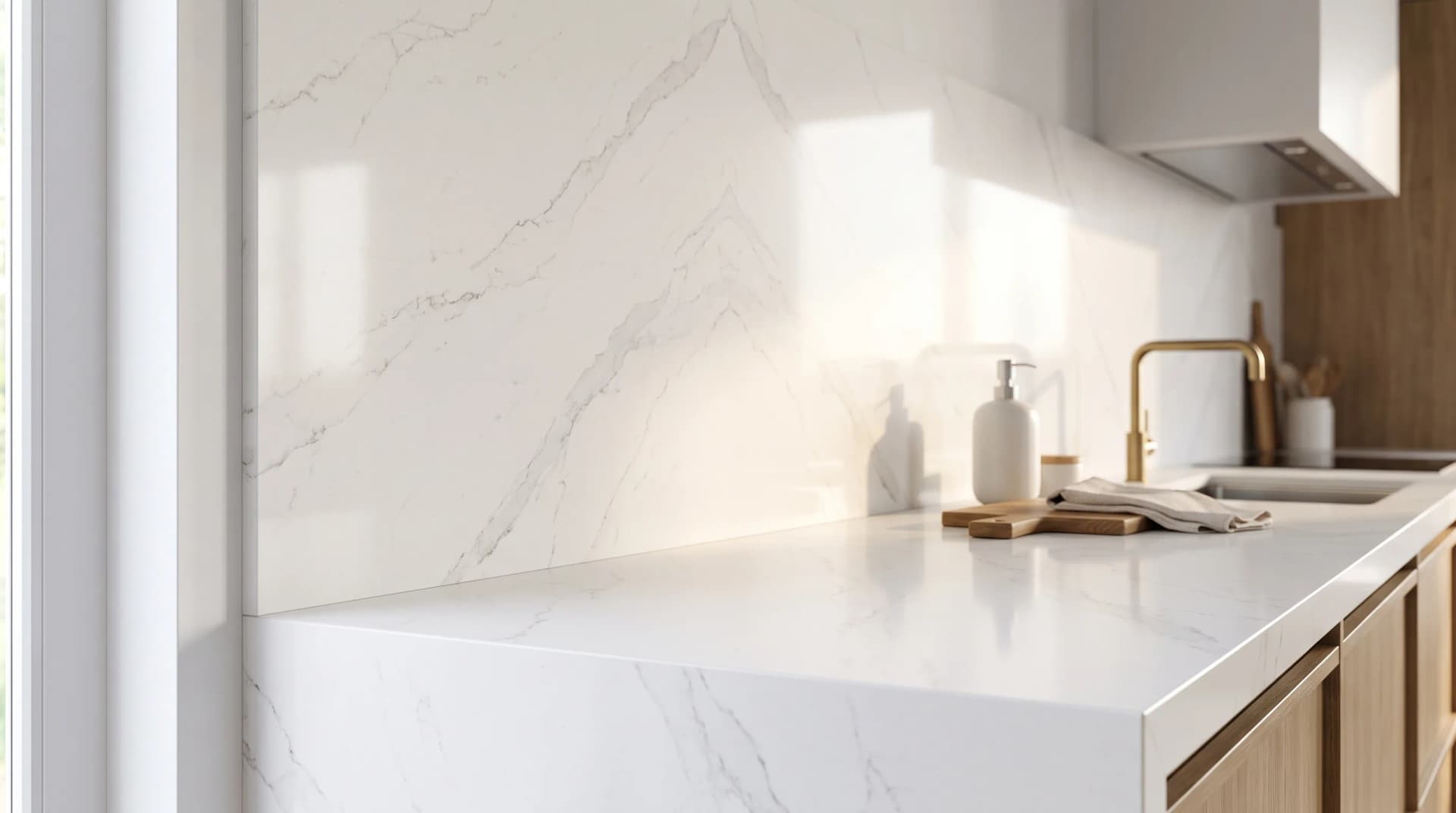
The reason a full-height quartz backsplash looks so intentional is continuity. Done well, the eye can't find where the counter ends and the wall begins. There are two ways to achieve it:
- Same-slab continuation. The backsplash is cut so its veining flows upward from the countertop, as if the stone folded up the wall — the designer-favourite look, especially with dramatic marble-look veining.
- Solid-colour simplicity. With a solid or lightly patterned quartz, matching is effortless: the colour reads as one continuous surface.
Edge and corner detailing matters here. Inside corners are mitred or tightly butted so the seam is nearly invisible. If you're still choosing your countertop edge, our guide to countertop edge profiles walks through the options.
“Our designer carried the Calacatta Nuvo veining straight up behind the range. Guests assume it's one giant piece of stone. Nobody believes there's a countertop seam at all.”
What a Quartz Backsplash Costs in Canada
Quartz backsplashes are quoted per square foot installed, and the number moves with height, finish, and how complex the cuts are.
| Backsplash Type | Typical Range (CAD/sq ft installed) |
|---|---|
| Standard 4" upstand | $35–$55 |
| Full-height, solid/light pattern | $50–$75 |
| Full-height, premium veined or book-matched | $70–$95+ |
What moves the price:
- Square footage & height — full-height covers far more wall than a 4-inch upstand.
- Cutouts — outlets, switches, and window returns each add fabrication time.
- Finish & pattern — book-matched veining requires extra slab and careful layout.
- Slab yield — extending the countertop slab up the wall may mean buying additional material.
The real cost comparison
When you compare quartz to a premium tile install — labour, grout, sealing, and eventual re-grouting — the lifetime gap narrows considerably. Tile can win on upfront cost; quartz frequently wins on total cost of ownership because there's no grout to maintain or redo. For full material pricing, see our quartz countertop cost guide.
Want an exact number for your wall?
Get a personalized estimate based on your kitchen layout, backsplash height, and finish — no sales pressure.
Get My EstimateCaring for a Quartz Backsplash
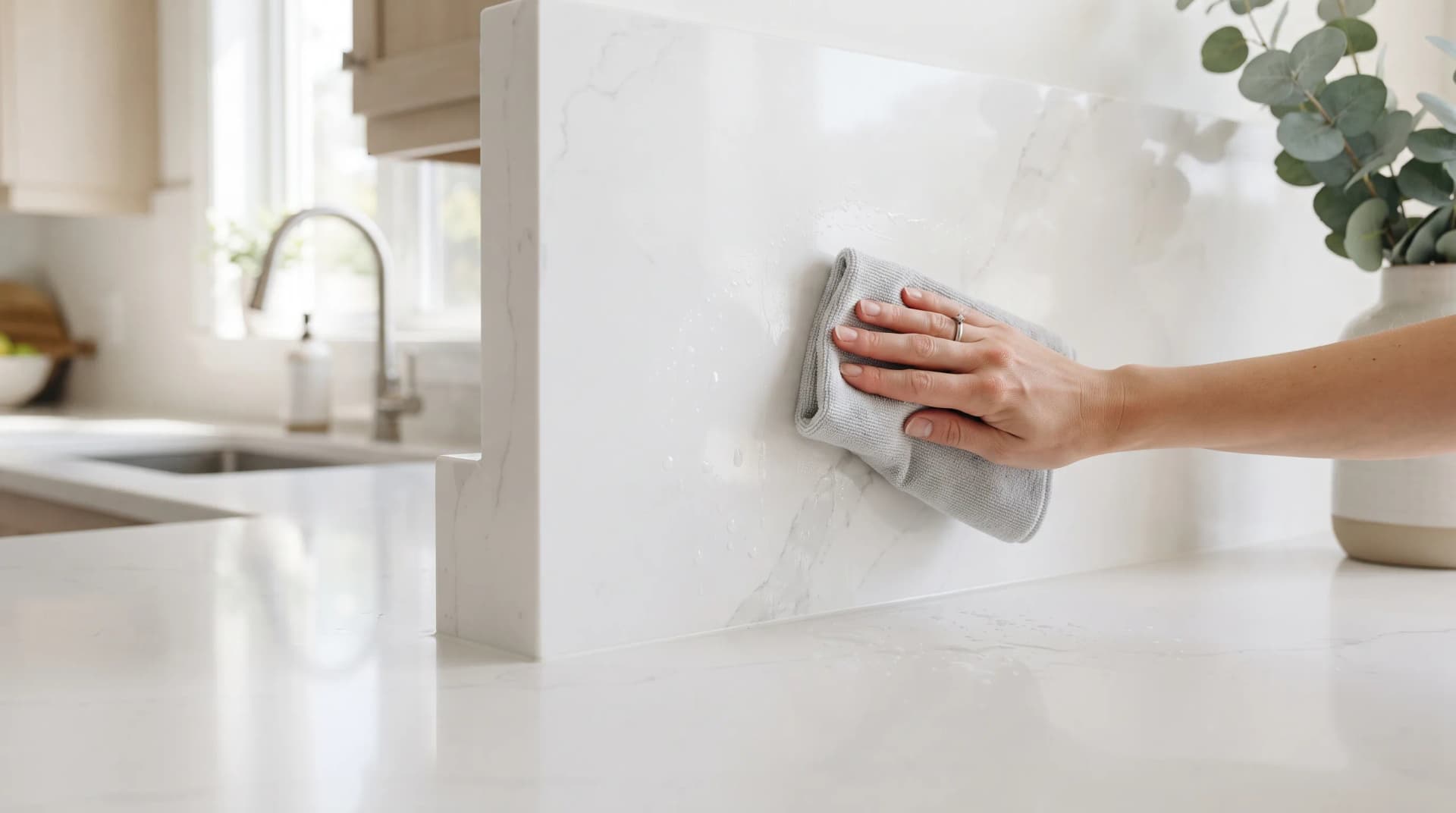
This is the payoff. A quartz backsplash is arguably the lowest-maintenance vertical surface you can put in a kitchen.
- Daily: Wipe with warm water and a drop of mild dish soap. Grease lifts off the non-porous surface without scrubbing.
- Avoid: Abrasive scouring pads and harsh, bleach-heavy cleaners, which can dull the finish over time. You never need to seal quartz.
- Behind the stove: With no grout to absorb it, cooking residue that would permanently stain tile joints simply wipes away.
Our daily quartz countertop care guide applies to backsplashes too — same material, same simple habits.
When Tile Still Makes Sense
An honest guide names the exceptions. There are a few cases where tile is the better call:
- Tight upfront budget. A simple ceramic tile install can cost less on day one than a full-height quartz slab.
- A very specific artisan look. Handmade zellige, patterned encaustic, or a bold mosaic delivers texture a smooth slab intentionally avoids.
- Small accent zones. For a tiny bar niche where cleaning isn't a concern, tile's higher maintenance matters less.
Notice what's not on that list: durability, hygiene, or ease of cleaning. On those, quartz wins outright. If your priority is a surface that stays effortless for a decade — especially behind a hard-working range — a quartz backsplash is the stronger choice, and it keeps the kitchen reading as one calm, cohesive surface.
Frequently Asked Questions
We fabricate and install what this article describes — see Calgary countertop installation and our Richmond showroom and service area.